
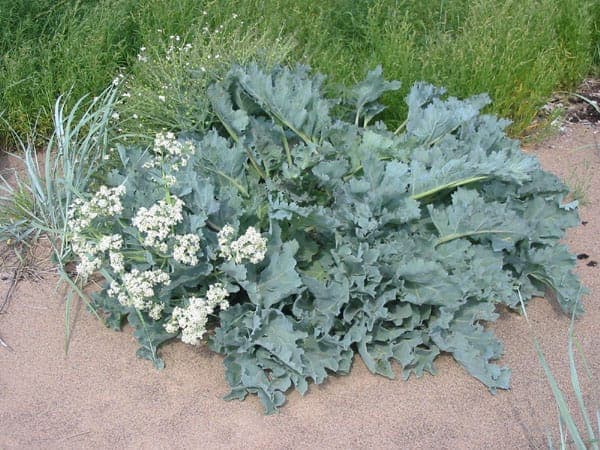
Siim at et.wikipedia / CC BY-SA 2.5, via Wikimedia Commons
Sea-kale: complete guide
Crambe maritima
Want to see Sea-kale: complete guide in your garden?
1 minute, no credit card
Overview
Crambe maritima, better known as Sea-kale, is a tough, clump-forming perennial that thrives in harsh coastal conditions across northern Europe. Native to shingle beaches and sandy dunes from Kent to Denmark, it's adapted to salt spray, strong winds, and poor, well-drained soils. Despite its edible history - once blanched like forced rhubarb - today's gardeners value it more for its ornamental presence. Its bold, glaucous foliage and frothy white flowers in late spring make it a standout in naturalistic and coastal planting schemes.
On gardenworld.app, you can design a garden layout that integrates Sea-kale's spreading habit and height into a balanced, low-maintenance border.
Appearance & bloom cycle
Sea-kale forms a dense basal rosette of large, wavy, blue-green leaves that can reach 30–40 cm in length. The foliage is thick and leathery, evolved to retain moisture and resist salt damage. In May, sturdy, branching flower stalks rise to 60–80 cm, topped with airy panicles of small, white, honey-scented flowers. Bloom peaks in May and lasts through early June. After flowering, seed pods form and dry by late summer, persisting into autumn and providing visual interest and food for finches.
The plant spreads slowly via thick rhizomes, so give it space or plant in a root barrier if you're wary of its expansion. It self-seeds moderately in well-drained, open soils.
Ideal location
Sea-kale loves full sun - aim for a light rating of 8/10. It performs best in south- or west-facing borders, coastal gardens, gravel beds, or dry slopes. It tolerates salt spray and wind exceptionally well, making it ideal for seaside plots. Avoid shaded, damp areas, where it becomes leggy and prone to fungal issues like powdery mildew.
It also works well in xeriscapes, green roofs with sandy substrate, or modern gravel gardens where structural plants are valued.
Soil requirements
This plant prefers lean, alkaline soils with a pH between 7.0 and 7.5. Sandy, gravelly, or chalky soils are ideal. Good drainage is non-negotiable - avoid heavy clay unless you raise the bed and amend with sharp sand and grit. Overly fertile soils lead to weak, floppy growth and reduced flowering.
If amending soil, mix in horticultural grit and avoid compost-rich blends. A top-dressing of crushed seashells can mimic its natural habitat and boost drainage.
Free design
Want to see Sea-kale: complete guide in your garden? Make a free design now.
Watering
Once established, Sea-kale is highly drought tolerant. Water deeply but infrequently during the first growing season, especially in dry spells. After that, it rarely needs supplemental watering, even in UK summers. Overwatering leads to root rot, particularly in winter.
Water at the base, not overhead, to prevent wet foliage. A drip irrigation system works well in larger plantings.
Pruning
Pruning is minimal. Cut back old foliage in late winter or early spring (February–March) to make way for fresh growth. After flowering, you can leave seed heads for winter structure and bird food, or cut them back for a tidier look. If collecting seeds, wait until late August when pods are dry and brown.
Wear gloves when handling - the stems exude a milky sap that can irritate sensitive skin.
Maintenance calendar
- Jan: check for winter damage, leave dead leaves as insulation
- Feb: remove old leaves and debris
- Mar: prepare soil around plant, ensure good airflow
- Apr: monitor for slugs on new shoots
- May: flowering begins, avoid cutting
- Jun: peak bloom, watch for seed formation
- Jul: leave seed heads or remove for neatness
- Aug: collect seeds or allow self-seeding
- Sep: divide clumps if overcrowded
- Oct: reduce intervention, mulch lightly if needed
- Nov: no feeding, minimal care
- Dec: dormant period, check drainage
On gardenworld.app, set up a seasonal maintenance reminder tailored to your region and plant collection.
Winter hardiness
Sea-kale is fully hardy to USDA zones 5–9 (-23°C to -1°C). It reliably survives most UK and northern European winters without protection. The foliage may die back, but the crown and roots remain viable. No mulch is needed, though a light layer of straw or leaf litter can help in exposed sites.
Avoid winter wet - that's the real enemy.
Companion plants
Pair Sea-kale with other sun-loving, drought-tolerant perennials. Good companions include Eryngium giganteum (for spiky texture), Stachys byzantina (for soft grey foliage), Sedum 'Matrona' (for late-season color), and Knautia macedonica (for long bloom). Grasses like Stipa tenuissima add movement.
Avoid moisture-loving plants like astilbe or ligularia. In coastal gardens, combine with Honckenya peploides or Limonium for authenticity.
Closing
Sea-kale is a quietly impressive perennial that asks little and gives much. It's tough, beautiful, and ecologically valuable - a magnet for pollinators and birds. Plant it in a sunny, dry spot with gritty soil, and you'll enjoy it for years. Visit gardenworld.app to explore planting plans and create a resilient coastal garden where Sea-kale takes center stage.
Want to see Sea-kale: complete guide in your garden? Make a free design now.
Upload a photo, pick a style, and get a photorealistic design with plant list in under a minute.
No credit card required


Similar plants
Brassica cretica: complete guide
Brassica cretica
Brassica cretica, the Cretan cabbage, grows wild on Aegean cliffs. Discover how to grow this drought-tolerant, yellow-flowered Mediterranean perennial.
Corsican cabbage: complete guide
Brassica insularis
Corsican cabbage is a rare Mediterranean rock cabbage with white flowers and blue-green leaves. Location, soil and winter protection.
Prostrate cabbage: complete guide
Brassica procumbens
Prostrate cabbage is a creeping North African cliff plant with yellow flowers. Discover location, soil type and winter protection.