
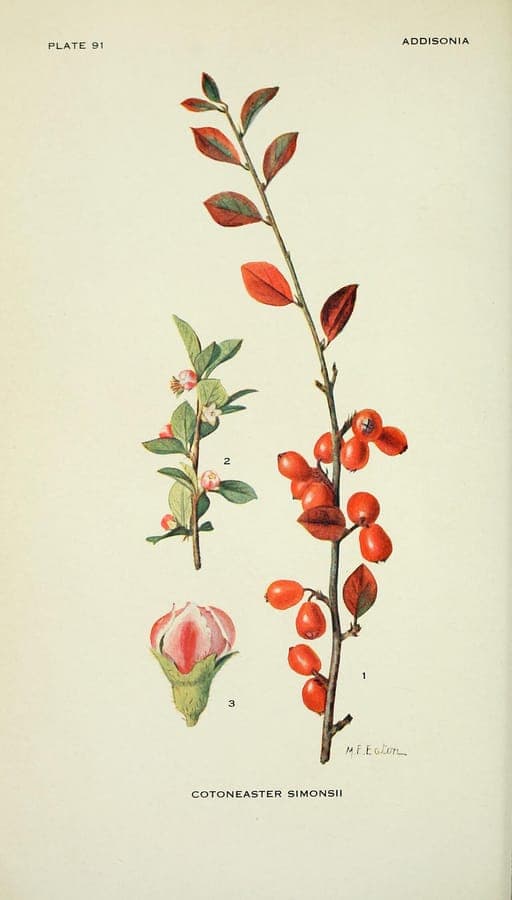
New York Botanical Garden. / Public domain, via Wikimedia Commons
Simons' cotoneaster: complete guide
Cotoneaster simonsii
Want to see Simons' cotoneaster: complete guide in your garden?
1 minute, no credit card
Simons' cotoneaster (Cotoneaster simonsii), also called Himalayan cotoneaster or khasia berry, is a valuable shrub from the Rosaceae (rose) family. Native to the Himalayan foothills-from Assam through Nepal to Myanmar-this shrub thrives on mountainous slopes and in open woodlands. With fine, small leaves, white summer flowers, and abundant red berries, it is invaluable for bird gardens and winter interest in borders.
Cotoneasters are indispensable in modern garden design. They provide flowers for pollinators, berries for birds, and interesting winter silhouettes. Cotoneaster simonsii is particularly popular across Europe and North America for landscaping.
Appearance & Bloom
Simons' cotoneaster grows to about 1.5-2 metres tall and 0.8-1 metre wide with an upright, spreading form. Leaves are small (1-2 cm long), oval, and green, often persisting well into winter. Small white flowers appear in May-June in clusters along the branches, followed by abundant pink-red berries that persist from August to October-highly attractive to birds.
The plant is semi-evergreen in temperate climates, meaning it usually retains leaves but may become partially bare in severe winters.
Ideal Location
Simons' cotoneaster thrives in full sun to partial shade. Flowering and fruiting are best in full sun (6+ hours daily), but it tolerates partial shade well. This flexibility suits many garden locations. Hardy to USDA zone 5b (-26 to -23 Celsius winter temperature).
Soil
This shrub is highly adaptable, growing on virtually any soil type: sand, clay, loam. It tolerates slightly poor drainage better than many plants, though well-drained soil is preferred. Neutral to slightly acidic pH (6.0-7.5) is fine. It accepts dry, under-fertilized conditions.
Free design
Want to see Simons' cotoneaster: complete guide in your garden? Make a free design now.
Watering
Once established, Simons' cotoneaster is drought-tolerant. Water regularly in the first growing season. Once growing, water only during prolonged dry periods. The plant thrives better with moderate moisture but adapts to drier conditions.
Pruning
Pruning for shape can be done in late winter or early spring. This shrub tolerates hard cutting and regenerates well. Remove dead or damaged wood. For bird feeding, minimal pruning is better, allowing berries to ripen fully and remain available for birds.
Maintenance Calendar
May-June: Blooming period. August-October: Berry season; enjoy and watch for birds. November-March: Winter period; minimal pruning in March. April-May: New growth; apply water as needed.
Winter Hardiness
Simons' cotoneaster is hardy to USDA zone 5b (-26 to -23 Celsius). This makes it suitable for many temperate and continental climates across Europe. Frost damage may occur in severe winters, but the plant usually recovers.
Companion Planting
Simons' cotoneaster pairs well with other bird-friendly shrubs: hawthorn, holly, and rowan. Plant in groups of three to five for greater impact. Combines well with dark-coloured evergreens as backdrops. In bird gardens, plant with native berry-producing shrubs and grasses.
In Conclusion
Simons' cotoneaster is an underrated shrub that delivers benefits year-round. Its white flowers, red berries, and elegant form make it a smart choice for mid-ground placement in borders. Find plants at garden centres. Visit gardenworld.app for complete inspiration on bird gardens and four-season designs.
Want to see Simons' cotoneaster: complete guide in your garden? Make a free design now.
Upload a photo, pick a style, and get a photorealistic design with plant list in under a minute.
No credit card required


Similar plants
Siberian crab apple: complete guide
Malus x robusta
Complete guide to the Siberian crab apple (Malus x robusta): location, soil, pruning, winter hardiness and the best companion plants for your garden.
Chinese flowering crabapple (Malus x spectabilis): complete guide
Malus x spectabilis
Meet the Chinese flowering crabapple (Malus x spectabilis): a classic spring bloomer with carmine buds and pink blossom.
Potentilla crassinervia: complete guide
Potentilla crassinervia
Potentilla crassinervia, the Corsican cinquefoil, grows wild on Corsica and Sardinia's peaks. Discover how to grow this hardy alpine rock garden gem.