
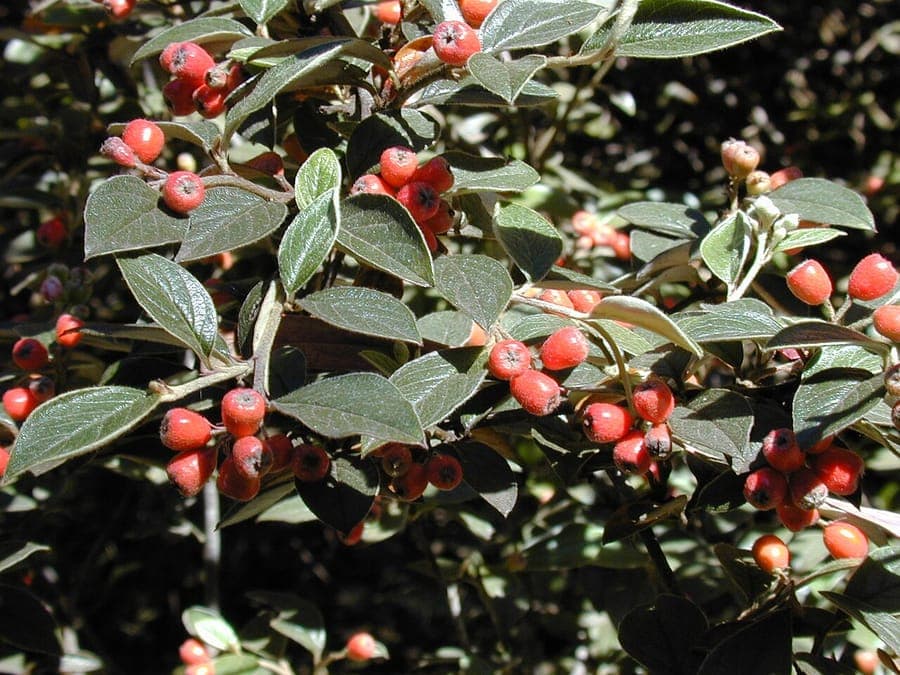
Forest & Kim Starr / CC BY 3.0, via Wikimedia Commons
Silverleaf cotoneaster: complete guide
Cotoneaster pannosus
Want to see Silverleaf cotoneaster: complete guide in your garden?
1 minute, no credit card
Overview
Cotoneaster pannosus, commonly known as Silverleaf cotoneaster, is a tough, spreading shrub that earns its place in UK and North American gardens thanks to its resilience and visual appeal. Native to south-central China, it adapts well to urban conditions and rural landscapes alike. It typically reaches 1.5 metres in height and can spread up to 2.5 metres, making it ideal as a ground cover or low-maintenance hedge.
Gardeners appreciate it for its glossy foliage, subtle spring bloom, and long-lasting berries. But while it's hardy, success starts with the right planting conditions. On gardenworld.app, you can create a custom garden plan that positions this shrub for maximum impact, factoring in sun exposure and spacing.
Appearance & bloom cycle
The leaves are lance-shaped, 3–5 cm long, with a distinctive silvery-white underside-hence the name 'Silverleaf'. In late spring, from April to early May, clusters of small pinkish-white flowers appear. They're modest but attract bees and other pollinators.
From August onwards, bright orange to red berries develop and persist well into winter, often lasting until January or February. These berries are toxic to humans but are a vital food source for birds like thrushes and waxwings during the colder months. The evergreen to semi-evergreen foliage adds texture and interest when many other plants have died back.
Ideal location
Choose a spot with full sun to light shade. Full sun maximises flowering and berry production. In deep shade, growth becomes leggy and sparse. The shrub tolerates coastal winds and urban pollution, but avoid poorly ventilated, damp corners where fungal issues can arise.
It works well in mixed borders, foundation plantings, or as a cascading plant on banks. If you're planning a layered garden design, gardenworld.app offers visual tools to layer plants by height and texture, so you can see how Silverleaf cotoneaster fits with taller shrubs and ground-level perennials.
Soil requirements
This shrub isn't fussy. It grows in sandy, loamy, or clay soils as long as drainage is good. A pH range of 5.5 to 7.5 is ideal. Avoid waterlogged conditions-root rot is the main threat.
Don't enrich the planting hole with fertiliser. Excess nutrients promote leafy growth at the expense of berries. Instead, mix in a bit of well-rotted compost to help roots establish.
Free design
Want to see Silverleaf cotoneaster: complete guide in your garden? Make a free design now.
Watering
Water weekly during the first growing season-5 to 10 litres per plant, depending on size. Once established, it's drought-tolerant and survives on rainfall alone. Only water during prolonged dry spells in summer, especially in containers or shallow soils.
Use rainwater when possible. Tap water, especially if hard, can leave deposits on leaves and affect soil pH over time. Water at the base to keep foliage dry and reduce fungal risk.
Pruning
Pruning is optional unless you're shaping it as a hedge. The best time is late winter, from February to early March, before new growth begins. Remove dead, damaged, or crossing stems with sharp bypass secateurs.
Avoid pruning in autumn-you'll remove the berries that provide winter interest and bird food. If you want berries, delay pruning until late winter or early spring.
Maintenance calendar
- Jan: inspect for bird activity and winter damage
- Feb: light pruning if needed
- Mar: check for aphids; treat with soapy water if necessary
- Apr: flowering begins, no action required
- May: peak bloom, pollinators active
- Jun: monitor soil moisture, water during dry spells
- Jul: same as June
- Aug: berries start to form
- Sep: watch for leaf spot; remove affected leaves
- Oct: leave fallen leaves as natural mulch
- Nov: no action
- Dec: enjoy berries and wildlife activity
Winter hardiness
Hardy in USDA zones 7–9 (-15°C to -7°C). In colder zones, top growth may die back, but it often resprouts from the base. In harsh winters, mulch the root zone with bark chips or leaf mould to protect the roots.
Birds usually leave the berries until late winter, making this shrub a valuable addition to wildlife gardens.
Companion plants
Pair with low perennials like Nepeta or Sedum for contrast in form and bloom time. Spring bulbs such as daffodils or alliums work well-they finish blooming before the cotoneaster fills out. For height contrast, consider taller shrubs like Cornus alba or Fothergilla, which offer seasonal colour and structure.
Avoid invasive ground covers like ivy or periwinkle, which can smother young shoots.
Closing
Cotoneaster pannosus is a reliable, low-fuss shrub that delivers year-round interest. Whether used as a ground cover, informal hedge, or wildlife support, it's a smart choice for modern gardens. Plant it right, give it water the first year, then step back. For design ideas and planting schedules, visit gardenworld.app-where you can build a garden plan tailored to your space, soil, and style. You'll also find seasonal maintenance reminders and plant pairing suggestions to keep your garden thriving.
Want to see Silverleaf cotoneaster: complete guide in your garden? Make a free design now.
Upload a photo, pick a style, and get a photorealistic design with plant list in under a minute.
No credit card required


Similar plants
Siberian crab apple: complete guide
Malus x robusta
Complete guide to the Siberian crab apple (Malus x robusta): location, soil, pruning, winter hardiness and the best companion plants for your garden.
Chinese flowering crabapple (Malus x spectabilis): complete guide
Malus x spectabilis
Meet the Chinese flowering crabapple (Malus x spectabilis): a classic spring bloomer with carmine buds and pink blossom.
Potentilla crassinervia: complete guide
Potentilla crassinervia
Potentilla crassinervia, the Corsican cinquefoil, grows wild on Corsica and Sardinia's peaks. Discover how to grow this hardy alpine rock garden gem.