
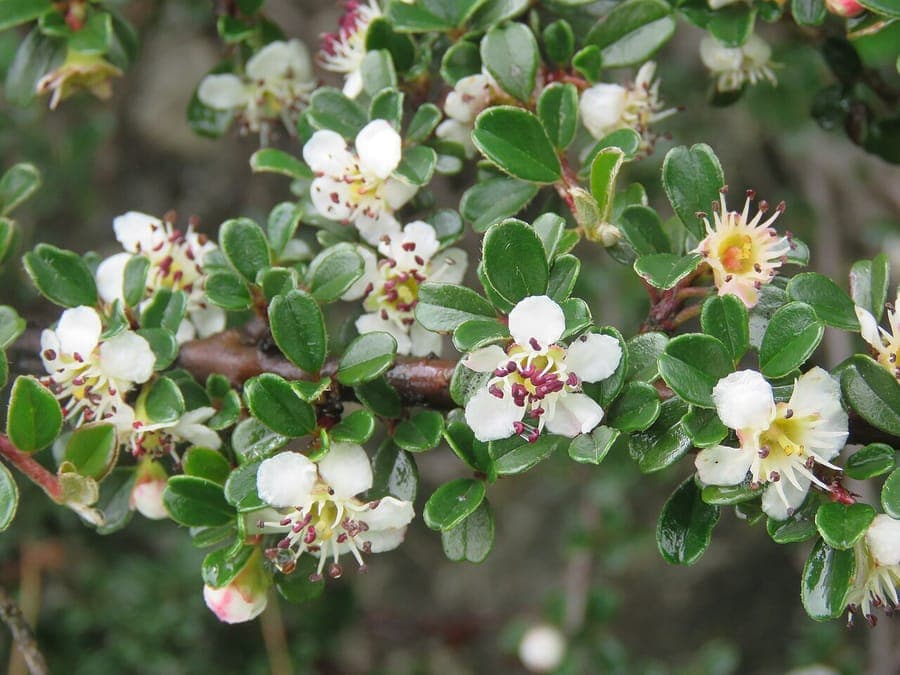
Vinayaraj / CC BY-SA 4.0, via Wikimedia Commons
Small-leaf cotoneaster: complete guide
Cotoneaster microphyllus
Want to see Small-leaf cotoneaster: complete guide in your garden?
1 minute, no credit card
Overview
Cotoneaster microphyllus, commonly known as small-leaf cotoneaster, is a tough, creeping evergreen shrub that earns its place in any practical garden. Native to the Himalayan region and parts of China and India, it has adapted well to temperate climates, including those across the UK and northern US. This plant thrives in USDA hardiness zones 7 to 9, making it a solid choice for gardeners seeking a reliable, year-round ground cover. It grows slowly but steadily, forming a dense mat that suppresses weeds and adds texture to borders, slopes, or rock gardens.
On gardenworld.app, you can design a planting scheme that integrates this shrub into dry, sunny spots where other plants struggle. Its low profile and spreading habit make it ideal for underplanting larger shrubs or softening the edges of paved areas.
Appearance & bloom cycle
The foliage of Cotoneaster microphyllus is small, oval, and glossy green, typically 1–2 cm long. In autumn, the leaves take on warm bronze to reddish tones, adding subtle seasonal interest. From late May to early June, it produces clusters of tiny pinkish-white flowers, often overlooked but highly attractive to bees and pollinating insects. These flowers give way to bright red berries that persist from September through winter, providing food for birds like thrushes and waxwings.
The plant grows to just 20–30 cm in height but can spread up to 1.5 meters wide, making it excellent for ground coverage. Its prostrate stems root at nodes as they trail along the ground, helping it establish a solid, weed-resistant carpet.
Ideal location
Plant in full sun to light shade for best results. A minimum of 5–6 hours of direct sunlight daily ensures dense growth and maximum berry production. While it tolerates partial shade, growth becomes looser and flowering diminishes. Avoid deep shade or areas with heavy overhead competition from tree canopies. It performs well in urban gardens due to its tolerance of pollution and dry soil conditions.
Use gardenworld.app to visualize how this plant fits into your garden layout, especially on slopes or under trees where soil moisture is low and maintenance access is tricky.
Soil requirements
This cotoneaster is adaptable to a wide range of soil types, including sandy, loamy, and clay soils, as long as drainage is adequate. It prefers a slightly acidic to neutral pH (5.5–7.5). Heavy clay soils should be amended with grit or compost to improve drainage. Avoid waterlogged areas-this plant will not survive prolonged wet feet. A light mulch of compost in spring can help retain moisture and suppress weeds without smothering the stems.
Free design
Want to see Small-leaf cotoneaster: complete guide in your garden? Make a free design now.
Watering
During the first growing season, water weekly if rainfall is below 2.5 cm per week. After establishment (usually by the second year), it becomes highly drought-tolerant and rarely needs supplemental watering. In extended dry spells-more than three weeks without rain-give a deep soak to prevent stress. Use a soaker hose or water at the base to avoid wetting the foliage, which can encourage fungal issues.
Pruning
Pruning is minimal. In early spring (March or April), you can trim back any leggy or overgrown stems to maintain shape. Avoid cutting into old wood, as regrowth may be slow. Use sharp, clean secateurs to prevent disease spread. If the plant spreads beyond its intended area, cut back the runners to 10–15 cm from the main clump. It responds well to light trimming and will quickly fill in.
Maintenance calendar
- Jan: Check for winter damage; no action needed.
- Feb: Remove any debris or dead stems if accessible.
- Mar: Light pruning possible. Apply mulch if desired.
- Apr: New growth begins. Light feeding optional.
- May: Flowers appear. Avoid pruning.
- Jun: Peak bloom. Beneficial for pollinators.
- Jul: Monitor during hot, dry periods.
- Aug: Water only if drought persists.
- Sep: Berries develop. Birds begin to visit.
- Oct: Autumn color appears. No pruning.
- Nov: Fallen leaves can be left as natural mulch.
- Dec: Fully winter-hardy. No care required.
Winter hardiness
Cotoneaster microphyllus is hardy down to -15°C (USDA zone 7). In zone 6, it may suffer tip dieback in harsh winters, but usually recovers in spring. The semi-evergreen foliage remains largely intact, providing visual interest in winter gardens. Avoid piling heavy mulch over the stems, as this can encourage rot.
Companion plants
Pair with drought-tolerant perennials like lavender, sedum, or thyme. It works well under pine trees or with ornamental grasses. Good companions include Heuchera, Helleborus, and Carex species. Avoid aggressive spreaders like ivy or periwinkle, which can overwhelm it. For contrast, plant alongside silver-foliage herbs like Artemisia.
Closing
Cotoneaster microphyllus is a dependable, low-fuss shrub that delivers year-round structure and ecological value. Whether you're covering a slope, filling a dry corner, or attracting wildlife, it's a smart addition. It's widely available at garden centres across the UK and US. For design inspiration, visit gardenworld.app and create a tailored garden plan that makes the most of this versatile ground cover.
Want to see Small-leaf cotoneaster: complete guide in your garden? Make a free design now.
Upload a photo, pick a style, and get a photorealistic design with plant list in under a minute.
No credit card required


Similar plants
Siberian crab apple: complete guide
Malus x robusta
Complete guide to the Siberian crab apple (Malus x robusta): location, soil, pruning, winter hardiness and the best companion plants for your garden.
Chinese flowering crabapple (Malus x spectabilis): complete guide
Malus x spectabilis
Meet the Chinese flowering crabapple (Malus x spectabilis): a classic spring bloomer with carmine buds and pink blossom.
Potentilla crassinervia: complete guide
Potentilla crassinervia
Potentilla crassinervia, the Corsican cinquefoil, grows wild on Corsica and Sardinia's peaks. Discover how to grow this hardy alpine rock garden gem.