
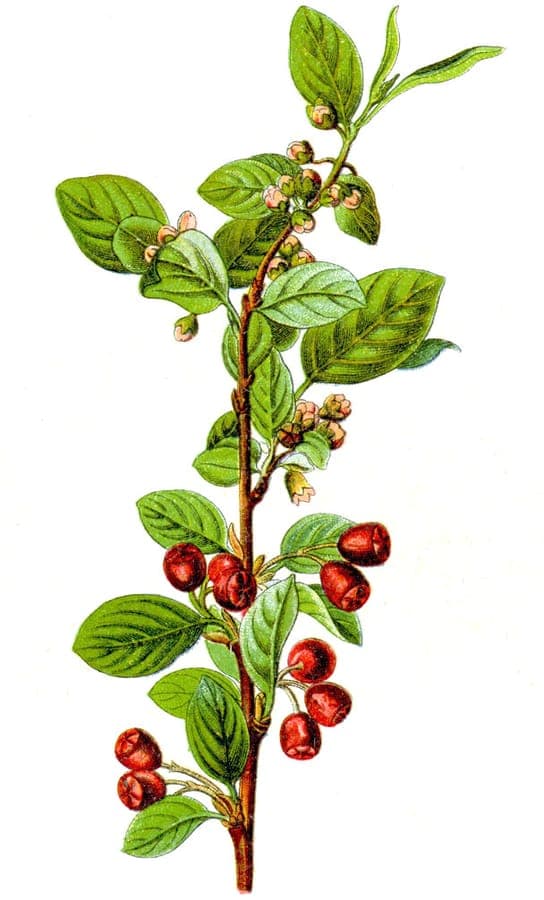
Johann Georg Sturm (Painter: Jacob Sturm) / Public domain, via Wikimedia Commons
Cotoneaster: complete guide
Cotoneaster integerrimus
Want to see Cotoneaster: complete guide in your garden?
1 minute, no credit card
Overview
Cotoneaster integerrimus is a tough, low-maintenance shrub that brings year-round structure and ecological value to gardens across temperate zones. A member of the Rosaceae family, it's native to woodlands, rocky slopes, and scrublands from Central Europe to parts of Asia. Reaching 1.5 to 2.5 metres in height with a spread of up to 2 metres, it's ideal as a free-standing specimen, informal hedge, or wildlife screen in medium to large gardens.
On gardenworld.app, you can design a planting scheme that highlights this shrub's strengths - especially its late-season berries and bird-attracting qualities. It's a go-to for gardeners who want beauty without constant upkeep.
Appearance & bloom cycle
In late spring, clusters of small pinkish-white flowers (5–8 mm across) appear between May and June. While not flashy, they're a magnet for bees and hoverflies. By September, these develop into round, 6–8 mm berries that ripen from orange to deep red. These persist well into winter, often lasting until February, providing vital food for birds like thrushes, blackbirds, and waxwings.
The leaves are narrow, lance-shaped, and dark green with a slight gloss on top and fine hairs underneath. In autumn, they turn a soft yellow-brown before dropping gradually. In mild winters, especially in sheltered spots, the shrub may retain some foliage - making it semi-evergreen in USDA zones 7 and above.
Ideal location
This cotoneaster thrives in full sun to light shade (light level 8/10). For best flowering and fruiting, plant it where it gets at least 6 hours of direct sunlight daily. It's excellent for hot, dry banks, south-facing walls, or gravel gardens. It tolerates urban pollution and coastal exposure, making it a strong choice for city gardens or exposed rural sites.
Give it space to spread - it doesn't like being cramped. Plant at least 1.5 metres from other shrubs. On gardenworld.app, you can simulate spacing and growth patterns to avoid overcrowding in your garden design.
Soil requirements
Cotoneaster integerrimus isn't picky about soil type, as long as drainage is good. It grows well in sandy, loamy, or chalky soils with a pH from 6.8 to 8.7. Avoid heavy, waterlogged clay. If planting in dense soil, mix in 30% grit or sharp sand to improve drainage.
No feeding needed. Over-fertilising, especially with nitrogen, leads to lush foliage at the expense of berries. A light mulch of leaf mould or composted bark in spring is plenty.
Free design
Want to see Cotoneaster: complete guide in your garden? Make a free design now.
Watering
Water deeply once a week during the first growing season if rainfall is below 25 mm per week. Use about 10 litres per plant. After establishment, it's highly drought-tolerant and rarely needs supplemental watering - even during dry summers. Mature plants can go weeks without rain.
Avoid overhead watering to prevent fungal issues. Drip irrigation or soaker hoses are ideal for keeping the root zone moist without wetting the foliage.
Pruning
Pruning isn't essential, but you can shape the shrub in early spring (March–April) to maintain density or control size. Cut back wayward branches to a healthy bud. For hedges, trim lightly in late June after flowering to avoid cutting off developing berries.
Use clean, sharp secateurs. Heavy pruning is not recommended - this species doesn't respond well to hard cutting back and may take years to recover.
Maintenance calendar
- Jan: Leave berries for birds; avoid pruning
- Feb: Check for nesting birds before any work
- Mar: Light pruning; plant new specimens
- Apr: Apply mulch; inspect for pests
- May: Flowers appear; pollinators active
- Jun: Peak bloom; light hedge trimming
- Jul: Minimal care; watch for drought stress
- Aug: No extra water unless prolonged dry spell
- Sep: Berries ripen; take garden photos
- Oct: Birds feed heavily; leave plant intact
- Nov: Clear fallen leaves; mulch base
- Dec: Final check; protect container plants in zone 5
Winter hardiness
Hardy in USDA zones 5 to 8 (–23°C to –12°C). In the UK and most of the US, it survives winter without protection. Young plants may suffer leaf scorch in harsh winters, but they recover in spring. Container-grown plants should be moved to a sheltered spot or insulated with bubble wrap.
Companion plants
Pair with other berry-producing shrubs like Ilex verticillata or Viburnum opulus for extended wildlife interest. Underplant with hardy perennials such as Helleborus or Carex for texture. Use low thyme or sedum in dry, sunny spots around the base.
Avoid invasive groundcovers like periwinkle, which can strangle young stems. On gardenworld.app, you can test plant combinations to ensure good spacing and compatibility.
Closing
Cotoneaster integerrimus isn't a headline-grabber, but it's a quietly effective workhorse in the garden. It supports wildlife, handles tough conditions, and asks for almost nothing in return. For gardeners who value function as much as form, it's a top-tier choice.
Available at major garden centres across the UK and US. Look for healthy, field-grown stock at trusted retailers. And remember: a great garden starts with smart plant choices. Use gardenworld.app to build a layout that works with your soil, light, and local climate - not against it.
Want to see Cotoneaster: complete guide in your garden? Make a free design now.
Upload a photo, pick a style, and get a photorealistic design with plant list in under a minute.
No credit card required


Similar plants
Siberian crab apple: complete guide
Malus x robusta
Complete guide to the Siberian crab apple (Malus x robusta): location, soil, pruning, winter hardiness and the best companion plants for your garden.
Chinese flowering crabapple (Malus x spectabilis): complete guide
Malus x spectabilis
Meet the Chinese flowering crabapple (Malus x spectabilis): a classic spring bloomer with carmine buds and pink blossom.
Potentilla crassinervia: complete guide
Potentilla crassinervia
Potentilla crassinervia, the Corsican cinquefoil, grows wild on Corsica and Sardinia's peaks. Discover how to grow this hardy alpine rock garden gem.