
A. Barra / CC BY 3.0, via Wikimedia Commons
Franchet's cotoneaster: complete guide
Cotoneaster franchetii
Want to see Franchet's cotoneaster: complete guide in your garden?
1 minute, no credit card
Overview
Cotoneaster franchetii, commonly known as Franchet's cotoneaster, is a graceful, spreading evergreen shrub native to south-central China, Tibet, and northern Thailand. In the garden, it earns its place through reliability, visual interest across seasons, and minimal care needs. Reaching 1.5 to 2 meters in height with a spread of up to 2.5 meters, it's ideal as a low, arching hedge or as a structural plant on slopes and walls. Its growth is moderate but steady, forming a dense, vase-shaped canopy over time. Unlike many cotoneasters, it holds most of its foliage year-round in milder climates, making it a strong candidate for year-round screening. On gardenworld.app, you can visualise how this shrub fits into your garden layout, balancing space, light, and seasonal colour.
Appearance & bloom cycle
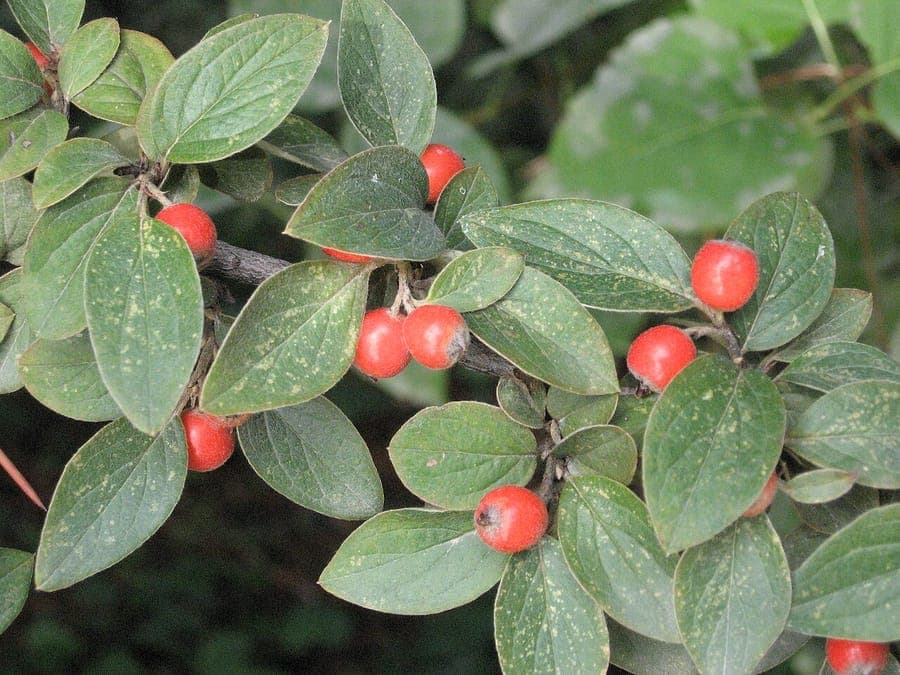
From May to June, clusters of small, pale pink to white flowers line the stems, attracting bees and hoverflies. These give way to small green berries that ripen to a vivid orange-red by late summer and persist well into winter-often until January or February. The foliage is narrow, lance-shaped, and glossy green above, with a soft, felt-like underside. New growth in spring shows a bronzy tint, adding subtle seasonal contrast. The arching branches create a natural, cascading effect, especially when planted on banks or near retaining walls.
Ideal location
Full sun is best for maximum flowering and fruiting, though it tolerates light shade. In dense shade, growth becomes leggy and berry production drops. Give it enough lateral space-this isn't a plant to cram into tight corners. It thrives on slopes, where its spreading habit stabilises soil, or along fence lines for informal screening. Avoid planting too close to foundations, as mature spread can reach 2.5 meters. Use gardenworld.app to map out spacing and sun exposure, ensuring your cotoneaster has room to develop without crowding nearby plants.
Soil requirements
Franchet's cotoneaster adapts to a wide range of soils as long as drainage is good. It grows well in sandy, loamy, or light clay soils with a pH from slightly acidic to mildly alkaline (5.5–7.5). Heavy, waterlogged clay should be improved with compost or grit to prevent root rot. A quick soil test will help determine if amendments are needed. Once established, it handles dry spells with ease, making it suitable for xeriscaping in suitable zones.
Free design
Want to see Franchet's cotoneaster: complete guide in your garden? Make a free design now.
Watering
During the first growing season, water weekly-especially during dry spells. Deep, infrequent watering encourages strong root development. After establishment (around 12 months), the plant is drought-tolerant and rarely needs supplemental irrigation. In prolonged summer droughts, a deep soak once a month will help maintain vigour. Avoid overhead watering if possible to reduce fungal risk, and use rainwater when available to prevent lime buildup in sensitive soils.
Pruning
Pruning is minimal. If needed, trim in early spring (March) to remove dead wood, crossed branches, or to control shape. Avoid hard pruning or clipping after mid-summer, as this removes next year's flower buds. Use sharp, clean secateurs to prevent disease spread. If used as a hedge, light shaping once a year is sufficient-this plant looks best when allowed to grow in its natural, arching form.
Maintenance calendar
- January: Check for winter damage. No pruning.
- February: Prepare for spring. Remove damaged stems if needed.
- March: Light pruning. Apply compost around the base.
- April: New growth appears. Monitor for aphids.
- May: Flowers emerge. Attract pollinators.
- June: Bloom continues. Stop fertilising.
- July: Berries begin forming. Water in extended dry periods.
- August: Fruit enlarges. Watch for bird activity.
- September: Berries turn bright orange-red. Peak ornamental value.
- October: No maintenance. Rake fallen leaves if needed.
- November: Mulch base lightly to protect roots.
- December: Berries still present. Avoid de-icing salt near roots.
Winter hardiness
Hardy in USDA zones 7–9 (-15°C to -7°C). In zone 6, it may survive with winter protection, especially when young. Mulch the root zone in late autumn to insulate against freeze-thaw cycles. Avoid planting near roads or paths where salt is used-sodium damages foliage and roots. In harsh winters, tip dieback can occur, but the shrub usually recovers well in spring.
Companion plants
Pair with plants that complement its texture and timeline. Ilex aquifolium adds architectural contrast, while Lonicera nitida provides denser screening. For understory interest, consider Mahonia × media for winter blooms or Kerria japonica for spring yellow flowers. Ground covers like Vinca minor or Pachysandra terminalis work well beneath, but avoid invasive types like ground elder. Keep competing root systems at bay, especially from large trees.
Closing
Franchet's cotoneaster is a quiet achiever-unspectacular up close, but stunning in mass or as a seasonal focal point. Its long-lasting berries, evergreen foliage, and low demands make it a smart choice for sustainable gardens. Find it at garden centres across the UK, often in 30–40 cm pots for quick establishment. Check gardenworld.app for planting combos and seasonal visuals to plan your ideal shrub border.
Want to see Franchet's cotoneaster: complete guide in your garden? Make a free design now.
Upload a photo, pick a style, and get a photorealistic design with plant list in under a minute.
No credit card required


Similar plants
Siberian crab apple: complete guide
Malus x robusta
Complete guide to the Siberian crab apple (Malus x robusta): location, soil, pruning, winter hardiness and the best companion plants for your garden.
Chinese flowering crabapple (Malus x spectabilis): complete guide
Malus x spectabilis
Meet the Chinese flowering crabapple (Malus x spectabilis): a classic spring bloomer with carmine buds and pink blossom.
Potentilla crassinervia: complete guide
Potentilla crassinervia
Potentilla crassinervia, the Corsican cinquefoil, grows wild on Corsica and Sardinia's peaks. Discover how to grow this hardy alpine rock garden gem.