
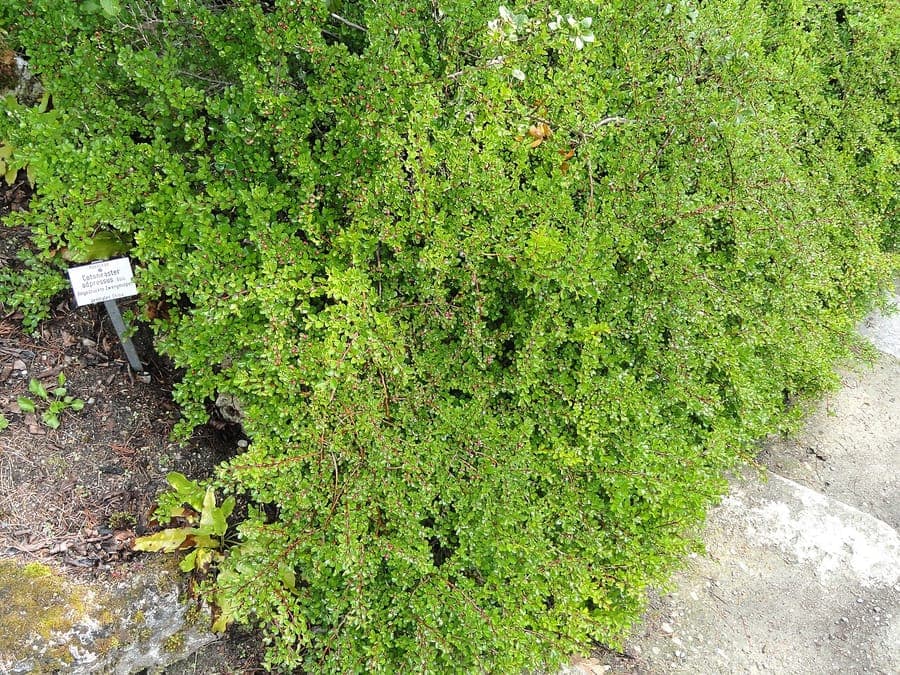
Daderot / Public domain, via Wikimedia Commons
Creeping cotoneaster: complete guide
Cotoneaster adpressus
Want to see Creeping cotoneaster: complete guide in your garden?
1 minute, no credit card
Overview
Cotoneaster adpressus, commonly known as creeping cotoneaster, is a reliable, slowly spreading shrub that excels as a groundcover in low-maintenance gardens. Native to high-altitude regions like Tibet, Nepal, and central China, this tough plant handles cold winters and dry summers with ease. In temperate climates such as the UK and northern Europe, it's prized for its dense, trailing growth and year-round visual interest. It reaches only 15–30 cm in height but spreads up to 1.5 meters wide, forming a mat-like cover perfect for slopes, rock gardens, or as edging along paths.
On gardenworld.app you can design a layout that takes full advantage of creeping cotoneaster's trailing habit, especially when working with retaining walls or tiered garden levels.
Appearance & bloom cycle
The plant features small, oval, glossy green leaves that turn shades of bronze, red, or purple in autumn. From May to June, it produces clusters of tiny pinkish-white flowers, modest in size but rich in nectar, attracting bees and other pollinators. By late summer, these give way to round, bright orange-red berries that persist from September through winter-provided birds haven't claimed them first. While toxic to humans, the berries are a valuable food source for birds like thrushes and waxwings.
This long display of foliage, flowers, and berries ensures the plant remains a focal point across multiple seasons, adding texture and colour when many other plants have gone dormant.
Ideal location
Creeping cotoneaster thrives in full sun to partial shade. For the densest growth and heaviest berry set, choose a sunny spot. In deeper shade, the plant may become leggy and produce fewer flowers and fruits. It's ideal for dry, rocky slopes, stone walls, or as a low hedge alternative. Its trailing stems drape beautifully over edges, with branches extending up to 50 cm beyond retaining walls.
Because it grows slowly but persistently, it's perfect for areas where aggressive groundcovers might be problematic. Pair it with natural materials like stone or timber to highlight its informal, cascading form.
Soil requirements
This cotoneaster is highly adaptable. It handles sandy, loamy, and even heavy clay soils as long as drainage is adequate-stagnant water is its main enemy. The ideal pH range is 5.5 to 7.5 (slightly acidic to slightly alkaline). In heavy clay, mix in coarse sand or grit to improve drainage. On very acidic soils (below pH 5.5), a light application of garden lime can help, but it's rarely necessary.
At planting, dig a generous hole and mix in compost or well-rotted manure. After that, no regular feeding is needed. The plant gets by just fine on average garden soil.
Free design
Want to see Creeping cotoneaster: complete guide in your garden? Make a free design now.
Watering
Water regularly during the first growing season-once or twice a week during dry spells-to establish a strong root system. After year one, it's highly drought-tolerant and survives on rainfall alone in most climates. Only during prolonged droughts should you consider supplemental watering. Overwatering, especially in poorly drained soils, can lead to root rot, so let the soil dry between waterings.
Pruning
Pruning is rarely required. The plant has a naturally tidy habit. If needed, trim stray stems in March or early April to maintain shape or contain spread. Avoid hard pruning, as recovery is slow. Dead or damaged branches can be removed at any time.
Use sharp secateurs for clean cuts and to prevent tearing. Light shaping can be done in summer, but stop by late summer to allow new growth to harden before winter.
Maintenance calendar
- Jan: check for winter damage
- Feb: assess soil structure and drainage
- Mar: light pruning if needed
- Apr: monitor for new growth and trailing stems
- May: flowering begins, watch for pollinators
- Jun: end of bloom, fruit set starts
- Jul: minimal care, check for dryness
- Aug: inspect for pests
- Sep: berries appear, birds may arrive
- Oct: peak berry display, foliage turns
- Nov: leave berries for winter interest
- Dec: minimal care, check for snow load on stems
Winter hardiness
Creeping cotoneaster is hardy to -20°C (USDA zone 6, and zone 5 in sheltered spots). It's semi-evergreen, holding most of its leaves through winter, which adds structure to the garden during bare months. In harsh winters, tip dieback may occur, but the plant usually recovers well in spring. No winter protection is needed, even in exposed locations.
Companion plants
Pair creeping cotoneaster with other low-growing, drought-tolerant plants like thyme (Thymus serpyllum), sedum (Sedum spurium), or bugleweed (Ajuga reptans). Contrast its glossy foliage with silver-leaved plants such as lamb's ear (Stachys byzantina) or bigroot geranium (Geranium macrorrhizum). On slopes, combine with dwarf lavender (Lavandula angustifolia) or heathers for a natural, textured look.
For seasonal contrast, grow it near shrubs with winter interest, such as red-twig dogwood (Cornus alba) or guelder rose (Viburnum opulus). On gardenworld.app, you can preview how these combinations work in your own garden, adjusting for light, soil, and spacing.
Closing
Creeping cotoneaster is a smart choice for gardeners wanting a tough, attractive groundcover that asks little and gives much. Its resilience, minimal care needs, and multi-season appeal make it a standout performer. Available at most garden centres across the UK and northern Europe, including major retailers, it's easy to find and simple to establish. Whether you're stabilising a slope, softening a wall, or covering dry ground, this cotoneaster does it with quiet elegance.
Want to see Creeping cotoneaster: complete guide in your garden? Make a free design now.
Upload a photo, pick a style, and get a photorealistic design with plant list in under a minute.
No credit card required


Similar plants
Siberian crab apple: complete guide
Malus x robusta
Complete guide to the Siberian crab apple (Malus x robusta): location, soil, pruning, winter hardiness and the best companion plants for your garden.
Chinese flowering crabapple (Malus x spectabilis): complete guide
Malus x spectabilis
Meet the Chinese flowering crabapple (Malus x spectabilis): a classic spring bloomer with carmine buds and pink blossom.
Potentilla crassinervia: complete guide
Potentilla crassinervia
Potentilla crassinervia, the Corsican cinquefoil, grows wild on Corsica and Sardinia's peaks. Discover how to grow this hardy alpine rock garden gem.