
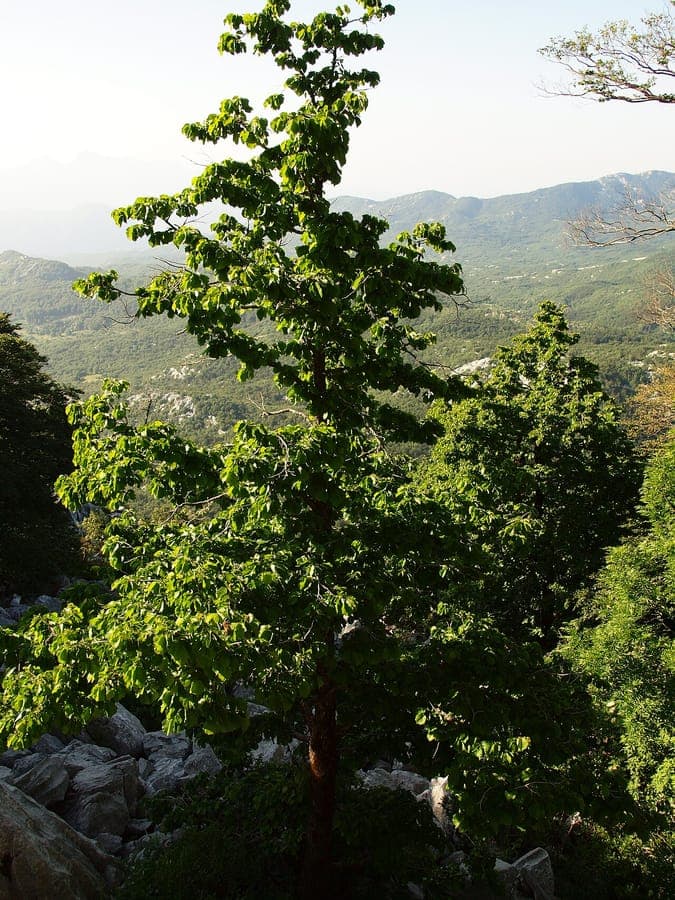
Orjen, Pavle Cikovac / CC BY-SA 3.0, via Wikimedia Commons
Turkish filbert: complete guide
Corylus colurna
Want to see Turkish filbert: complete guide in your garden?
1 minute, no credit card
Overview
Corylus colurna, commonly known as the Turkish filbert, is a deciduous tree that stands out from its shrubby relatives by developing a strong central trunk and a neat, pyramidal crown. Native to southeastern Europe and western Asia - including regions of Turkey, the Balkans and the Caucasus - this tree thrives in forested hillsides and well-drained slopes. Unlike common hazels that grow as multi-stemmed shrubs, the Turkish filbert grows as a true tree, reaching heights of 12 to 15 meters with a spread of 6 to 8 meters at maturity.
It's a slow starter in the first few years, but once established, it gains momentum and becomes a long-lived, structural presence in the garden. Its upright, columnar habit makes it ideal for smaller gardens where space is limited but vertical interest is desired. You'll increasingly spot it in modern landscape designs, especially in urban gardens where clean lines and seasonal interest are valued.
On gardenworld.app, you can design a planting scheme that accounts for the tree's mature dimensions, ensuring it doesn't overcrowd other plants or structures. Proper spacing from the start avoids future issues with root competition or shading.
Appearance & bloom cycle
What really sets the Turkish filbert apart is its winter bloom. From January through March, before the leaves emerge, the tree produces long, pendulous yellow catkins up to 5 cm in length. These male flowers sway gently in the breeze, releasing pollen that's carried by wind - a vital process since this species is wind-pollinated. The female flowers are tiny and red, barely visible at the base of the buds, but they develop into small, edible nuts later in the season.
New leaves appear in April: broadly oval, 8–15 cm across, with a rough, wrinkled texture and a toothed margin. They start out a soft green and mature to a deep, glossy green by midsummer. In autumn, they turn a soft yellow to golden brown, providing subtle fall color without the mess of dramatic leaf drop.
The nuts themselves are small, round hazelnuts fully enclosed in a green, leafy husk. While edible, they're less palatable than cultivated varieties due to the thick husk and smaller kernel. Still, they attract birds and small mammals, adding ecological value to your garden.
Ideal location
Full sun to light shade is ideal for Corylus colurna. It performs best with at least 6 hours of direct sunlight daily but appreciates some afternoon shade in hotter climates. A spot with morning sun and dappled afternoon light works well, especially in urban gardens where heat buildup can stress trees.
Thanks to its non-invasive root system - deep and moderately spreading - it can be planted closer to buildings or paved areas than many other trees, provided there's at least 1.5 meters of clearance. As a standalone feature, it shines in open lawns or near patios where its form can be appreciated from all angles.
Use gardenworld.app to simulate sun patterns in your garden and determine the best planting spot based on light exposure and available space.
Free design
Want to see Turkish filbert: complete guide in your garden? Make a free design now.
Soil requirements
This tree isn't fussy about soil type but prefers deep, loamy, well-drained soils. It tolerates clay if drainage is improved with organic matter, and it handles sandy soils as long as supplemental watering is provided during dry spells. The ideal pH range is between 5.5 and 7.5 - slightly acidic to neutral.
Avoid waterlogged soils, especially in winter, as prolonged wet conditions can lead to root rot. If your soil is heavy clay, consider planting on a slight mound or amending the planting hole with compost and grit to enhance drainage.
Watering
During the first two to three growing seasons, consistent watering is crucial. Provide a deep soak of 20–30 liters weekly during dry periods. After establishment, the tree becomes fairly drought-tolerant, though it benefits from occasional deep watering during extended summer droughts.
Applying a 5–8 cm layer of mulch (wood chips or compost) in spring helps retain moisture, suppress weeds, and protect roots. Keep mulch a few inches away from the trunk to prevent collar rot.
Pruning
Minimal pruning is required. The natural pyramidal shape develops without intervention. If needed, remove any crossing, broken, or inward-growing branches during late winter or early spring while the tree is dormant. Avoid heavy pruning, as it can delay flowering and disrupt the tree's form.
For street or avenue planting, gradually remove lower branches over the first five years to create a clean trunk of 1.8–2 meters, enhancing clearance and formal appearance.
Maintenance calendar
- Jan: inspect for storm damage; catkins visible
- Feb: final pruning window; monitor bloom development
- Mar: last chance to prune before budbreak
- Apr: apply mulch; watch for leaf emergence
- May: check for aphids or powdery mildew
- Jun: no routine care needed unless drought stress
- Jul: water deeply during prolonged heat
- Aug: continue monitoring soil moisture
- Sep: observe autumn color development
- Oct: leaf fall begins; prepare for winter
- Nov: leave fallen leaves under canopy as natural mulch
- Dec: assess structure and winter resilience
Winter hardiness
Corylus colurna is hardy to USDA zones 5–8 (-20°C to -10°C). In temperate regions like the UK, northern Europe and the northeastern US, it thrives without protection. Young trees may suffer tip dieback in harsh winters but typically recover well in spring. No winter wrapping or special care is needed.
Companion plants
Underplant with shade-tolerant species like hellebores, hostas, or ferns. Early spring bulbs such as daffodils or snowdrops provide contrast against the bare winter branches. Woodland perennials like Epimedium or Anemone nemorosa blend naturally with its ecology.
Avoid aggressive groundcovers like Vinca minor or Lamium, which can outcompete the tree for water and nutrients.
Closing
The Turkish filbert is a smart, understated choice for gardeners who value seasonal rhythm and structural elegance. Its winter interest, clean growth habit, and low upkeep make it a standout in both traditional and contemporary landscapes. Find young specimens at garden centres or online nurseries, and use gardenworld.app to plan your planting for long-term success.
Want to see Turkish filbert: complete guide in your garden? Make a free design now.
Upload a photo, pick a style, and get a photorealistic design with plant list in under a minute.
No credit card required


Similar plants
Heart-leaf birch: complete guide
Betula cordifolia
Heart-leaf birch is an attractive North American birch tree for large gardens. Discover growth, white papery bark and winter hardiness.
Tropical hornbeam: complete guide
Carpinus tropicalis
Everything about Carpinus tropicalis, the tropical hornbeam from Central America. Growing tips, location, care, and garden use explained.
Japanese Alder (Alnus firma): complete guide
Alnus firma
Learn everything about Japanese Alder in our complete guide. Discover care, growth, and applications for larger gardens.