
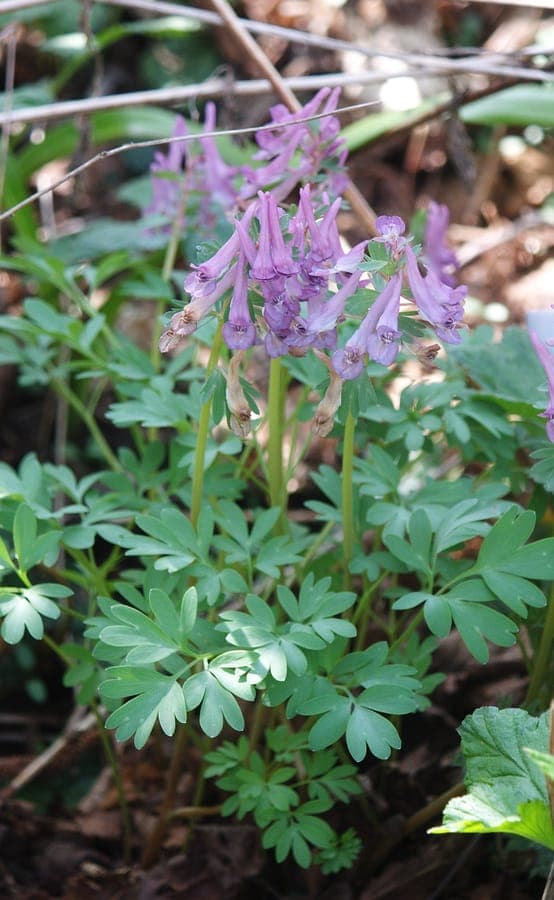
Bernd Haynold / CC BY 2.5, via Wikimedia Commons
Bird-in-a-bush: complete guide
Corydalis solida
Want to see Bird-in-a-bush: complete guide in your garden?
1 minute, no credit card
Overview
Corydalis solida, commonly known as Bird-in-a-bush, is a graceful early spring bloomer from the Papaveraceae family. Native to broad regions of Central and Eastern Europe, including the Baltic States, Belarus, and Bulgaria, this herbaceous perennial thrives in woodland settings and lightly shaded borders. It's a plant that quietly announces the end of winter with soft, arching sprays of delicate flowers, usually between late February and early May, depending on local climate.
Reaching heights of 15 to 30 cm, it's perfect for the front or middle of a border, especially where other perennials haven't yet emerged. The plant grows from small tubers and dies back completely after flowering, going dormant through summer. It's not flashy, but its subtle charm makes it a favorite among thoughtful gardeners. On gardenworld.app you can create a customized planting plan that integrates Corydalis solida with other spring performers for a seamless transition.
Appearance & bloom cycle
Bird-in-a-bush features finely divided, blue-green foliage that forms a soft, fern-like mound. The leaves are delicate but resilient, and they appear just before or with the flowers. The blooms are carried in short, dense racemes, each flower shaped like a tiny spurred bird-hence the whimsical common name. Colors range from soft lilac-pink to deep magenta, with cultivars like 'George Baker' offering rich crimson tones.
Flowering begins as early as late February in mild zones and can last into May in cooler areas. Each bloom lasts several weeks, and the overall display is subtle but persistent. After flowering, the foliage yellows and disappears by early summer, leaving no trace until the following spring. This ephemeral nature means planning is essential-pair it with plants that will fill the gap.
Ideal location
Choose a spot with partial to light shade. Dappled sunlight under deciduous trees or at the edge of a shrub border works best. Corydalis solida prefers light levels around 4 out of 10-too much sun, especially in April and May, will scorch the leaves and shorten the bloom time. Avoid hot, south-facing spots with full afternoon sun.
Urban gardens with limited space can still accommodate this plant in sheltered corners with overhead light filtration. If you're unsure where to place it, use gardenworld.app to map out your garden's light patterns and pinpoint the best microclimate for Corydalis solida.
Soil requirements
This plant demands a well-drained, humus-rich soil. The ideal pH is neutral to slightly alkaline, between 7.0 and 7.5. Heavy clay soils must be amended with compost, leaf mold, and coarse sand to improve drainage. A mix of garden soil, organic matter, and grit works well in borders. In containers, use a blend of potting mix and perlite to prevent waterlogging.
Plant tubers in autumn at a depth of 5–8 cm. Ensure the soil is moist but not soggy at planting time. A mulch of leaf litter helps retain moisture and mimics natural woodland conditions.
Free design
Want to see Bird-in-a-bush: complete guide in your garden? Make a free design now.
Watering
During active growth-from late winter to late spring-keep the soil consistently moist. Water during dry spells, especially if rainfall is below average. Once flowering ends in May or June, gradually reduce watering as the plant enters dormancy. Let the soil dry out in summer; overwatering at this stage causes tuber rot.
Potted plants need extra attention. Water lightly in spring when growth appears, but stop completely once the foliage dies back. Use room-temperature, standing water to avoid shocking the roots.
Pruning
No pruning is required. Let the foliage die back naturally, as it feeds energy back into the tuber for next year's growth. Cutting it down prematurely weakens the plant. Remove only dead or damaged leaves, and leave the rest until they wither completely.
In formal beds, you can hide the fading foliage with low ground covers like Ajuga reptans or early Hostas. This keeps the border tidy without interfering with the plant's natural cycle.
Maintenance calendar
- January: Check planting sites. Protect emerging shoots with mulch if hard frost is expected.
- February: First shoots appear. Water lightly during dry periods.
- March: Peak flowering begins. Maintain even moisture.
- April: Continue bloom. No fertilizing needed.
- May: Flowers fade. Gradually reduce watering. Let foliage yellow naturally.
- June – August: Dormant period. No care required.
- September: Assess tuber clumps. Divide if overcrowded.
- October: Ideal time to plant new tubers.
- November: Apply mulch to protect against early frost.
- December: No active maintenance.
Winter hardiness
Corydalis solida is hardy in USDA zones 4 to 8. It survives temperatures as low as -34°C if the soil drains well and isn't waterlogged. In colder zones, a light mulch of leaves or straw helps insulate the tubers. For container-grown plants, move pots to a sheltered spot or unheated greenhouse to prevent freeze-thaw cycles from damaging the roots.
Companion plants
Pair Bird-in-a-bush with other spring ephemerals like Erythronium, Anemone blanda, or Pulmonaria. These share similar light and soil needs. Understory trees like birch, hazel, or dogwood create ideal conditions. Small bulbs like Scilla siberica or Narcissus 'Tête-à-tête' complement its soft palette.
Avoid aggressive spreaders or plants that dry out the soil quickly. For a naturalized look, combine with native ferns or wild ginger (Asarum europaeum). These combinations create a layered, woodland feel.
Closing
Corydalis solida isn't a plant for the impatient gardener. It doesn't dominate-instead, it offers quiet elegance in the spring garden. Its fleeting beauty rewards those who plan ahead and appreciate subtle shifts in the seasonal rhythm. With proper placement and companions, it becomes a reliable, low-effort performer year after year.
You can find tubers at garden centres in autumn, often near other spring bulbs. Look for reputable suppliers to ensure healthy stock. Once established, it may self-seed gently, creating small colonies over time. On gardenworld.app, explore design ideas that highlight its understated appeal and help you make the most of your growing space.
Want to see Bird-in-a-bush: complete guide in your garden? Make a free design now.
Upload a photo, pick a style, and get a photorealistic design with plant list in under a minute.
No credit card required


Similar plants
Papaver gorodkovii: complete guide
Papaver gorodkovii
Papaver gorodkovii, the arctic poppy, thrives from Alaska to Russia's Far East. Discover how to grow this rare, extremely cold-hardy rock garden treasure.
Papaver setiferum: complete guide
Papaver setiferum
Papaver setiferum is a hardy giant Caucasian poppy with fiery red blooms. Discover siting, soil, deadheading and winter hardiness.
Pale Poppy: complete guide
Papaver alboroseum
Discover pale poppy (Papaver alboroseum) - rare alpine poppy with white-pink flowers. Precious beauty from Kamchatka. Cultivation in alpine and rock gardens.