
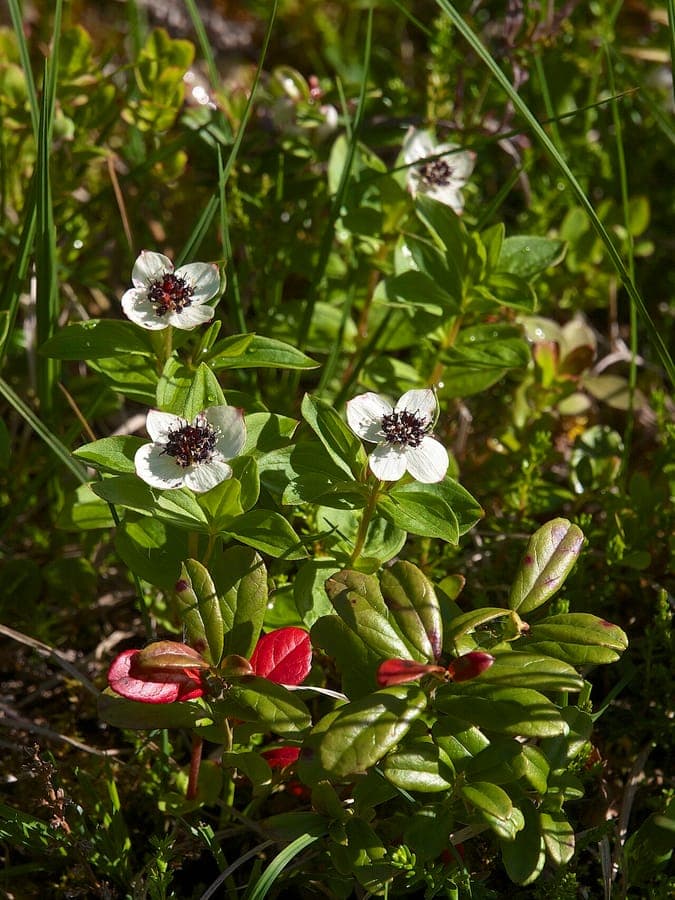
Jörg Hempel / CC BY-SA 3.0 de, via Wikimedia Commons
Dwarf cornel: complete guide
Cornus suecica
Want to see Dwarf cornel: complete guide in your garden?
1 minute, no credit card
Overview
Cornus suecica, commonly known as dwarf cornel, is a quietly impressive addition to cool-climate gardens. Native across northern Europe and parts of North America-from Finland and the Baltic States to Alaska and British Columbia-this low-growing shrub thrives in the damp, acidic understory of coniferous and mixed woodlands. It's rarely found in mainstream garden centres, but specialist nurseries and larger retailers like garden centres in the UK are starting to stock it, especially those focusing on native or ecological planting.
Growing to just 15–30 cm tall, it behaves more like a subshrub than a true bush, making it ideal for foreground planting in naturalistic designs. On gardenworld.app, you can design a woodland edge layout that integrates dwarf cornel with mosses, ferns, and early spring ephemerals for a layered, low-maintenance effect.
Appearance & bloom cycle
The dwarf cornel forms a compact, creeping mound of slender green stems. Its leaves are small (2–4 cm), oval, and glossy, creating a neat carpet-like texture. In early summer-typically from late May to mid-June-it produces tiny flower heads, about 1.5 cm wide, with four to five pale pink or creamy-white petals. The blossoms aren't flashy, but they attract small pollinators like hoverflies and native bees.
By late summer, the flowers give way to round, glossy berries that ripen to a deep purplish-red by August. These aren't edible for people, but birds such as thrushes may nibble them in autumn. Foliage turns a soft yellow to reddish-brown in fall-not dramatic, but it blends beautifully with decaying leaf litter and surrounding greenery.
Ideal location
Choose a spot with light to full shade, ideally under open canopies of birch, pine, or spruce. Full sun is only suitable if the soil stays consistently moist. Avoid exposed, windy sites, as the shallow root system can dry out quickly. A sheltered woodland edge or a north-facing slope works best.
Use gardenworld.app to model microclimates in your garden where moisture and shade overlap-perfect conditions for dwarf cornel to spread slowly and form natural clusters over time.
Soil requirements
This plant demands acidic, humus-rich soil with a pH between 4.5 and 6.0. It dislikes chalk and will struggle in alkaline conditions. The ideal mix includes plenty of organic matter-think leaf mould, well-rotted pine compost, or peat-free ericaceous soil. Heavy clay should be improved with grit and compost to prevent waterlogging, while sandy soils need extra organic content to retain moisture.
Never use lime or limestone mulch near this plant. Even tap water with high alkalinity can cause long-term chlorosis in sensitive specimens.
Free design
Want to see Dwarf cornel: complete guide in your garden? Make a free design now.
Watering
Keep the soil evenly moist, especially during the first two growing seasons and in prolonged dry spells. Mulching with pine needles or bark chips helps conserve moisture and suppress weeds. Once established, the plant shows moderate drought tolerance, but prolonged dryness will cause leaf scorch and dieback.
Avoid overhead watering if possible, as wet foliage in cool weather can encourage fungal issues. Water at the base instead.
Pruning
No pruning is required. The dwarf cornel grows slowly and self-maintains its compact shape. Dead or damaged stems can be removed in early spring if needed, but don't cut back healthy growth-there's no need, and it could delay flowering.
If the plant spreads via underground runners, you can thin out excess shoots to keep it in check. Propagation is best done by division in early spring or autumn.
Maintenance calendar
- January: Dormant. Check for vole or rabbit damage.
- February: Top up mulch if eroded. No fertiliser.
- March: Watch for emerging shoots. Protect from deer or rodents if necessary.
- April: Keep soil moist. No feeding required.
- May: Monitor for slugs, especially on new growth.
- June: Peak bloom. Maintain consistent moisture.
- July: Berries begin to form. Continue watering in dry periods.
- August: Fruit ripens. No pruning.
- September: Foliage starts to change. Leave fallen leaves as natural mulch.
- October: Clear excessive debris, but leave some leaf litter for habitat.
- November: Apply fresh organic mulch to protect roots from freeze-thaw cycles.
- December: Full dormancy. Minimal care needed.
Winter hardiness
Dwarf cornel is exceptionally hardy, surviving temperatures down to -30°C (USDA zone 3). It handles snow cover well and doesn't require winter protection in most temperate climates. The above-ground stems may look ragged after winter, but new growth emerges reliably in spring. In areas with little snow and strong winter sun, a light mulch helps prevent root desiccation.
Companion plants
Pair dwarf cornel with other shade-loving, acid-tolerant plants. Good companions include wood anemone (Anemone nemorosa), twinflower (Linnaea borealis), bluebell (Hyacinthoides non-scripta), and ferns like Dryopteris filix-mas. For spring interest, plant it near snowdrops (Galanthus) or dog's tooth violet (Erythronium).
Avoid competitive groundcovers like ivy or periwinkle, which can overwhelm its delicate growth.
Closing
Cornus suecica won't grab attention from across the garden, but it earns its place through quiet resilience and seasonal subtlety. It's a plant for gardeners who appreciate understated beauty and ecological function. Though still uncommon in retail, it's becoming easier to source from garden centres and native plant suppliers. With thoughtful placement-planned easily on gardenworld.app-dwarf cornel can become a foundational piece in a woodland garden, linking seasons and supporting local wildlife without demanding much in return.
Want to see Dwarf cornel: complete guide in your garden? Make a free design now.
Upload a photo, pick a style, and get a photorealistic design with plant list in under a minute.
No credit card required


Similar plants
Toughleaf Dogwood: complete guide
Cornus asperifolia
Toughleaf dogwood is a suckering, thicket-forming shrub native to the southeastern US, ideal for wildlife hedges on damp, low-lying ground.
Silky dogwood (Cornus obliqua): complete guide
Cornus obliqua
Silky dogwood: cultivation, care tips, and garden uses. White flowers, colorful berries, and stunning fall foliage.
Roughleaf dogwood: complete guide
Cornus drummondii
Everything you need to know about Cornus drummondii: siting, soil, pruning, winter hardiness and companion plants for a naturalistic garden.