
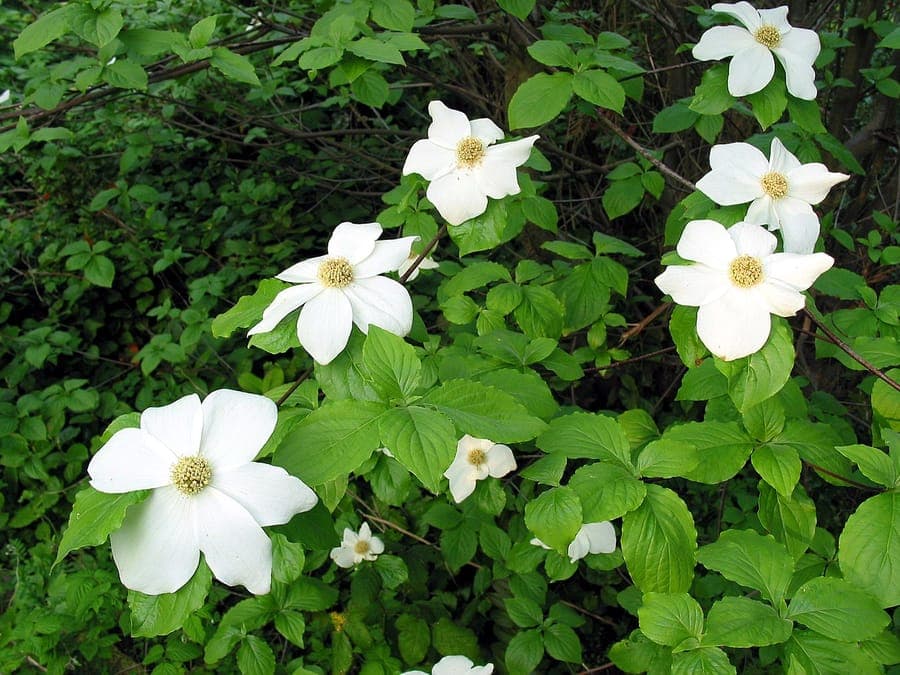
Paul Schultz from Kenmore, USA / CC BY 2.0, via Wikimedia Commons
Cornus nuttallii: complete guide
Cornus nuttallii
Want to see Cornus nuttallii: complete guide in your garden?
1 minute, no credit card
Overview
The Pacific dogwood (Cornus nuttallii) is a graceful, medium-sized tree native to western North America, celebrated for its spectacular white floral bracts and eye-catching red berries. Growing naturally from the mountains of Washington through Oregon and California, this deciduous tree brings elegant form and seasonal interest to any front garden design. Whether you seek a statement piece for spring color or a bird-magnet for autumn, the Pacific dogwood delivers year-round appeal.
Reaching heights of 10-15 meters in cultivation and living for decades, the Pacific dogwood has become a favorite among gardeners seeking dramatic seasonal transformation. Its late-spring bloom, vibrant summer canopy, and prolific fruiting cycle make it a triple-threat in terms of visual impact. With thoughtful placement, this tree becomes the focal point of a mature garden design.
Appearance and Bloom
The Pacific dogwood develops a broad, well-branched crown with a naturally pyramidal form when young. In April-May, the first signs of blooming appear: not true flowers, but showy white bracts (modified leaves) that frame the actual tiny yellow flowers hidden within. These spectacularly white bracts persist for three to four weeks, creating an almost uninterrupted sea of color from late spring through early summer.
During summer, the tree wears glossy, medium-green leaves that persist attractively throughout the growing season. By August-September, small drupe fruits mature to a brilliant red, creating a secondary display that attracts migratory birds in droves. As autumn approaches, foliage transforms to plum and reddish tones before dropping, extending the ornamental season further.
Ideal Location
Pacific dogwood thrives in dappled shade to partial sun, requiring a minimum of 4-6 hours of sunlight daily. In hotter climates (above 30 degrees Celsius), afternoon shade becomes essential to prevent leaf scorch and stress. The tree appreciates protection from harsh northwest winds, particularly in exposed coastal regions. Given its mountain valley origins, it prefers cool, well-aerated microclimates.
Space plantings at least 6-8 meters from walls and major structures to allow full crown development. It works beautifully as a specimen tree in the center of a front garden or at the back corner. The crown spread can reach 8 meters, so adequate spacing ensures the tree reaches its full architectural potential.
Soil
The Pacific dogwood shows moderate soil preferences, thriving in moist, well-draining soil with a pH range of 4.9-7.3. Heavy clays should be avoided when possible, though the tree functions adequately in moderate clay provided drainage remains good. Ideal conditions feature a friable loam enriched with organic matter.
Amend planting holes generously with 30% organic material such as compost or leaf mould, improving moisture retention in sandy soils and drainage in clay-based sites. Apply 5-8 centimeters of mulch in a circle around the base (extending 30-50 centimeters from the trunk) to stabilize soil moisture and keep roots cool throughout the growing season.
Free design
Want to see Cornus nuttallii: complete guide in your garden? Make a free design now.
Watering
Once established, the Pacific dogwood requires surprisingly little supplemental water compared to many ornamental trees. First-year trees need watering two to three times per week if rainfall is sparse, keeping soil consistently moist but never waterlogged. After two to three years of establishment, the tree becomes quite drought-tolerant, needing water only during extended dry periods.
For mature specimens, natural rainfall usually suffices except during severe drought. Avoid overhead watering that wets foliage, as this invites fungal issues. Water deeply at the base during early morning or late evening hours. In extremely dry summers, provide thorough watering if two weeks pass without rain.
Pruning
Pacific dogwood needs minimal pruning to thrive. Light formative pruning in the first year encourages a balanced branching structure, but aggressive cuts should be avoided. Once the tree establishes its natural form (3-4 years), only maintenance pruning becomes necessary.
Remove any dead, diseased, or damaged wood promptly year-round. Primary pruning occurs in late summer (August) after flowering, though minor adjustments fit throughout the year. Keep large wound openings minimal to prevent pathogen entry; limit major cuts to two or three per season.
Maintenance Calendar
February-March: Apply balanced spring fertilizer (phosphorus-rich for flower formation). April-May: Monitor blooming period, provide supplemental water during drought. June-July: Regular watering during extreme heat, refresh mulch. August-September: Observe fruit coloration, encourage bird visitation. October-November: Clean fallen leaves, prepare for dormancy. December-January: Dormant season maintenance pruning as needed.
Winter Hardiness
The Pacific dogwood is reliably hardy in USDA zone 6 (average annual minima -23 to -18 degrees Celsius), thriving throughout the Netherlands and Belgium without protection. In exceptional winters with temperatures below -25 degrees, twigs may sustain frost damage, but the tree typically recovers from the main trunk.
Young trees benefit from winter protection during their first seasons. Wrapping the trunk with hessian or burlap shields against extreme wind-chill effects. After 3-4 years, such protection generally becomes unnecessary.
Companion Plants
Pair this tree with shade-tolerant perennials that thrive in dappled light: fuchsias, hellebores, or hostas create elegant contrast beneath the canopy. Low-growing groundcovers like Pachysandra or Vinca Minor fill the void at ground level.
Adjacent shrubs such as Viburnum or Skimmia work nicely alongside the main tree. Avoid excessive competition directly under the canopy due to root and moisture interactions. Grouping 3-5 trees creates the impression of a natural woodland edge.
Closing Thoughts
The Pacific dogwood merits a place in any garden with adequate space and suitable conditions. Its triple seasonal appeal (flowers, foliage, fruits) combined with minimal care requirements makes it a sound long-term investment in garden beauty. Sourced through quality nurseries, this tree will serve your garden for countless years.
Choosing the Pacific dogwood means selecting a species capable of living for centuries. Transform your front garden with the timeless elegance of this American classic, perfect for gardenworld.app users seeking enduring natural beauty and sophisticated design.
Want to see Cornus nuttallii: complete guide in your garden? Make a free design now.
Upload a photo, pick a style, and get a photorealistic design with plant list in under a minute.
No credit card required


Similar plants
Toughleaf Dogwood: complete guide
Cornus asperifolia
Toughleaf dogwood is a suckering, thicket-forming shrub native to the southeastern US, ideal for wildlife hedges on damp, low-lying ground.
Silky dogwood (Cornus obliqua): complete guide
Cornus obliqua
Silky dogwood: cultivation, care tips, and garden uses. White flowers, colorful berries, and stunning fall foliage.
Roughleaf dogwood: complete guide
Cornus drummondii
Everything you need to know about Cornus drummondii: siting, soil, pruning, winter hardiness and companion plants for a naturalistic garden.