
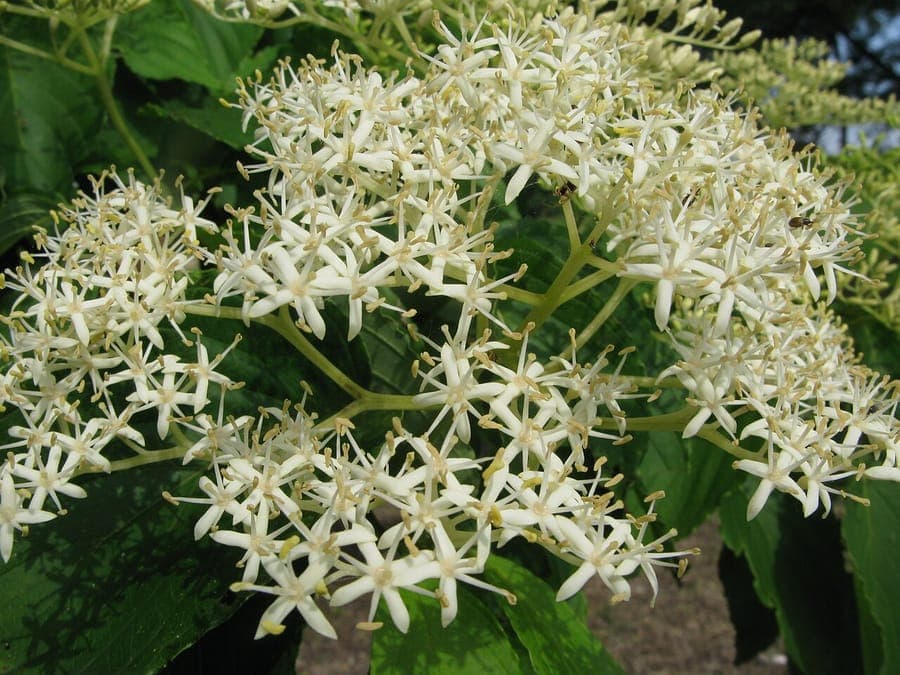
Qwert1234 / Public domain, via Wikimedia Commons
Largeleaf dogwood: complete guide
Cornus macrophylla
Want to see Largeleaf dogwood: complete guide in your garden?
1 minute, no credit card
Overview
The largeleaf dogwood, scientifically Cornus macrophylla, is a hardy tree from the Himalayan region and Asian mountain areas. This tree is renowned for its distinctly large green leaves and its valuable ecological role. The plant creates interesting visual effects throughout the year with seasonal transitions between fresh green, white flowers, and colored fruits.
Appearance and Bloom
The largeleaf dogwood grows as an upright, well-branched tree reaching 6-12 meters in favorable conditions. The characteristic feature is the very large leaves - much larger than most other dogwood species - displaying elegant oval shapes and fine venation. The leaves are dark green, creating a full, impressive canopy.
The flowers are small, cream-white to pale yellow, gathered in flat cymes at branch ends. They bloom in May-June, attracting many pollinators. The fruits are small, dark-blue berries enjoyed by birds. In autumn, the leaves display beautiful yellow to orange-red colors.
Ideal Location
Choose a location with full sun to partial shade. The tree thrives in both conditions, though full sun produces better autumn colors. Provide sufficient space for complete development. The tree is hardy and feels comfortable in locations with regular wind.
Soil
The largeleaf dogwood is adaptable to soil type. It performs best in moist, nutrient-rich, well-draining soil. It will grow in many soils without amendments. It prefers pH 6.0-7.0 but can tolerate slightly more acidic or alkaline conditions.
Free design
Want to see Largeleaf dogwood: complete guide in your garden? Make a free design now.
Watering
Water regularly in the first years after planting until the tree is well-established. Once established, the tree is reasonably drought-tolerant, though it grows better with regular water during dry periods. Water deeply and less frequently rather than shallow regular watering. Ensure the soil never becomes permanently waterlogged.
Pruning
The tree requires minimal pruning. Remove dead, diseased, or crossing branches. In the first years, you can subtly prune for shape. The tree naturally grows into an attractive form. Avoid heavy pruning.
Maintenance Calendar
Spring: Check for pruning needs. Begin regular watering.
Summer: Monitor for diseases. Ensure regular watering.
Autumn: Enjoy the beautiful colors. Less water needed.
Winter: Minimal activity. The tree is completely hardy.
Winter Hardiness
The largeleaf dogwood is very hardy and can tolerate temperatures as low as -30 degrees Celsius. It is one of the hardiest dogwood species and can overwinter outdoors without problems in temperate climates. Protection is rarely needed.
Companion Plants
Combine with other hardy trees and shrubs. Rhododendrons, fuchsias, and other shade-loving plants work well at the base. Ground-covering plants create attractive layers.
Closing Remarks
The largeleaf dogwood is a fantastic, easy choice for those seeking a hardy tree with character. With its striking foliage, delicate flowers, and seasonal interest, this tree adds dimension to any garden. In temperate climates, it grows without much fuss and rewards year after year with beauty.
Available at major garden centers. Consult gardenworld.app for designs with hardy tree selection. Gardenworld.app also helps with seasonal garden accents.
Want to see Largeleaf dogwood: complete guide in your garden? Make a free design now.
Upload a photo, pick a style, and get a photorealistic design with plant list in under a minute.
No credit card required


Similar plants
Toughleaf Dogwood: complete guide
Cornus asperifolia
Toughleaf dogwood is a suckering, thicket-forming shrub native to the southeastern US, ideal for wildlife hedges on damp, low-lying ground.
Silky dogwood (Cornus obliqua): complete guide
Cornus obliqua
Silky dogwood: cultivation, care tips, and garden uses. White flowers, colorful berries, and stunning fall foliage.
Roughleaf dogwood: complete guide
Cornus drummondii
Everything you need to know about Cornus drummondii: siting, soil, pruning, winter hardiness and companion plants for a naturalistic garden.