
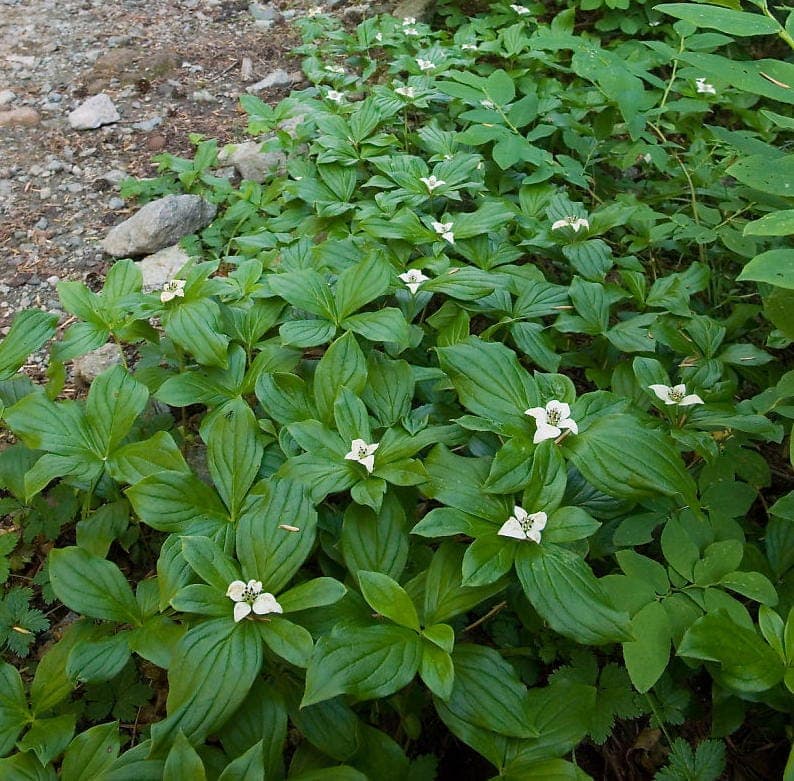
original: JohnHarvey; derivative: Peter coxhead / CC BY-SA 3.0, via Wikimedia Commons
Bunchberry: complete guide
Cornus canadensis
Want to see Bunchberry: complete guide in your garden?
1 minute, no credit card
Overview
Cornus canadensis, commonly known as bunchberry, is a petite but resilient perennial that brings quiet elegance to shaded garden corners. Reaching only 10 to 20 cm in height, it forms dense mats through underground rhizomes, thriving where few other plants dare to grow. Native to cool, moist forests across North America and parts of northern Asia, it's an excellent choice for naturalistic plantings, woodland edges, or understorey beneath conifers and hardwoods.
While not native to the UK or much of Western Europe, bunchberry adapts well to similar conditions if given the right start. It's a slow spreader, but over time it builds a lush, evergreen carpet that suppresses weeds and adds texture throughout the growing season. If you're planning a shady garden, use gardenworld.app to map out ideal planting zones and companion pairings for bunchberry.
Appearance & bloom cycle
The plant forms tight rosettes of dark green, oval leaves arranged in whorls of four to six-hence the French name 'Quatre-temps'. In late spring, from May to June, clusters of tiny greenish-yellow true flowers emerge, surrounded by four large, white bracts that look like petals. These bracts are actually modified leaves, not true petals, and they create a striking star-like effect.
By mid to late summer, the flowers develop into clusters of bright red berries that persist into October. Though technically edible for humans, the berries are bland and mealy. However, they're a valuable food source for birds like thrushes and juncos during early autumn. The foliage remains evergreen in mild winters, though it may take on a bronzed hue in colder zones.
Ideal location
Bunchberry thrives in dappled to full shade. Direct sun, especially in the afternoon, will scorch the leaves and dry out the shallow root system. The best spot is beneath deciduous trees like maples, beeches, or birches, where sunlight filters through the canopy. It also performs well under pines and spruces, as long as the soil is not too dry.
Avoid planting in open lawns or sunny borders. This is a woodland specialist, and it needs a cool, sheltered microclimate. If your garden has a shaded, moist corner under trees, it's likely the perfect home. Use gardenworld.app to run a shade assessment and see if your garden matches the ideal light profile for bunchberry.
Soil requirements
The soil must be consistently moist, well-drained, and rich in organic matter. A slightly acidic pH between 5.0 and 6.5 is essential. Heavy clay soils can be improved with leaf mould or pine compost; sandy soils need amending with well-rotted compost to retain moisture.
Avoid alkaline soils (pH above 7.0), as they cause nutrient lockout and poor growth. If your soil is too alkaline, consider creating a raised bed with ericaceous compost or planting in a container with acid mix.
Free design
Want to see Bunchberry: complete guide in your garden? Make a free design now.
Watering
Keep the soil evenly moist, especially during dry spells in spring and summer. The shallow roots dry out quickly, so regular watering is key in the first two growing seasons. Use rainwater when possible, as tap water can raise pH over time.
Mulch with 5–7 cm of pine needles, leaf litter, or bark chips to retain moisture and regulate soil temperature. Avoid plastic mulch-it prevents water penetration and harms the delicate root system.
Pruning
Pruning is rarely needed. Bunchberry maintains a neat, compact form on its own. You can remove any damaged or discoloured leaves in early spring to tidy up, but this is purely cosmetic. No formal pruning or deadheading is required.
Maintenance calendar
- January–February: Dormant period. No action needed. Check for winter burn.
- March: Begin monitoring for new growth. Top up mulch if needed.
- April: Leaves emerge. Watch for invasive weeds.
- May–June: Blooming period. Maintain consistent moisture.
- July–August: Berries begin to form. Continue watering in dry weather.
- September–October: Berries ripen. Attract birds. Do not fertilise.
- November–December: Foliage may bronze. Leave fallen leaves as natural mulch.
Winter hardiness
Bunchberry is extremely cold-hardy, surviving in USDA zones 2 to 7. It handles snow cover well and re-emerges reliably each spring. In zone 8, it can still thrive if the soil doesn't dry out in winter. The plant dies back slightly in harsh conditions but regenerates from rhizomes.
Companion plants
Pair bunchberry with other shade-loving, acid-tolerant plants such as foamflower (Tiarella), wild ginger (Asarum), ferns like Dryopteris or Polystichum, and dwarf hostas. It blends beautifully with spring ephemerals like bloodroot (Sanguinaria) and trout lily (Erythronium).
Avoid aggressive ground covers like periwinkle (Vinca) or pachysandra, which can outcompete it. Also steer clear of plants that prefer dry, alkaline conditions.
Closing
Cornus canadensis is a quiet achiever-unassuming at first glance, but invaluable in the right setting. It asks for shade, moisture, and acidic soil, but in return offers year-round interest, wildlife support, and a lush, natural look. Buy plants from reputable garden centres during spring or autumn planting seasons.
With patience and proper care, bunchberry will form a dense, living carpet beneath your trees. And remember, you can design your ideal woodland garden on gardenworld.app, where bunchberry can shine as a key component of your shade scheme.
Want to see Bunchberry: complete guide in your garden? Make a free design now.
Upload a photo, pick a style, and get a photorealistic design with plant list in under a minute.
No credit card required


Similar plants
Toughleaf Dogwood: complete guide
Cornus asperifolia
Toughleaf dogwood is a suckering, thicket-forming shrub native to the southeastern US, ideal for wildlife hedges on damp, low-lying ground.
Silky dogwood (Cornus obliqua): complete guide
Cornus obliqua
Silky dogwood: cultivation, care tips, and garden uses. White flowers, colorful berries, and stunning fall foliage.
Roughleaf dogwood: complete guide
Cornus drummondii
Everything you need to know about Cornus drummondii: siting, soil, pruning, winter hardiness and companion plants for a naturalistic garden.