
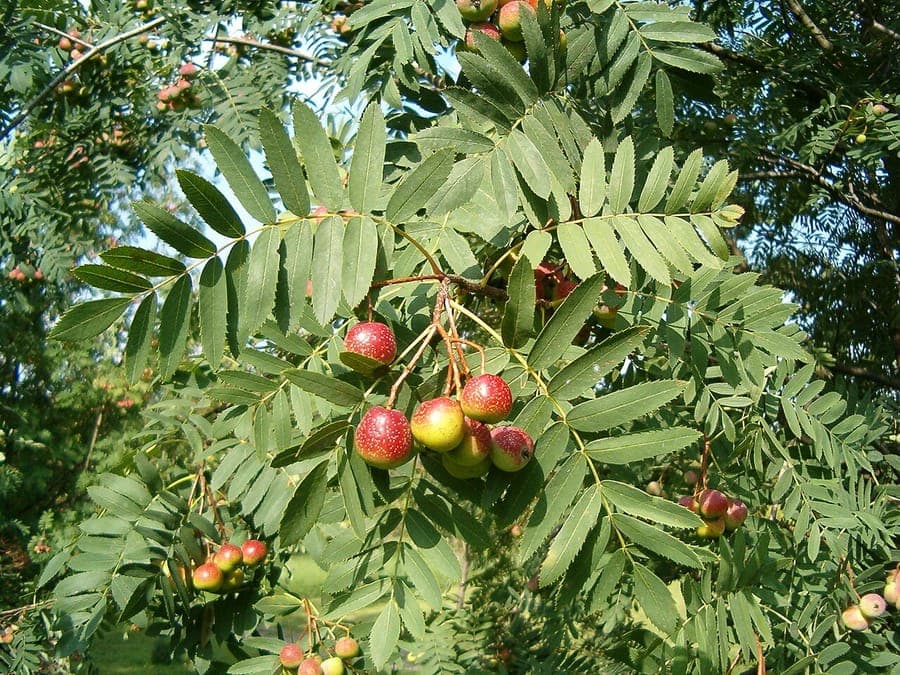
BotBln / CC BY-SA 3.0, via Wikimedia Commons
Servicetree: complete guide
Cormus domestica
Want to see Servicetree: complete guide in your garden?
1 minute, no credit card
Overview
The Servicetree (Cormus domestica) is a slow-growing, deciduous tree that brings a quiet dignity to gardens and landscapes. Native to southern and central Europe-from Austria to Greece and as far west as Belgium-this member of the Rosaceae family has been cultivated for centuries, though it's now somewhat overlooked. Standing 10 to 15 meters tall with a spread of 6 to 8 meters, it grows at a rate of 20–30 cm per year, making it manageable for medium to large gardens. Its presence is especially welcome in heritage or naturalistic planting schemes where character and longevity matter.
On gardenworld.app, you can create a garden design that integrates the Servicetree seamlessly, factoring in its mature size, seasonal changes, and shading patterns. Unlike fast-growing ornamentals, this tree rewards patience. It's not just a visual anchor-it also produces edible fruit and supports pollinators, giving it real ecological value.
Appearance & bloom cycle
The tree develops a sturdy, upright trunk with deeply fissured grey-brown bark, adding texture even in winter. The crown becomes broad and rounded, often with a slightly irregular shape that enhances its rustic appeal. In late spring, from April to May, clusters of white, five-petaled flowers appear in flat-topped corymbs up to 10 cm across. These blooms are rich in nectar, attracting bees, hoverflies, and early butterflies.
After pollination, small green fruits form, resembling miniature pears. They remain hard and astringent until late autumn, ripening between October and November. Exposure to frost or storage (a process called bletting) softens them, revealing a sweet, apple-like flavor ideal for jellies or baking. In fall, the leaves turn a brilliant copper-orange, creating a striking seasonal highlight.
Ideal location
Choose a site with full sun to light shade. Full sun maximizes fruit production and autumn color. The tree thrives in open, airy spots with good air circulation to prevent fungal issues. Plant at least 4 meters from buildings or underground utilities-its root system spreads widely as it matures. Avoid confined urban planters unless oversized; this is not a container plant.
If you're planning a mixed border or food forest, the Servicetree fits well as a mid-canopy layer. On gardenworld.app, you can visualize how it will interact with other plants over time, including shade cast and root competition.
Soil requirements
The Servicetree is adaptable to a range of soils-sandy, loamy, or clay-as long as drainage is adequate. It dislikes waterlogged conditions. The ideal pH is between 6.0 and 7.5. On heavy clay, amend the planting hole with grit or compost to improve structure. On very acidic soils, a light application of lime can help. Avoid saline or highly compacted urban soils.
Free design
Want to see Servicetree: complete guide in your garden? Make a free design now.
Watering
Young trees need consistent watering during their first two to three years. Supply 10–15 liters per week during dry spells, using drip irrigation or a soaker hose to deliver moisture deep into the root zone. Once established, the tree is remarkably drought-tolerant and rarely needs supplemental watering, even in prolonged dry summers.
Pruning
Pruning should be minimal. Focus on removing dead, damaged, or crossing branches during late winter or early spring while the tree is dormant. Avoid heavy pruning, as it can delay fruiting. If shaping is needed, do so gradually over several seasons. Always use clean, sharp tools to prevent disease transmission.
Maintenance calendar
- Jan: Inspect for storm damage; light pruning if needed
- Feb: Prepare for spring; add compost around the base
- Mar: Apply organic mulch to retain moisture
- Apr: Flowers emerge; monitor for pests
- May: Check for aphids or powdery mildew
- Jun: No routine care needed; water only if drought persists
- Jul: Observe fruit development; keep soil moist for young trees
- Aug: Continue monitoring; avoid fertilizing now
- Sep: Reduce watering; prepare for harvest
- Oct: Harvest fruit after first frosts; rake fallen leaves
- Nov: Use leaf litter as mulch; protect young trunks from rodents
- Dec: Final inspection; ensure no diseased material remains
Winter hardiness
The Servicetree is fully hardy in USDA zones 5 through 8, tolerating temperatures down to -25°C. It requires no winter protection once mature. Young trees may benefit from tree guards to prevent rabbit or vole damage. Avoid piling mulch against the trunk to prevent rot.
Companion plants
Pair the Servicetree with shade-tolerant perennials like Epimedium spp., ferns such as Dryopteris filix-mas, or fruiting shrubs like Cornus mas. Low-growing groundcovers like Pachysandra or Alchemilla mollis help suppress weeds and retain soil moisture. Avoid invasive species like Lonicera japonica that could compete aggressively.
Closing
The Servicetree is a quiet achiever-unspectacular at first glance but deeply rewarding over time. With its edible fruit, wildlife value, and seasonal beauty, it's a smart choice for thoughtful gardeners. It's not commonly stocked, but you may find it at specialist nurseries or larger garden centres. Check availability at trusted retailers like OBI or Hornbach in Germany, or Truffaut and Jardiland in France. In the UK and US, look for it at independent garden centres that focus on heritage or edible plants. On gardenworld.app, you can build a long-term planting plan that includes growth projections and companion suggestions, helping you make the most of this underappreciated tree.
Want to see Servicetree: complete guide in your garden? Make a free design now.
Upload a photo, pick a style, and get a photorealistic design with plant list in under a minute.
No credit card required


Similar plants
Siberian crab apple: complete guide
Malus x robusta
Complete guide to the Siberian crab apple (Malus x robusta): location, soil, pruning, winter hardiness and the best companion plants for your garden.
Chinese flowering crabapple (Malus x spectabilis): complete guide
Malus x spectabilis
Meet the Chinese flowering crabapple (Malus x spectabilis): a classic spring bloomer with carmine buds and pink blossom.
Potentilla crassinervia: complete guide
Potentilla crassinervia
Potentilla crassinervia, the Corsican cinquefoil, grows wild on Corsica and Sardinia's peaks. Discover how to grow this hardy alpine rock garden gem.