
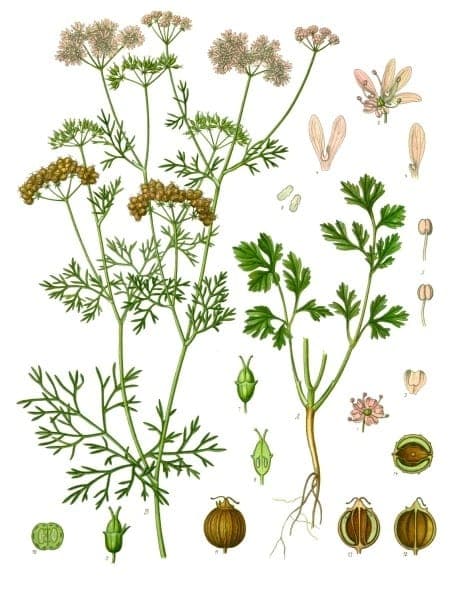
Franz Eugen Köhler, Köhler's Medizinal-Pflanzen / Public domain, via Wikimedia Commons
Chinese-parsley: complete guide
Coriandrum sativum
Want to see Chinese-parsley: complete guide in your garden?
1 minute, no credit card
Overview
Coriandrum sativum, commonly known as Chinese-parsley or cilantro, is a fast-growing annual herb prized for both its aromatic leaves and seeds. Native to regions across the Middle East and South Asia, it has adapted well to temperate climates, including those across the UK and northern Europe. Reaching heights of 30 to 60 cm, this herb thrives in full sun to light shade and completes its life cycle within a single growing season.
What sets coriander apart is its dual-purpose nature: the lacy, bright green foliage brings a citrusy zing to salsas, chutneys, and curries, while the round, tan seeds are ground into spice blends or used whole in pickling and baking. The plant also serves as a pollinator magnet, attracting hoverflies and beneficial wasps that help control aphids.
If you're planning a compact herb garden, consider using gardenworld.app to map out a layout that maximizes sun exposure and crop rotation for continuous harvests.
Appearance & bloom cycle
Young coriander plants produce soft, fern-like leaves that are deeply lobed and bright green. As the plant matures-typically from June through August-it sends up tall, slender stalks crowned with clusters of tiny white flowers arranged in umbels. These blooms signal the onset of bolting, a natural shift from leaf production to seed development.
Once flowering begins, leaf flavor deteriorates quickly, turning bitter. To maintain a steady supply of fresh leaves, sow seeds every 2 to 3 weeks from April to July. The plant will reach full height just before blooming, and if left unchecked, will produce seed heads by late summer. Harvest seeds when they turn light brown and dry on the stem.
Ideal location
Coriander prefers a light level of 7 out of 10, meaning it needs at least 5 to 6 hours of direct sunlight daily. A south- or east-facing windowsill, patio container, or sunny herb bed works best. Avoid intense afternoon sun in summer, as this accelerates bolting.
Space plants 15–20 cm apart to allow airflow and reduce disease risk. In garden beds, companion plant with tomatoes, spinach, or chives. For balcony gardeners, a deep pot (minimum 20 cm depth) prevents root restriction and supports stable growth. Use gardenworld.app to visualize your herb arrangement and ensure optimal spacing and sunlight mapping.
Soil requirements
Coriander grows best in neutral to slightly alkaline soil with a pH between 7.0 and 7.5. The soil must be well-draining-sandy loam or amended clay soils work well. Poor drainage leads to root rot, especially in containers. Avoid overly rich compost, as excessive nitrogen encourages leafy growth but promotes premature flowering.
Because coriander develops a long taproot, deep containers are essential. When sowing directly in the ground, plant seeds about 2 cm deep in loosened soil.
Free design
Want to see Chinese-parsley: complete guide in your garden? Make a free design now.
Watering
Keep soil consistently moist but not soggy, especially during germination and early growth. Water 1–2 times per week, depending on weather and container size. Check moisture by inserting a finger 2–3 cm into the soil-if dry at that depth, it's time to water.
Use rainwater when possible, as tap water high in lime can gradually raise pH. During hot spells, water container-grown plants daily in the morning to prevent stress.
Pruning
Harvest outer leaves first, cutting them at the base to encourage new growth from the center. Use clean scissors to avoid introducing disease. If bolting occurs early, cut off flower stalks to extend leaf production-but remember, this delays seed harvest.
Regular harvesting prevents the plant from going to seed too quickly. Pick leaves in the morning when essential oils are most concentrated for maximum flavor.
Maintenance calendar
- March: Start seeds indoors in pots on a sunny windowsill.
- April: Sow directly outdoors once soil temperature exceeds 10°C.
- May–July: Successive sowings every 2–3 weeks. Keep soil moist.
- June–August: Flowering begins. Harvest leaves before bolting.
- September: Final sowing for autumn use. Collect seeds when brown and dry.
- October–February: No activity. Store seeds in a cool, dark place for up to 3 years.
Winter hardiness
Coriander is not frost-hardy and will not survive winter outdoors in USDA zones below 9. It is sensitive to temperatures below -2°C. However, it can be grown indoors year-round on a sunny windowsill with temperatures above 8°C. Seeds remain viable for several years if stored properly.
Companion plants
Coriander enhances biodiversity in the garden by attracting beneficial insects. Grow it near tomatoes, lettuce, or cucumbers to deter pests naturally. Avoid planting near fennel or dill, as they may cross-inhibit growth through allelopathy.
Alliums like garlic and onions make good companions-they repel many pests and improve soil health. In mixed containers, pair coriander with thyme or marjoram, but keep mint in a separate pot to prevent takeover.
Closing
Growing coriander successfully comes down to timing, location, and consistent care. By staggering sowings and providing the right conditions, you can enjoy fresh leaves from late spring through autumn. Watch for signs of stress-wilting or early flowering-which often point to heat or drought.
Whether in garden beds or on urban balconies, coriander fits seamlessly into edible landscapes. For planting inspiration, check garden designs on gardenworld.app tailored to small-space herb gardening. Seeds and starter plants are widely available at garden centres from March onward.
Want to see Chinese-parsley: complete guide in your garden? Make a free design now.
Upload a photo, pick a style, and get a photorealistic design with plant list in under a minute.
No credit card required


Similar plants
Whorled carrot: complete guide
Daucus involucratus
Daucus involucratus is a Mediterranean umbellifer with white flower heads framed by lacy bracts. Growing this gravel garden gem.
Daucus muricatus: complete guide
Daucus muricatus
Daucus muricatus, the spiny wild carrot, grows wild on Mediterranean coasts. Discover sowing, June-July bloom, and wildflower meadow use.
Daucus pumilus: complete guide
Daucus pumilus
Daucus pumilus is a dwarf wild carrot relative with white lacy umbels, thriving on dunes and coastal rock in poor, fast-draining soil.