
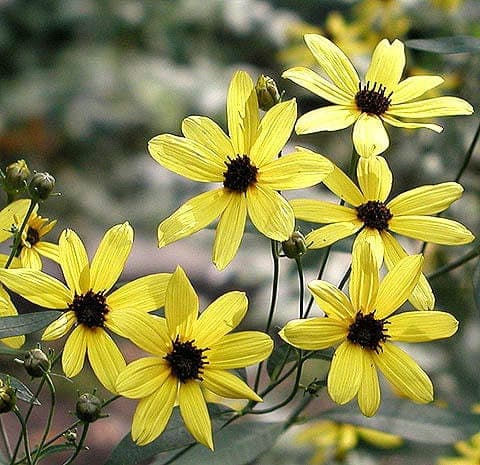
Hardyplants at English Wikipedia / Public domain, via Wikimedia Commons
Coreopsis tripteris: complete guide
Coreopsis tripteris
Want to see Coreopsis tripteris: complete guide in your garden?
1 minute, no credit card
Overview
Coreopsis tripteris, commonly called tall coreopsis or Atlantic coreopsis, is a striking North American perennial that reaches impressive heights of up to 6 feet (180 cm). This member of the Asteraceae family stands out for its delicate, thread-like foliage and prolific golden-yellow flowers. It is a favorite among gardeners seeking a low-maintenance bloomer that flowers late into the season.
Native to eastern and central North America, from Canada to Florida, tall coreopsis thrives in prairies, grasslands, and along roadside edges. This wild heritage makes it exceptionally resilient and well-adapted to dry conditions and poor soils.
Appearance and Bloom
Tall coreopsis is immediately recognizable by its elegant form. The plant produces tall, slender, upright stems clothed with very fine, almost thread-like leaves. The foliage is sparse and airy, giving the plant a gossamer appearance that allows views through to the plants behind it.
Flowering extends from August through October, with bright golden-yellow blooms approximately 1 inch (2-3 cm) in diameter. The flowers are composed of ray petals surrounding a yellow center, held on thin, wiry stems that move gracefully in the slightest breeze. A well-established plant can produce hundreds of flowers, creating a luminous display in the autumn garden.
Ideal Location
Tall coreopsis demands full sun for optimal flowering, requiring at least 6-8 hours of direct sunlight daily. The plant will not thrive in partial shade and may fail to flower adequately if light levels are insufficient.
Its tall stature makes it perfect as a back-of-the-border plant or for creating layered depth in planting schemes. It works exceptionally well in wildflower meadows, native plant gardens, and naturalistic settings. The airy growth habit means it does not create a dense wall of vegetation, allowing sightlines through to plants beyond.
Soil
Tall coreopsis is remarkably flexible regarding soil type, thriving in sandy, loamy, or even clay soils provided drainage is excellent. The plant absolutely cannot tolerate waterlogged conditions, as this will inevitably lead to root rot.
The plant requires no heavy feeding. Impoverished soils suit tall coreopsis perfectly, as it evolved in prairie soils that are typically nutrient-poor. Over-fertilizing may actually reduce flowering by promoting excessive vegetative growth.
Watering
Once established, tall coreopsis is exceptionally drought-tolerant. In its first season, water regularly to encourage root development. After establishment, the plant requires minimal supplemental water beyond natural rainfall.
During the growing season, allow the soil to dry between waterings. Never allow the plant to sit in waterlogged conditions. This drought-tolerance makes tall coreopsis an excellent choice for water-wise gardens and xeriscaping.
Free design
Want to see Coreopsis tripteris: complete guide in your garden? Make a free design now.
Pruning
Regular deadheading removes spent flowers and encourages continued blooming throughout the season. Pinching back the growing tips in early summer can result in a more compact, bushier plant with more flower stems.
After frost in late autumn, cut the plant back to approximately 6 inches (15 cm) above ground level. This prevents wind damage and reduces disease by removing old stems that might harbor overwintering pests.
Maintenance Calendar
February-March: Tidy up any remaining dead material as the last frosts pass. Apply fresh mulch if needed.
April-May: Plant new specimens in full sun. Divide large plants. Apply slow-release fertilizer if desired, though it is optional.
June-July: Water regularly during dry spells. Insert plant supports if plants will exceed 5 feet in height.
August-September: Peak flowering period. Deadhead regularly to extend bloom. Enjoy the golden display.
October-November: Flowering continues. Cut back hard in late November.
December-January: Dormant season. Minimal maintenance required.
Winter Hardiness
Tall coreopsis is hardy in USDA zones 3-10, tolerating temperatures as low as -40°F (-40°C). It is fully winter-hardy throughout North America and Europe.
The plant is not water-tolerant in winter. Heavy snowfall can bend or snap tall stems. Provide stakes or supports in areas with heavy snow loads. Otherwise, winter hardiness is rarely an issue.
Companion Plants
Tall coreopsis pairs beautifully with other late-season bloomers such as Salvias, Rudbeckia, and Echinacea. The delicate foliage texture contrasts wonderfully with the bold forms of sedums and ornamental grasses.
In wildflower plantings, tall coreopsis works excellently with prairie grasses and other native plants. The airy stem structure allows grasses to grow through, creating a naturalistic, layered appearance.
Closing Thoughts
Tall coreopsis is an outstanding choice for gardeners seeking a long-flowering, virtually care-free perennial. Once established, this plant demands minimal attention beyond deadheading and occasional watering during droughts. Purchase quality plants from garden centers that prioritize strong root systems. Explore tall coreopsis designs on gardenworld.app.
The elegant growth form and extended bloom season make tall coreopsis an excellent investment in long-term garden enjoyment. Whether planted in formal borders or wild meadows, this undemanding native will reward you with months of golden flowers.
Want to see Coreopsis tripteris: complete guide in your garden? Make a free design now.
Upload a photo, pick a style, and get a photorealistic design with plant list in under a minute.
No credit card required


Similar plants
Calendula stellata: complete guide
Calendula stellata
Complete guide to Calendula stellata, the star-flowered marigold from Sicily: location, soil, watering and companion planting tips.
Korean chrysanthemum: complete guide
Chrysanthemum x rubellum
Chrysanthemum x rubellum is a hardy autumn perennial with single pink to copper flowers from August to November. Care and combinations.
Helianthus divaricatus: complete guide
Helianthus divaricatus
Helianthus divaricatus is a North American woodland sunflower with yellow summer blooms, ideal for naturalistic borders and shady edges.