
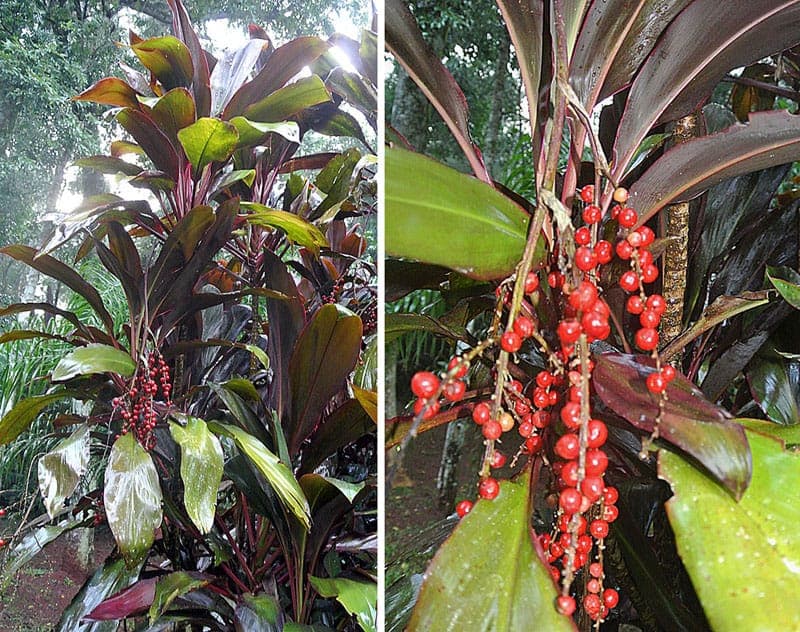
Dick Culbert from Gibsons, B.C., Canada / CC BY 2.0, via Wikimedia Commons
Cordyline fruticosa: complete guide
Cordyline fruticosa
Want to see Cordyline fruticosa: complete guide in your garden?
1 minute, no credit card
Overview
Cordyline fruticosa, commonly known as Broadleaf palm-lily or Ti-plant, is an exotic foliage plant from Papua to the Western Pacific. This dramatic plant offers elongated, beautifully colored leaves in shades of red, purple, pink, or green, depending on cultivar. In the front garden, it serves as a striking structural foliage and adds tropical elegance and exotic interest to contemporary and Mediterranean designs.
Cordyline fruticosa is renowned for its stunning foliage colors and relatively compact growth form (in mild climates). It thrives in full sun to partial shade and provides dramatic vertical structure without dominating the entire front yard.
Appearance and Bloom
Cordyline fruticosa grows as an upright plant with long, narrow leaves that can reach 20-60 cm in length. The leaves display characteristic purplish, red, or multicolored hues, depending on cultivar and light intensity. Young leaves can be brighter-colored with contrasting veins and margins.
Flowers are small, white or purple, appearing in loose panicles in warm seasons. Plants may form small berries after flowering, though these don't appear in all climates. The plant grows slowly and forms a unique, sculptural form.
Ideal Location
Cordyline fruticosa grows best in full sun to partial shade. For optimal foliage color, full sun is essential, though the plant can also thrive in partial shade. In very hot climates, afternoon shade may be beneficial.
This plant is ideal for container planting and can be used as an accent plant in the front yard. It works well at entrance doors, against south-facing walls, or as foliage focus in borders. In temperate climates, it can be overwintered indoors.
Soil
Cordyline fruticosa grows optimally in well-draining, fertile soils. Add compost or humus for better water-buffering capacity. The plant prefers slightly acidic to slightly alkaline soil (pH 6.0-6.5).
In containers, potting mix with perlite or sand can be used for drainage. Ensure good drainage both in-ground and in containers, as the plant doesn't tolerate moisture excess.
Free design
Want to see Cordyline fruticosa: complete guide in your garden? Make a free design now.
Watering
Cordyline fruticosa loves consistently moist soil during the growing season. Water when the top 2-3 cm of soil feels dry. In winter, water less, but don't let the plant dry completely.
In very hot, dry periods, daily watering may be needed. Ensure good drainage to prevent root rot. The plant prefers lukewarm water; many plants respond poorly to extremely cold water.
Pruning
Pruning helps Cordyline fruticosa maintain a compact form. Remove dead leaves at the base as they die. For more compact growth, growing tips can be pinched in spring, though this recovers slowly.
The plant responds well to light pruning and naturally forms a beautiful rounded or columnar shape without aggressive intervention.
Maintenance Calendar
Spring/Summer: Consistently moist soil, feeding. Autumn: Water less as temperatures drop. Winter: Minimal maintenance, frost protection in temperate zones.
Winter Hardiness
Cordyline fruticosa is hardy to zone 10-11. In temperate climates (zones 9-10), it can overwinter outdoors if protected from severe frost. In colder areas, this plant is likely annual or biennial unless overwintered indoors.
Companion Plants
Cordyline fruticosa combines well with other exotic foliage plants such as caladiums, impatiens, and hibiscus. For contrast, use it with light green foliage of coleus or silvery artemisia. Also works well in containers with trailing ivies.
It works well as an accent among green structural plants. Avoid very large growing partners that might overshadow it.
Closing Thoughts
Cordyline fruticosa offers garden designers a dramatic, colorful foliage plant with exotic elegance. It is perfect for warm climates where it can grow as a permanent element, or for temperate areas where it can be used seasonally or in containers. Upload your front garden photo to GardenWorld and receive a design featuring this tropical jewel. Available at specialized nurseries.
Want to see Cordyline fruticosa: complete guide in your garden? Make a free design now.
Upload a photo, pick a style, and get a photorealistic design with plant list in under a minute.
No credit card required


Similar plants
Narrow-leaved dracaena: complete guide
Dracaena angustifolia
Everything about Dracaena angustifolia - the narrow-leaved dracaena: location, care, overwintering and use as a houseplant or patio plant.
Chaparral yucca: complete guide to Hesperoyucca whipplei
Hesperoyucca whipplei
Hesperoyucca whipplei (Our Lord's candle) is a dramatic rosette-forming plant from California that produces a towering flower spike, ideal for dry and gravel gardens.
False lily-of-the-valley: complete guide
Maianthemum dilatatum
Everything about Maianthemum dilatatum, the false lily-of-the-valley. Care, shade location, propagation and garden combinations for this popular shade ground cover.