
Toni Gürke / Public domain, via Wikimedia Commons
East African cordia: complete guide
Cordia africana
Want to see East African cordia: complete guide in your garden?
1 minute, no credit card
Overview
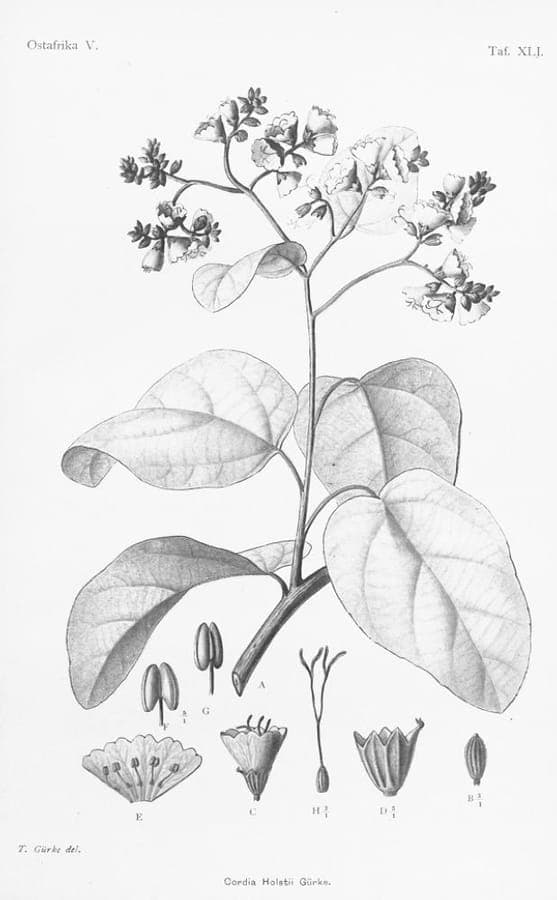
Cordia africana, better known as East African cordia or Sudan teak, is a valuable tree from tropical Africa and the Arabian Peninsula. This tree is renowned for its strong, durable hardwood and beautiful, large evergreen canopy. In the garden, it is an impressive, shade-providing tree that adds character.
Appearance and Bloom
Cordia africana grows into a medium to large tree, typically 6-10 meters tall in garden settings. The tree has a strong, full crown with large, rough-textured, dark green leaves. The leaves reach up to 20 centimeters long and create a dense, attractive canopy.
The flowers are small, distinctive, and creamy-yellow, grouped in inflorescences at shoot tips. They bloom in spring and early summer, attracting many insects. Later, small, fleshy green fruits develop.
Ideal Location
Choose an open spot with full sun to light shade. The tree thrives best at locations receiving at least 4-6 hours of daily sunlight. Provide sufficient space as this tree grows to considerable size. Protect from very strong winds, though it is reasonably wind-resistant.
Soil
Cordia africana is not very particular about soil. It prefers nutrient-rich, well-draining soil but can grow on less fertile ground. Ensure the soil drains well. A pH between 6.0 and 7.5 is ideal. Add compost regularly to poor soils.
Watering
The tree needs regular water, especially in the first years after planting and during dry periods. Once established, the tree is reasonably drought-tolerant. Water more deeply but less frequently than shallow, regular watering. Ensure the soil is not permanently waterlogged.
Free design
Want to see East African cordia: complete guide in your garden? Make a free design now.
Pruning
Pruning is mainly needed for shaping in youth. Form the young tree into a single stem with a clear crown. Later, remove dead or diseased branches. The tree naturally forms itself well. Avoid heavy pruning, which can damage tree structure.
Maintenance Calendar
Spring: Moderate pruning for shape. Support growth with feeding.
Summer: Water regularly. Monitor for diseases and pests.
Autumn: Feeding can reduce. Prepare for possible dormancy.
Winter: Minimal activity. In temperate areas: possible protection.
Winter Hardiness
Cordia africana is frost-sensitive and cannot tolerate temperatures below 5-10 degrees Celsius. In temperate areas, the tree must be in a protected location or overwintered. As an overwintering tree, it is less suitable - better to keep it outside in warm climates.
Companion Plants
Use Cordia africana as a standalone tree due to its size. Underplanting works well with low-growing tropical plants like anthurium, fuchsia, or shade-tolerant ferns.
Closing Remarks
Cordia africana is a true investment in your garden. The tree grows slowly but steadily into a magnificent, imposing structure. With beautiful green leaves and softly scented flowers, it adds years of beauty. In warm climates, this is a must-have tree for those wanting to create a subtropical paradise.
Available at major garden centers. Consult gardenworld.app for advice on large trees in your design. Gardenworld.app also offers consultation on large garden elements.
Want to see East African cordia: complete guide in your garden? Make a free design now.
Upload a photo, pick a style, and get a photorealistic design with plant list in under a minute.
No credit card required


Similar plants
Western waterleaf: complete guide
Hydrophyllum occidentale
Full growing guide for western waterleaf (Hydrophyllum occidentale): shade tolerance, soil needs, watering, winter hardiness and naturalistic garden use.
Limestone phacelia (Phacelia affinis): complete guide
Phacelia affinis
Full guide to Phacelia affinis, the limestone phacelia: sowing tips, purple-blue bee flowers, drought tolerance and uses in dry or wildlife gardens.
Pyrenean viper's bugloss: complete guide
Echium asperrimum
Echium asperrimum is a striking biennial from the western Mediterranean with rough bristly stems and vivid blue flowers. A magnet for bees and a bold border plant.