
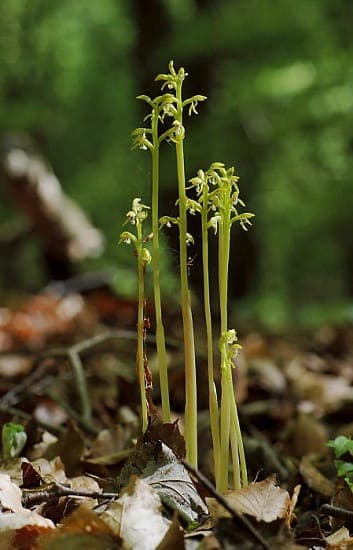
Wikimedia Commons / CC BY-SA 3.0, via Wikimedia Commons
Early coralroot: complete guide
Corallorhiza trifida
Want to see Early coralroot: complete guide in your garden?
1 minute, no credit card
Overview
Early coralroot (Corallorhiza trifida) isn't your average garden plant - it's a rare, mycoheterotrophic orchid that survives without chlorophyll by tapping into fungal networks in the soil. Native to boreal and temperate forests across North America and northern Europe, it's most often found in damp, shaded woodlands under spruce, birch, or alder trees. In the wild, it pops up sporadically, making it a prized find for botanists and wild garden enthusiasts alike. If you're aiming to create a naturalistic woodland garden, this species adds a quiet, mysterious charm.
But here's the catch: Early coralroot can't be legally collected from the wild. It's protected in many regions, and removing it disrupts fragile ecosystems. Your only ethical option is sourcing from licensed nurseries that propagate it sustainably. Look for it at reputable garden centres in the UK and North America, especially those specialising in native orchids. On gardenworld.app, you can design a custom woodland planting plan that integrates this elusive species with compatible understory plants.
Appearance & bloom cycle
The plant stands 10 to 30 cm tall with a pale, yellowish stem that lacks green foliage. Instead of leaves, it has scale-like bracts hugging the stem. The flowers are small - about 5 to 8 mm across - creamy white with subtle yellow or greenish spots, arranged densely along the upper half of the stem. Blooming occurs from May to July, depending on elevation and local climate. The flowers open gradually, and the entire bloom period lasts roughly three weeks.
What makes this orchid truly unusual is its coral-like underground rhizome, which gives the plant its name. This branching structure connects with mycorrhizal fungi, which in turn are linked to tree roots. The plant essentially steals nutrients through this tripartite relationship. After flowering, seed capsules form and release thousands of dust-like seeds. These require specific fungi to germinate - a process that can take years.
Ideal location
Choose a deeply shaded or semi-shaded spot with minimal direct sunlight - a rating of 2 on the light scale (1–10) means full shade is essential. An ideal site is under deciduous or coniferous trees, especially birch, alder, or spruce. The microclimate should be cool and humid, with consistent moisture and minimal temperature swings. Avoid south-facing slopes or open lawns.
Air humidity should stay above 70%. A north-facing woodland edge or a low-lying area that collects mist works well. Make sure the site is undisturbed - no digging, tilling, or heavy foot traffic. On gardenworld.app, you can simulate moisture levels and shade patterns to find the perfect spot for Early coralroot in your garden layout.
Free design
Want to see Early coralroot: complete guide in your garden? Make a free design now.
Soil requirements
Soil must be acidic, with a pH between 4.5 and 5.0. Use a mix of forest humus, pine bark fines, and leaf mould. Avoid composts or manures high in nitrogen or lime. The substrate should be well-aerated yet moisture-retentive. A thick layer of fallen leaves, especially from birch or beech, helps maintain humidity and provides organic breakdown for fungal growth.
Do not use sterile potting soil - it lacks the essential fungi this orchid depends on. The plant cannot survive without its mycorrhizal partners, so introducing it to a chemically treated or overly clean bed will fail. Plant directly into natural woodland soil if possible.
Watering
Keep the soil consistently moist from April through August. Use rainwater or filtered water to avoid raising pH with lime-heavy tap water. Water when the top layer feels slightly dry, but never let the soil dry out completely. During dry spells, mist the base of the plant in the early morning or late evening.
Avoid overwatering - standing water can suffocate fungal hyphae and lead to rot. A natural leaf litter layer helps regulate moisture and prevents evaporation. Never use irrigation systems that flood the area.
Pruning
No pruning is needed. Allow the flowering stem to remain after bloom to let seeds mature. In late autumn or winter, you can gently remove the dry stalk, but it's often best to leave it in place to decompose naturally and feed the soil ecosystem.
This plant doesn't respond to human intervention - it thrives on neglect. If you want to propagate it, seed sowing is the only method, but be prepared for a wait of several years before any visible growth appears.
Maintenance calendar
- January–March: Check mulch layer. Replenish with fresh leaf litter if needed.
- April: Monitor for early shoot emergence. Keep soil moist.
- May–July: Main flowering period. Maintain high humidity and avoid soil disturbance.
- August–September: Seed development. No fertilisation. Reduce watering slightly.
- October–December: Let plant material decompose. Add protective leaf cover for winter.
Winter hardiness
Early coralroot is hardy in USDA zones 3 to 7. It dies back to its rhizome in winter and re-emerges in spring. A natural blanket of leaves or pine needles offers sufficient insulation. In extreme cold (below -25°C), an extra layer of organic mulch can help, but avoid piling it directly against the crown.
Snow cover acts as a natural insulator - don't remove it from the area. Avoid cultivating the soil in winter, as this can damage dormant rhizomes.
Companion plants
Pair with shade-loving, acid-tolerant species such as ferns (Dryopteris spp.), wild ginger (Asarum canadense), twinflower (Linnaea borealis), or bunchberry (Cornus canadensis). Avoid invasive groundcovers or grasses that compete for space. The presence of host trees like birch or spruce is critical, as they support the fungal networks the orchid depends on.
Closing
Growing Early coralroot isn't about control - it's about creating the right conditions and stepping back. It's a plant for patient gardeners who value ecological balance over instant results. Purchase only from ethical suppliers at garden centres that support conservation. Remember, success with Corallorhiza trifida isn't measured in blooms per season, but in the quiet return of a rare woodland ghost to your garden.
Want to see Early coralroot: complete guide in your garden? Make a free design now.
Upload a photo, pick a style, and get a photorealistic design with plant list in under a minute.
No credit card required


Similar plants
Ram's-head lady's slipper: complete guide
Cypripedium arietinum
Everything you need to know about growing Cypripedium arietinum, a rare woodland orchid for cool, moist garden settings. Soil, care and planting tips.
Sparrow's-egg lady's slipper: complete guide
Cypripedium passerinum
Everything about growing Cypripedium passerinum, a cold-hardy subarctic orchid suited to cool, moist, shaded garden spots. Soil, care and companion plants.
Algerian Butterfly-orchid: complete guide
Platanthera algeriensis
Everything about Platanthera algeriensis, the rare Mediterranean orchid with greenish flowers native to Algeria, Morocco, Corsica and Spain.