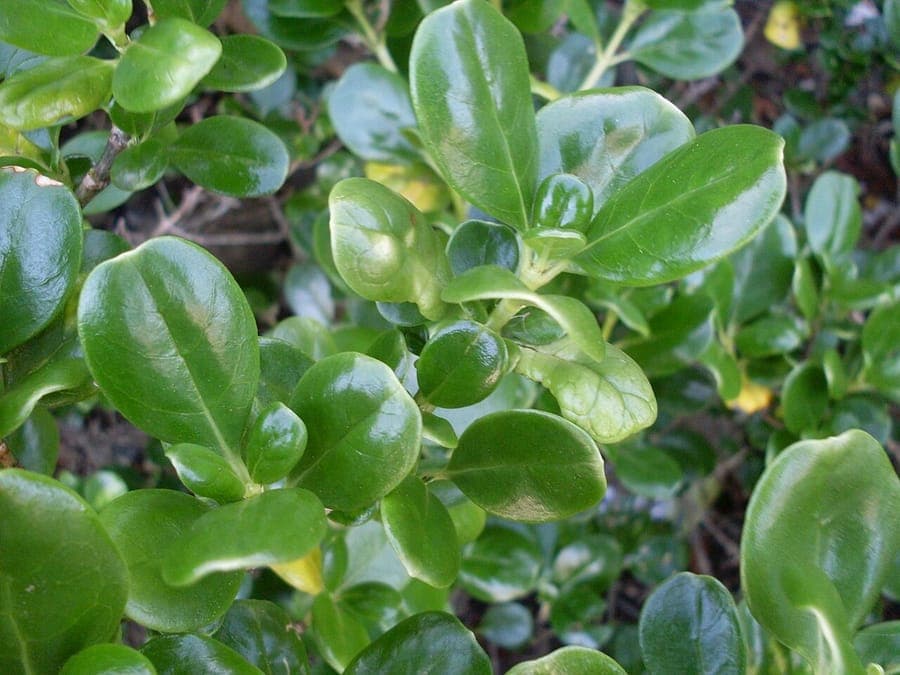
John Tann from Sydney, Australia / CC BY 2.0, via Wikimedia Commons
Mirror bush (Coprosma repens): care guide
Coprosma repens
Want to see Mirror bush (Coprosma repens): care guide in your garden?
Full design in HD: €7.99
Look after your Mirror bush with the GardenWorld app
Identify plants with your camera and get a care calendar with reminders for this plant.


Overview
Coprosma repens is an evergreen shrub from New Zealand, grown for leaves so glossy they look freshly varnished. That shine gives the plant its familiar English names, mirror bush and looking-glass plant, while in New Zealand it is widely known by its Māori name, taupata. It belongs to the madder family (Rubiaceae), the same family as coffee and sweet woodruff.
In the wild, taupata grows on coastal cliffs, rocks and dunes, right in the path of salt spray and strong wind. On exposed headlands it stays low and almost creeping, yet in shelter it can become a sizeable shrub or small tree several metres tall. In gardens and containers it usually stays between 1 and 2 m, not least because it responds so well to clipping. In Britain it is most often seen in mild coastal gardens or grown in a pot on a sunny patio.
Most plants sold today are coloured or variegated cultivars. 'Marble Queen' has green leaves heavily splashed with cream, 'Picturata' carries a yellow blotch in the centre of each leaf, and selections such as 'Pacific Night', 'Pacific Sunset' and 'Evening Glow' range from chocolate brown to coppery orange and deep red, colouring most strongly in cool weather. If you are wondering how such a bold foliage plant would fit into your own plot, gardenworld.app can create a garden design that takes your aspect, soil and winters into account.
One point deserves an honest mention. Coprosma repens has escaped from gardens in several parts of the world. It is classed as an environmental weed in coastal Australia and is naturalised in Hawaii, California and South Africa. In Europe it has been recorded as a garden escape on Madeira and locally in Britain. Birds eat the orange berries and carry the seed into dunes and coastal scrub. If you garden near the sea, choose a male plant or a cultivar that does not fruit, and never plant it in or beside a nature reserve.
Appearance and bloom cycle
The leaves are held in opposite pairs and are oval to broadly oval, roughly 3 to 8 cm long, thick and leathery. The upper surface is deep green and mirror-smooth, and the edges often curl slightly downwards. Small stipules sit at the base of each leaf stalk, a typical feature of the genus.
The flowers are inconspicuous. Coprosma repens is dioecious, meaning male and female flowers are borne on separate plants. Male plants produce dense clusters of greenish flowers with long, dangling stamens in spring and early summer, as the plant is wind-pollinated. Female plants carry smaller groups of flowers. Only a female plant with a male nearby will set the egg-shaped, orange-red berries, about 1 cm long, in late summer and autumn. Many cultivars on sale are male clones, so they never fruit.
Ideal location
Give mirror bush a spot in full sun or light partial shade. In full sun it stays compact and the variegated and red cultivars show their best colour. In deep shade it becomes leggy and loses some of its gloss. It shrugs off wind and salt, which makes it a strong choice for a low hedge or windbreak in a seaside garden, provided you keep the invasion risk in mind.
Away from the mildest coasts it is not reliably hardy, so in most of Britain it does best in a container. Stand the pot on a sunny terrace, against a warm wall or on a balcony for the summer. In a sheltered town garden or a mild coastal garden in the south and west, you can try it in open ground, ideally against a south- or west-facing wall.
Soil requirements
Taupata grows on sand, shingle and rock in nature, and its needs reflect that. The soil must drain freely. Light, sandy soil is ideal; heavier soil is tolerated as long as water does not sit around the roots in winter. pH is not critical, and anything from slightly acidic to slightly alkaline will do.
In a container, use a good loam-based compost and mix in a fifth to a quarter of coarse grit or sharp sand. Put a layer of crocks or clay pebbles at the bottom and make sure the drainage hole is generous. Feed sparingly: a slow-release or organic fertiliser in spring is plenty. Too much nitrogen gives soft, lanky shoots and duller leaf colour.
Free preview
Want to see Mirror bush (Coprosma repens): care guide in your garden? Make a free preview of your design.
Watering
An established plant in open ground is fairly drought tolerant, since its thick, waxy leaves limit water loss. In the first year after planting, water regularly during dry spells so the roots can settle in properly.
Containers are a different story. A pot dries out quickly in summer, so check every two or three days in warm weather. Water once the top few centimetres feel dry, then water thoroughly until it runs from the drainage hole. Never leave the pot standing in a saucer full of water. In winter, when the plant is indoors somewhere cool, give just enough to stop the rootball drying out completely. Wet roots in a cold room are the quickest route to root rot.
Pruning
Coprosma repens takes pruning well and readily resprouts, even from older wood. For a compact dome or a neat hedge, cut back the shoots to shape in April or May. A second light trim in summer keeps the plant dense.
Variegated cultivars sometimes throw an all-green shoot. Remove it at its base straight away, because green shoots are more vigorous and can take over the variegated parts. If you want to protect the surrounding countryside, pick off the berries of a female plant before they ripen, especially in a coastal garden.
Maintenance calendar
March and April: Once nights stay frost-free, harden off container plants in a sheltered spot outdoors. Cut out frosted or dead twigs.
May: Move the pot to its summer position. Give a spring feed and carry out the main shaping. Repot a plant that has filled its container with roots.
June to August: Water as needed, especially in pots. A light trim keeps the plant compact. Remove plain green shoots on variegated cultivars.
September and October: Stop feeding. Remove berries if you want to prevent spread. Semi-ripe cuttings root well now.
November to February: Keep container plants cool and bright indoors, at roughly 5 to 10 °C. Protect plants in open ground with fleece during hard frost.
To keep jobs like these on your radar, the plant calendar on gardenworld.app guides you through each month.
Winter hardiness
Coprosma repens is only borderline hardy. Most cultivars cope with a brief, light frost of a few degrees below zero; from around -5 °C damage becomes likely, and in a wet winter trouble can start sooner. The RHS rates several cultivars H3, which means suitable for coastal and relatively mild parts of the UK. For most gardens inland, that means growing it in a pot and bringing it under cover for winter.
A cool, bright place such as an unheated conservatory, a greenhouse or a cool porch works best. A warm living room is less suitable, as the plant soon drops leaves there. If you leave it outdoors, choose the warmest, driest spot, mulch the base and cover the plant with a double layer of fleece in frosty spells.
Little is known about toxicity. Coprosma repens does not appear on the usual lists of plants poisonous to people or pets, but reliable toxicological data are lacking, so do not let children or animals eat the berries or leaves.
Companion plants
The glossy leaves of Coprosma repens look best beside plants with a contrasting texture. Think of the fine, wavy foliage of Pittosporum tenuifolium, the upright blades of Phormium tenax or the grey tones of Teucrium fruticans. Together they create a bold, evergreen planting with a New Zealand or Mediterranean feel.
In a group of containers on the patio, it pairs well with Agapanthus praecox and its blue flower heads, Pittosporum tobira with its scented white flowers, and a few grasses such as Festuca glauca. A dark red coprosma placed next to lime-green or silver plants adds real depth. In a seaside garden it forms a wind-proof evergreen backdrop with Olearia macrodonta and escallonias.
Final thoughts
Coprosma repens is a plant for anyone who loves gloss and colour in foliage. In a pot on a sunny terrace it looks good all year, and the coloured cultivars bring a warm glow to autumn and winter that few other shrubs can match. It asks little: free-draining soil, moderate watering and a frost-free spot in winter.
At the same time, it is not a plant to let loose in the wild. It has naturalised along coasts around the world, including Madeira and parts of Britain. In a coastal garden, choose a male plant, remove any berries and keep prunings out of the dunes. With those precautions, taupata is a tough and handsome shrub that gives a garden or patio a gleaming accent.
Frequently asked questions about Mirror bush
Is Mirror bush winter hardy?
Coprosma repens is only borderline hardy. Most cultivars cope with a brief, light frost of a few degrees below zero; from around -5 °C damage becomes likely, and in a wet winter trouble can start sooner.
When and how do you prune Mirror bush?
Coprosma repens takes pruning well and readily resprouts, even from older wood. For a compact dome or a neat hedge, cut back the shoots to shape in April or May.
How much water does Mirror bush need?
An established plant in open ground is fairly drought tolerant, since its thick, waxy leaves limit water loss. In the first year after planting, water regularly during dry spells so the roots can settle in properly.
Where does Mirror bush grow best?
Give mirror bush a spot in full sun or light partial shade. In full sun it stays compact and the variegated and red cultivars show their best colour.
What soil does Mirror bush need?
Taupata grows on sand, shingle and rock in nature, and its needs reflect that. The soil must drain freely.

See it in your garden
See Mirror bush in your garden
One photo of your garden and a few questions. You see the result in about a minute.
Try it with a photoIdentify this plant in your own garden. Identify a plant
Similar plants
Pittosporum tenuifolium: complete guide to Tawhiwhi
Pittosporum tenuifolium
Tawhiwhi is an elegant New Zealand tree with thin leaves and fine texture. Learn growth, shaping and maintenance requirements.
New Zealand flax: complete guide
Phormium tenax
Discover Phormium tenax, the stunning architectural plant from New Zealand. Learn about its dramatic foliage, growing requirements, and design applications.
Agapanthus praecox: complete guide
Agapanthus praecox
Agapanthus praecox or African lily is an elegant ornamental plant with striking purple-blue flower heads. Master cultivation, care and design tips here.
