
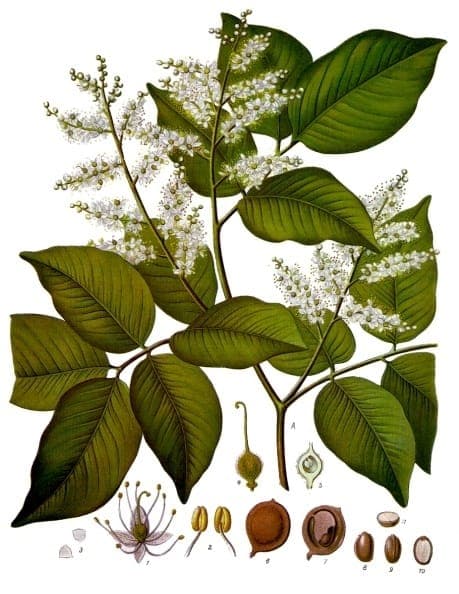
Franz Eugen Köhler, Köhler's Medizinal-Pflanzen / Public domain, via Wikimedia Commons
Copaiba balsam tree: complete guide
Copaifera officinalis
Want to see Copaiba balsam tree: complete guide in your garden?
1 minute, no credit card
Overview
Copaifera officinalis, commonly known as copaiba or copaiba balsam, is a tropical tree in the legume family Fabaceae, and one of approximately 40 species in the genus Copaifera. Its native range covers Venezuela, northeastern Brazil and Bolivia, with introduced populations in Cuba, the Dominican Republic, Trinidad and Tobago, India and Sierra Leone. The tree is famed throughout the Amazon basin for the oily resin - copaiba balsam or copaiba oil - that accumulates in cavities within its heartwood and can be tapped by boring into the trunk. This balsam has been used in traditional medicine by indigenous Amazonian peoples for centuries and is today an ingredient in cosmetics, perfumery, and phytotherapy products worldwide. Outside the tropics, Copaifera officinalis is grown only in botanical gardens and by specialist tropical plant collectors, always in a heated greenhouse or as a large container specimen. Gardenworld.app can inspire you with ideas on how tropical trees can serve as striking focal points in a garden or conservatory design.
Appearance and bloom cycle
In its native habitat Copaifera officinalis grows into a medium to large tree reaching 15 to 25 metres in height. Young trunks are relatively smooth but become furrowed and rougher with age. The crown is broad and well-furnished with pinnate compound leaves, each consisting of several pairs of oval, glossy, leathery dark green leaflets. If you hold a leaflet up to the light, you can see tiny translucent oil glands dotting the surface - a characteristic feature of the genus. The flowers are modest compared to the impressive crown: small, creamy white blooms arranged in loose panicles. Flowering occurs near the end of the dry season or at the onset of the rainy season in the tropics - roughly November to February in the southern hemisphere growing regions. After pollination, small pods develop, each containing a seed enclosed in a bright red or orange fleshy aril that attracts birds as seed dispersers.
Ideal location
In the wild, Copaifera officinalis grows in tropical rainforest and savanna woodland, typically on freely drained sandy or loamy soils. The tree demands ample light but tolerates some shade in its juvenile phase, allowing it to establish beneath the forest canopy before emerging into full sun. As a container or greenhouse plant it needs a bright, warm position: a well-lit heated greenhouse, a large conservatory, or a sheltered sunny terrace during the warmest summer months. The species belongs to USDA zones 11 to 12 and has absolutely no frost tolerance. Temperatures below 10 degrees Celsius cause damage; frost is lethal. In the Netherlands and Belgium the tree can only be grown successfully under glass or in a heated indoor space. A minimum winter temperature of 15 degrees Celsius is recommended; 18 to 22 degrees Celsius is ideal.
Soil
In its native range the Copaiba balsam tree grows across a variety of soil types, from sandy savannas to the rich, moist soils of gallery forests. For container culture, use a rich, freely draining growing medium: a blend of good quality tropical compost mixed with one quarter perlite or bark chippings provides excellent drainage without drying out too rapidly. The preferred pH is slightly acid to neutral, between 5.5 and 7.0. Repot every two to three years when roots fill the container, replacing all the growing medium and moving up to the next pot size. Ensure containers always have sufficient drainage holes and place a layer of broken crocks or expanded clay pellets in the base to prevent waterlogging.
Watering
The Copaiba balsam tree requires a watering regime that mirrors tropical seasonal patterns. During the active growing season - in our climate from May to September - water regularly as soon as the top layer of compost begins to dry. The tree enjoys moist roots but cannot tolerate standing water. Use rainwater or filtered water wherever possible. In winter, reduce watering but never allow the root ball to dry out completely: unlike some tropical species, Copaifera officinalis does not go through a pronounced dry rest period in the wild. During hot, dry weather, mist the foliage daily with a hand sprayer to raise humidity around the leaves. The tree is accustomed to the high humidity of tropical rainforest environments and benefits greatly from elevated atmospheric moisture.
Free design
Want to see Copaiba balsam tree: complete guide in your garden? Make a free design now.
Pruning
In botanical cultivation the Copaiba balsam tree is rarely pruned unless space management requires it. If the tree outgrows its greenhouse position, the longest branches can be shortened after the growing season using clean, sharp tools. Treat larger pruning wounds with a wound sealant to prevent disease entry. Remove dead or damaged wood as soon as it is noticed, at any time of year. Formative training in the young plant's first years can encourage a well-shaped, upright trunk. Avoid pruning during the dormant winter months when the tree's regenerative capacity is at its lowest.
Maintenance calendar
January to February: minimal activity; keep warm and frost-free (15 degrees Celsius minimum), reduce watering. March to April: growth resumes; increase watering gradually and begin monthly liquid feeding. May: move to a sheltered outdoor position if temperatures allow; increase misting. June to August: peak growing season; liquid feed every two weeks with a tropical plant fertiliser; mist daily in dry weather; inspect weekly for scale insects and spider mites. September: begin reducing feeding and watering; bring indoors before night temperatures fall below 12 degrees Celsius. October: settle the tree back in its winter quarters; carry out any necessary pruning. November to December: rest phase; water minimally but never allow to dry completely. For ideas on how to make tropical container trees the centrepiece of an exotic garden or conservatory, explore gardenworld.app.
Winter hardiness
The Copaiba balsam tree has no frost tolerance whatsoever. It belongs to USDA zones 11 and 12, corresponding to minimum temperatures above 10 degrees Celsius. Even brief exposure to temperatures below 5 degrees Celsius causes leaf damage; frost kills the plant outright. The tree's native climate is essentially frost-free year-round, with seasonal variation expressed mainly through rainfall rather than temperature. In Belgium and the Netherlands it must be kept in a heated greenhouse or conservatory throughout the winter months without exception. Adequate light during winter is also important: supplement with grow lights if the available natural light falls below 6 hours per day. High humidity (50 to 70 percent) in the overwintering space reduces stress on the foliage and discourages spider mite infestations.
Companion plants
In a shared tropical greenhouse or conservatory, Copaifera officinalis combines well with other large-growing tropical species that share its warmth and humidity requirements. Ficus benghalensis (banyan fig) provides dramatic foliage contrast. Plumeria species offer fragrant flowers through the warmer months. Jatropha integerrima contributes year-round red blooms to the composition. On the summer terrace, the Copaiba balsam tree makes an impressive solitary statement in a large container, surrounded by lush tropical groundcovers such as Tradescantia or Fittonia. In a botanical-style collection, it pairs naturally with palms, Heliconia and Strelitzia as representatives of the greater tropical plant palette. Ensure adequate ventilation in shared enclosed growing spaces to reduce the risk of fungal disease.
The copaiba balsam and its uses
The most remarkable characteristic of Copaifera officinalis and its close relatives is the production of copaiba balsam, an oleo-resin that accumulates in cavities within the heartwood. The balsam can be harvested by boring a hole of several centimetres depth into the trunk: mature wild trees can yield several litres per tapping session. The resin - also called copaiba oil or copaiva - is rich in sesquiterpene compounds including beta-caryophyllene, which has demonstrated anti-inflammatory properties in scientific studies. Indigenous Amazonian peoples have used copaiba balsam for centuries to treat wounds, respiratory ailments and skin conditions. Today copaiba oil is widely sold as an aromatherapy product, a dietary supplement, and an ingredient in cosmetics and pharmaceutical preparations. In the garden setting, the tree is cultivated for its ornamental and botanical value rather than commercial resin production.
Closing
The Copaiba balsam tree is an extraordinary plant: a tropical giant with a rich cultural and medicinal history, beautiful pinnate foliage and a mysterious resin within its heartwood. As a greenhouse or container specimen it demands commitment - warmth, light and humidity throughout the year - but for dedicated growers it represents a living piece of Amazonian biodiversity. Consult gardenworld.app for ideas on how rare tropical trees and other exotic specimens can be woven into a memorable garden or conservatory experience.
Want to see Copaiba balsam tree: complete guide in your garden? Make a free design now.
Upload a photo, pick a style, and get a photorealistic design with plant list in under a minute.
10,000+ gardens designed already
No credit card required


Similar plants
Tall Silky Lupine: complete guide
Lupinus elatus
Tall silky lupine is a fast-growing Californian perennial with silvery foliage and blue-purple flower spikes, ideal for a prairie-style garden.
Garfield Lupine: complete guide
Lupinus garfieldensis
The Garfield lupine is a rare, fast-growing American perennial for alkaline, dry grassland gardens, with striking blue flower spikes.
Lupinus elegans: complete guide
Lupinus elegans
Lupinus elegans, the elegant lupine, is a spectacular blooming plant from Mexico with blue flower spikes. Care, cultivation and garden use.