
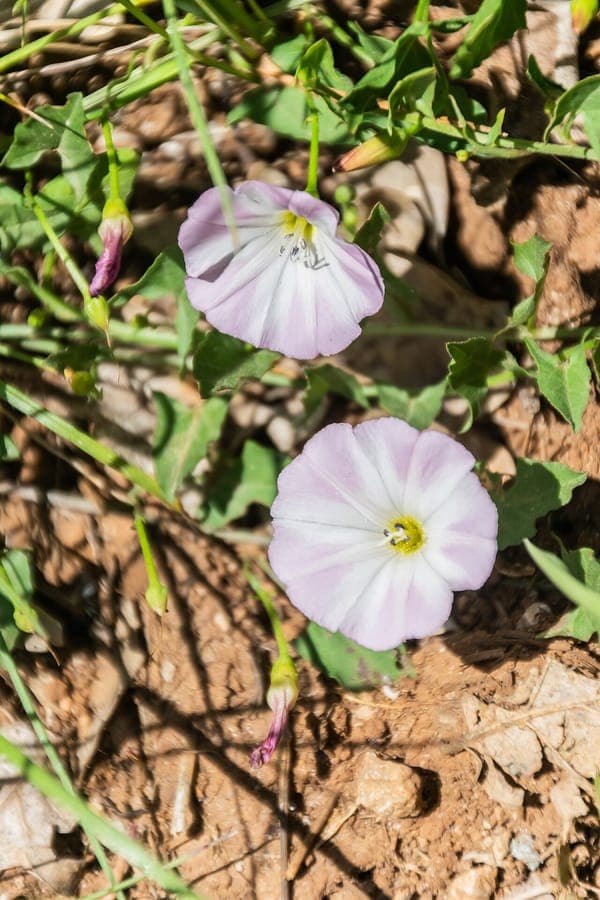
Krzysztof Golik / CC BY-SA 4.0, via Wikimedia Commons
Field bindweed: complete guide
Convolvulus arvensis
Want to see Field bindweed: complete guide in your garden?
1 minute, no credit card
Overview
Field bindweed, botanically known as Convolvulus arvensis, is a plant that divides gardeners. On one hand, its delicate white or pale pink trumpet-shaped flowers have a certain charm. On the other, it's one of the most tenacious weeds you'll encounter in the garden. Native to Europe and parts of Asia, this perennial vine has spread globally and shows no mercy to borders or flowerbeds. It twists around fences, strangles other plants, and spreads aggressively via deep roots and creeping stems. But with the right knowledge, you can either control it or grow it intentionally in a confined space.
Appearance & bloom cycle
Field bindweed has narrow, arrowhead-shaped leaves about 2 to 5 cm long with pointed tips. The flowers are its standout feature: funnel-shaped, 1.5 to 2.5 cm wide, and usually white with a pink tinge at the base. They open only in full sun, typically from June to September. Each individual flower lasts just a day, but the plant produces new buds continuously, ensuring a long bloom season. The vines can reach 1 to 2 meters in length and twine clockwise around supports.
Ideal location
This plant thrives in full sun but tolerates partial shade. It grows best in open, disturbed soils - think fields, roadsides, and fallow land. In the garden, you'll want to restrict its growth. Consider planting it in a large container with deep root barriers, or train it on a sturdy trellis away from vegetable patches and borders. Avoid planting near delicate perennials. Using gardenworld.app, you can design a layout that accommodates bindweed without risking invasion of other areas.
Soil requirements
Field bindweed is not picky. It grows in sand, loam, and clay, as long as drainage is adequate. It tolerates a wide pH range from 5.5 to 8.0. What makes it so resilient is its root system: a main taproot can reach depths of up to 3 meters, and lateral roots spread horizontally, forming new shoots from nodes. Even small root fragments left in the soil can regenerate - which is why complete removal is so difficult.
Watering
Once established, field bindweed is drought-tolerant and rarely needs supplemental watering. During prolonged dry spells, a deep soak can help if you're cultivating it on purpose. However, consistent moisture encourages root development, so if you're trying to eradicate it, avoid irrigation. Letting the soil dry out between rains weakens the plant over time. Never waterlogged - it prefers well-drained conditions.
Free design
Want to see Field bindweed: complete guide in your garden? Make a free design now.
Pruning
Regular cutting or mowing helps deplete the plant's energy reserves. Cut stems back to ground level every 3 to 4 weeks during the growing season, especially before flowering. This prevents seed production and forces the plant to use stored energy to regrow. Do not compost cuttings - dispose of them in the trash or burn them. If growing bindweed intentionally, light pruning after flowering can encourage bushier growth.
Maintenance calendar
- January: Dormant; no action needed
- February: Check for early shoots in mild areas
- March: Begin monitoring; soil warming up
- April: First weeding; remove young shoots with roots
- May: Vigilance increases; vines spread quickly
- June: Blooming starts; cut back if needed
- July: Peak growth; maintain control
- August: Repeat mowing; prevent seeding
- September: Final blooms; trim for neatness
- October: Clear plant debris; do not compost
- November: Dormancy begins; monitor for late growth
- December: Fully dormant; no maintenance
Plan your seasonal tasks with gardenworld.app, where you can set reminders for weeding and pruning bindweed based on your local climate.
Winter hardiness
Field bindweed is hardy to USDA zones 3–9, surviving temperatures down to -20°C. The above-ground vines die back in winter, but the root system remains alive and sprouts again in spring. In milder regions, new growth can appear as early as February. No winter protection is needed, though mulch may insulate roots - a double-edged sword if you're trying to eliminate it.
Companion plants
Due to its aggressive nature, field bindweed doesn't play well with others. Avoid planting near vegetables, herbs, or low-growing perennials. If grown intentionally, pair it with strong, non-invasive climbers like climbing rose 'New Dawn' or clematis 'Jackmanii' on a separate support. These can hold their own without being overwhelmed.
Closing
Field bindweed is a plant of contradictions - beautiful in bloom, brutal in behavior. If you're fighting it as a weed, consistency is key: pull early, pull often, and never let it seed. If you're growing it on purpose, contain it strictly. You can find it - sometimes unintentionally - at garden centres across the UK and US. While it's rarely sold as an ornamental, it often arrives with other plants. Prevention and planning are your best tools. With smart design and timing - like using gardenworld.app to map growth zones and maintenance schedules - you can keep bindweed under control.
Want to see Field bindweed: complete guide in your garden? Make a free design now.
Upload a photo, pick a style, and get a photorealistic design with plant list in under a minute.
No credit card required


Similar plants
Spreading alkaliweed: complete guide
Cressa truxillensis
Full growing guide for Cressa truxillensis, the salt-tolerant groundcover of alkaline flats: location, soil, watering, pruning and winter care.
Betony-leaved bindweed: complete guide
Convolvulus betonicifolius
Full guide to betony-leaved bindweed (Convolvulus betonicifolius): origin, appearance, ideal site, soil, watering and garden uses.
Ivyleaf morning glory: complete guide
Ipomoea hederacea
Everything about Ipomoea hederacea: location, soil and climbing care. A fast-growing annual vine with blue funnel flowers for sunny walls and pergolas.