
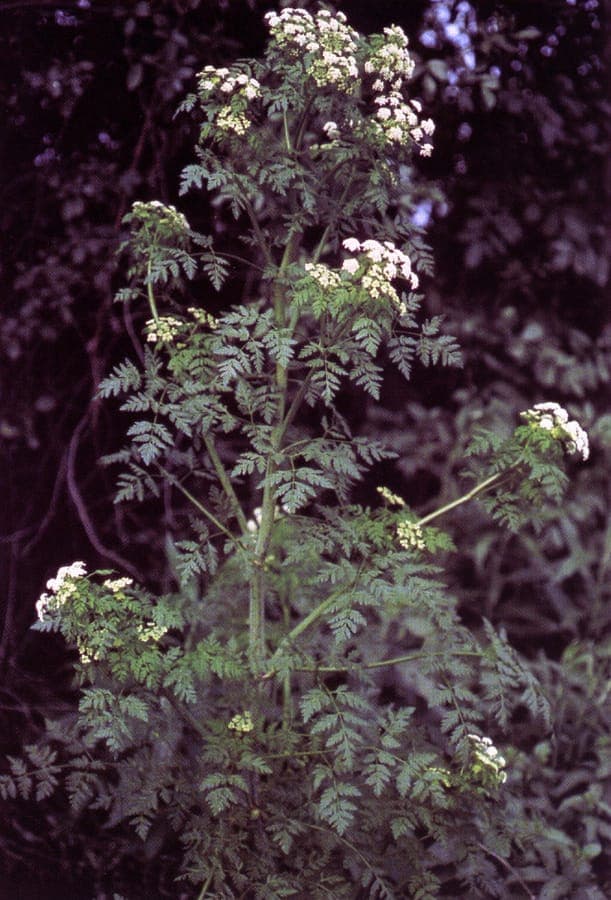
Wikimedia Commons / Public domain, via Wikimedia Commons
Carrot-fern: complete guide
Conium maculatum
Want to see Carrot-fern: complete guide in your garden?
1 minute, no credit card
Overview
Carrot-fern, better known by its scientific name Conium maculatum, is a biennial herb notorious for its extreme toxicity. Despite its fern-like foliage and airy white flower clusters, every part of this plant - roots, stems, leaves, and seeds - contains coniine, a potent neurotoxin that has historically been used to execute prisoners. Native across much of Europe and parts of Asia, it thrives in disturbed soils, ditches, and woodland edges. While it may look inviting, especially to foragers unfamiliar with the Apiaceae family, this plant should never be handled without gloves or planted near edible crops.
On gardenworld.app, you can design a garden layout that safely isolates toxic plants like Carrot-fern, keeping them visible but out of reach of children and pets.
Appearance & bloom cycle
In its first year, Carrot-fern forms a low rosette of finely divided, dark green leaves that emit a musty, unpleasant odour when crushed. In the second year, it sends up a single, hollow stem reaching 1.5 to 2.5 meters in height. The stem is smooth and prominently marked with dark purple blotches - a key identification feature. From June to August, large compound umbels of tiny white flowers appear, each measuring up to 10 cm across. These attract hoverflies, bees, and other beneficial insects.
After flowering, the plant produces ribbed, oval-shaped fruits that turn from green to brown. These seeds remain viable in the soil for several years, leading to persistent regrowth. Because of its resemblance to wild carrot or parsley, misidentification is common - and potentially fatal.
Ideal location
Carrot-fern grows best in partial to light shade (light level 7/10), though it tolerates full sun if soil moisture is maintained. Ideal spots include damp hedgerows, ditch banks, or the edges of woodlands. Avoid planting near vegetable gardens, children's play areas, or pet zones. In cultivated landscapes, use it only as a dramatic background plant in secluded corners.
You can simulate its natural habitat on gardenworld.app by mapping moisture zones and shade patterns to find the safest placement.
Soil requirements
This plant prefers moist, fertile soils with a pH between 6.5 and 7.0. It performs well in clay or loam rich in organic matter but struggles in dry, sandy conditions. Incorporate well-rotted compost or leaf mould when planting to boost water retention. Poor drainage isn't a problem - in fact, it often flourishes in waterlogged areas where other plants fail.
Because it spreads aggressively by seed, consider planting it in contained areas or removing flower heads before seeds mature.
Free design
Want to see Carrot-fern: complete guide in your garden? Make a free design now.
Watering
Carrot-fern demands consistent moisture. During dry spells, water deeply once or twice a week to prevent wilting. Avoid overhead watering if possible, as wet foliage can encourage fungal issues. In wet seasons, no supplemental irrigation is needed. If grown in containers, ensure pots have drainage holes but never let the soil dry out completely.
Pruning
No regular pruning is required, but deadheading after flowering is crucial to prevent self-seeding. Always wear gloves and long sleeves when handling the plant - skin contact with sap can cause dermatitis or systemic poisoning. Tools should be washed thoroughly with soapy water after use.
Never compost plant debris; dispose of it in sealed bags to prevent accidental exposure.
Maintenance calendar
- Jan: Dormant; no action needed
- Feb: Check for early rosettes in mild climates
- Mar: Clear old stems from previous season
- Apr: Monitor for seedlings; thin if overcrowded
- May: Rapid growth phase; check soil moisture weekly
- Jun: Flowers begin; watch for pollinators
- Jul: Peak bloom; deadhead to prevent seeding
- Aug: Flowering ends; collect or cut seed heads
- Sep: Remove remaining stalks; clean area
- Oct: Add compost to soil
- Nov: Soil should stay moist; avoid drying out
- Dec: Above-ground parts die back; clear debris
Winter hardiness
Carrot-fern is hardy in USDA zones 5 to 8. The first-year rosette survives winter under leaf litter or snow cover. In colder zones, mulching helps, but isn't essential. The plant does not require winter protection but can be killed by prolonged ice crusts or extreme freeze-thaw cycles on exposed sites.
Companion plants
Due to its toxicity, avoid pairing Carrot-fern with edibles or herbs. Instead, grow it with tall, non-edible perennials like Joe-Pye weed (Eutrochium maculatum) or Meadowsweet (Filipendula ulmaria). In damp meadows, it can coexist with Ironweed (Vernonia noveboracensis) or Boneset (Eupatorium perfoliatum), provided there's enough space.
Never plant near parsley, dill, or fennel - the visual similarity increases foraging risks.
Closing
Carrot-fern is a bold, architectural plant with ecological value, but its dangers far outweigh its ornamental appeal for most home gardens. If you choose to grow it, do so with extreme caution and full awareness of the risks. Never sell or share seeds. In the UK and Ireland, it's illegal to cultivate near public footpaths. Reputable garden centres do not stock it; instead, look for safer alternatives like Queen Anne's Lace (Daucus carota) or White Snakeroot (Ageratina altissima) at local garden centres.
Want to see Carrot-fern: complete guide in your garden? Make a free design now.
Upload a photo, pick a style, and get a photorealistic design with plant list in under a minute.
No credit card required


Similar plants
Whorled carrot: complete guide
Daucus involucratus
Daucus involucratus is a Mediterranean umbellifer with white flower heads framed by lacy bracts. Growing this gravel garden gem.
Daucus muricatus: complete guide
Daucus muricatus
Daucus muricatus, the spiny wild carrot, grows wild on Mediterranean coasts. Discover sowing, June-July bloom, and wildflower meadow use.
Daucus pumilus: complete guide
Daucus pumilus
Daucus pumilus is a dwarf wild carrot relative with white lacy umbels, thriving on dunes and coastal rock in poor, fast-draining soil.