
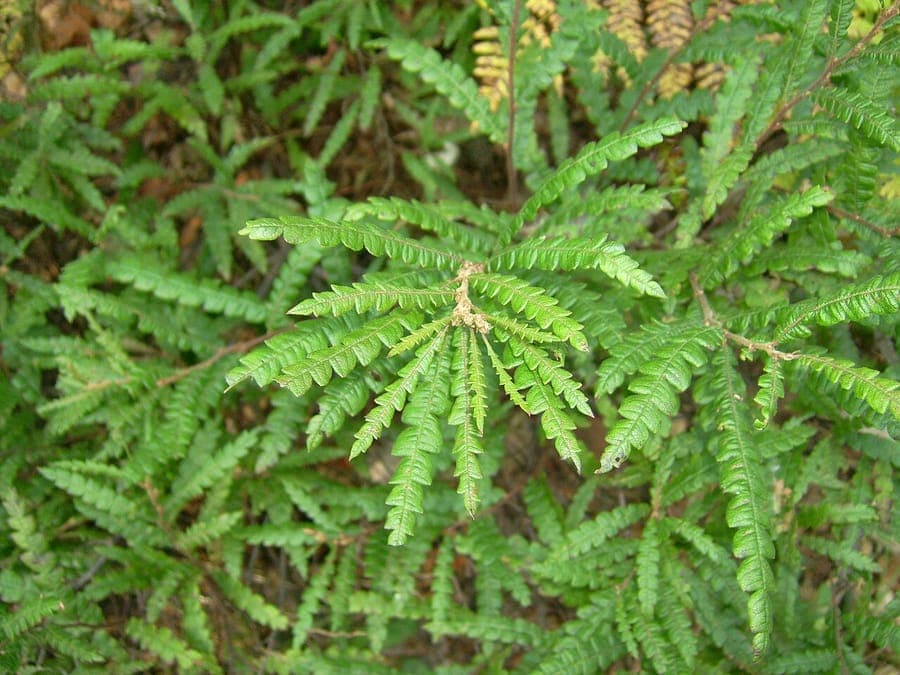
Fungus Guy / CC BY-SA 3.0, via Wikimedia Commons
Comptonia peregrina: complete guide
Comptonia peregrina
Want to see Comptonia peregrina: complete guide in your garden?
1 minute, no credit card
Comptonia peregrina, commonly known as sweet fern, Sweetfern, or Fern-gale, is a fascinating North American native shrub belonging to the Myricaceae family. This plant naturally occurs throughout eastern North America, from Canada south to North Carolina, particularly in sandy and rocky soils with preference for dry locations. The plant earns considerable acclaim for its exceptionally fine fern-like foliage and its intoxicating aromatic fragrance resembling sweet camphor.
Comptonia peregrina typically reaches heights of 60 to 150 centimeters, though under ideal conditions can exceed 2 meters. The plant develops as a compact, upright shrub with numerous fine branches. The characteristic feature of this plant consists of extremely fine, linear leaves measuring 5 to 8 centimeters long. These leaves feature exceptionally fine, narrowly-lobed margins resembling bracken fern foliage. When gently brushing against leaves or passing through the plant, an enchanting aromatic fragrance releases.
Blooming occurs April through May, before new foliage fully emerges. Comptonia peregrina is dioecious, meaning male and female flowers develop on separate plants. Male flowers produce dark, elongated catkins, while female flowers occur in bud-like clusters. Following pollination, small spherical bur-like bracts containing seeds form. This seed dispersal mechanism via wind proves remarkably effective.
The plant thrives in full sun to light shade, requiring minimum 4 to 5 hours direct daily sunlight. In extremely hot climates, light afternoon shade proves appreciated. The plant tolerates shade well but develops less densely. Wind tolerance proves excellent; this shrub adapts readily to windy locations. Comptonia peregrina demonstrates exceptional cold hardiness, tolerating temperatures to -30 degrees Celsius, thriving in USDA hardiness zones 2 to 7.
This plant requires well-draining, sandy to rocky soil. Heavy clay-bearing soils require amendment. The plant thrives in poor, infertile soils where many plants fail. Acidic to neutral pH between 5.5 and 7.0 proves ideal. Do not add compost to planting hole; this plant flourishes in poor soils. Sand and perlite serve as useful amendments. Waterlogging is absolutely unacceptable, so drainage must be excellent.
Watering is needed only during the first growing season. Once established, Comptonia peregrina tolerates dry conditions and requires virtually no supplemental water. This makes it an exceptionally water-efficient choice for dry gardens. A young plant in its first year should be kept evenly moist but not waterlogged. In dry periods, irrigate, but once the plant matures (after first year), allow it to remain dry.
This plant requires minimal fertilization. In fact, fertilization can prove detrimental by stimulating luxuriant foliage growth at fragrance intensity expense. No annual feeding needed. A single slow-release fertilizer application in spring of planting year suffices. In extremely poor soils, semi-annual application might help, but usually unnecessary. The plant performs better in infertile soils than well-fertilized ones.
Regular pruning proves unnecessary, though light pruning helps maintain compact form. In early spring, lightly cut back shoot tips, approximately 10 to 15 centimeters. This stimulates bushiness. After several years, old woody growth can be removed. However, extensive pruning likely damages plants, so less proves better. Allow the plant to largely determine its own form.
This plant remains relatively untroubled by pests and diseases under normal growing conditions. Moisture-related diseases can occur in very wet conditions, but this remains rare given the excellent-draining soils this plant prefers. Insect pests are practically unknown. The plant proves very low-maintenance once established.
Hardiness represents a strong Comptonia peregrina attribute. The plant easily tolerates temperatures to -30 degrees Celsius and thrives in USDA hardiness zones 2 to 7. This makes it suitable for extremely cold climates where many Mediterranean or tropical shrubs would fail. In warm climates (zone 8 or higher), the plant may suffer under extreme summer heat and humidity.
Comptonia peregrina fits perfectly in natural, native plant gardens. Combine with other North American native shrubs such as Vaccinium (blueberry), Ilex (holly), and Kalmia (mountain laurel). Plant near native grasses like Panicum and Andropogon. This plant also excels for erosion control on slopes through its fibrous root system. In dry, sandy gardens, it creates the foundation for low-maintenance landscaping.
Comptonia peregrina represents excellent choice for cold-climate gardeners with dry, sandy soils. With full sun, poor soils, and virtually no maintenance, this plant delivers years of enchanting fragrance and fine fern-like foliage. For water-scarce regions and native plant gardens, it proves indispensable. This is a plant wanting to grow requiring minimal intervention from you.
Want to see Comptonia peregrina: complete guide in your garden? Make a free design now.
Upload a photo, pick a style, and get a photorealistic design with plant list in under a minute.
No credit card required


Similar plants
Acer pycnanthum: complete guide
Acer pycnanthum
Acer pycnanthum, the Japanese swamp maple, is a fast-growing tree with early red flowers and brilliant autumn color, ideal for damp garden settings.
Freeman maple: complete guide
Acer × freemanii
Everything about the Freeman maple (Acer x freemanii): a fast-growing shade tree with spectacular autumn colour for large gardens.
Silver vine: complete guide
Actinidia polygama
Discover silver vine (Actinidia polygama): a hardy climbing plant with silvery foliage, loved by gardeners and cats alike.