
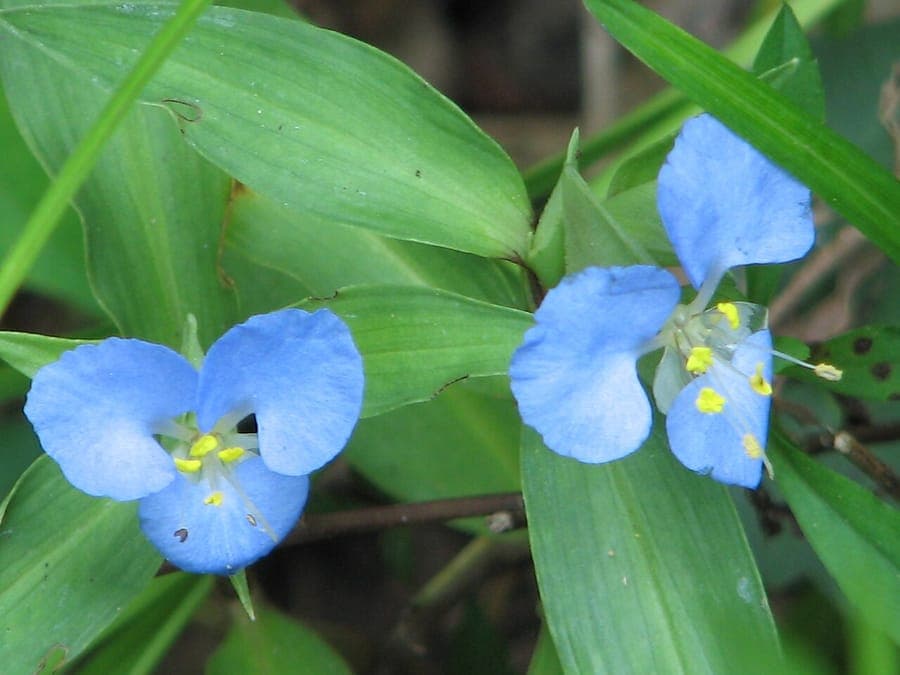
Theresa Thom / Public domain, via Wikimedia Commons
Virginia dayflower: complete guide
Commelina virginica
Want to see Virginia dayflower: complete guide in your garden?
1 minute, no credit card
Overview
Virginia dayflower (Commelina virginica) is a stoloniferous herbaceous perennial belonging to the spiderwort family, Commelinaceae. Described by Carl Linnaeus in 1762, the species takes its name from Virginia, one of the original colonies where it was first formally collected. The genus name Commelina honours the Dutch botanist brothers Caspar and Johan Commelin - two distinguished scientists recalled by the two showy blue petals, while a lesser-known third Commelin brother is represented by the small, inconspicuous third petal. This charming botanical story was invented by Linnaeus himself.
The common name 'dayflower' refers directly to each individual bloom lasting only a single day. In practice this is no drawback: the plant produces a continuous succession of fresh flowers from June through September, maintaining vivid colour throughout the summer months. It is native across central and eastern North America, from Virginia and the Carolinas south to Texas and Florida, and north to Illinois and Ohio, where it occupies moist woodlands, stream banks, ditches and floodplain margins.
For garden designers interested in water features, rain gardens and naturalistic planting, Virginia dayflower offers reliable summer-long colour in wet spots where many other plants struggle. Visit gardenworld.app to see how plants like this can be woven into a professional garden design.
Appearance and bloom cycle
Commelina virginica forms clumps of fleshy, branching stems that typically reach 40 to 90 cm in height. Stems are round, slightly succulent and tend to sprawl at the base before rising upright. The leaves are lance-shaped to oblong-ovate, 5 to 15 cm long and 2 to 4 cm wide, with a prominent clasping sheath at the base of each leaf. The foliage texture is noticeably coarse, which distinguishes this species from some of its relatives.
Flowers emerge from a folded, boat-shaped spathe (a modified bract). Each flower carries three petals: two large, rounded, vivid blue upper petals and one smaller, often whitish or pale lower petal. The stamens are showily yellow, creating an appealing contrast against the blue. Flowering begins in June, peaks during July and August, and continues into September or even early October in mild years. Because each individual flower lasts only one day, the plant relies on high flower-production rates to maintain its display.
After flowering, small three-celled capsule fruits develop, containing hard seeds. The plant also spreads by stolons - above-ground runners that root wherever they contact moist soil, slowly colonising suitable ground.
Ideal location
In nature, Virginia dayflower grows in moist to wet habitats: stream margins, swampy woodland edges, seasonally flooded flats and roadside ditches. It tolerates both full sun and partial shade, though flowering is most prolific in at least four to six hours of direct sun per day.
In the garden, the best positions are beside ponds, along slow streams, in rain gardens or in any low-lying area that stays reliably moist. The plant copes well with periodic waterlogging and can even be grown in shallow standing water up to about 10 cm deep. It is less suitable for conventional dry borders; in such conditions it will survive only with very frequent watering.
Avoid deep shade, which produces lush but largely non-flowering plants. Also avoid calcareous, alkaline soils combined with dry conditions. For guidance on designing planting schemes around water features, gardenworld.app provides detailed garden planning tools.
Soil
Virginia dayflower thrives in rich, moisture-retentive soils. In its native habitat it colonises alluvial silts, clay loams and organically rich loams along floodplains. The preferred pH range is 5.2 to 7.2, meaning it grows well in both mildly acidic and near-neutral conditions.
In garden practice, incorporate generous amounts of garden compost or well-rotted leaf mould into the planting area to boost water retention and fertility. Heavy clay soils work well as long as they do not dry out and crack in summer. Pure sandy soils require significant amendment with organic matter and will need frequent watering. Stony or gravelly soils are generally unsuitable.
For container planting near a terrace pond or tub water feature, use a mix of topsoil, compost and aquatic planting medium. Place the container in a tray kept permanently filled with water, or sit it directly in a shallow pond margin.
Watering
As a native wetland plant, Virginia dayflower requires consistently moist to wet conditions. It is not drought-tolerant: in dry periods the stems droop, leaves curl and flower production ceases. Fortunately, recovery is rapid once water is restored.
Besides natural pond-side settings where moisture is guaranteed, in regular garden borders the plant needs deep watering two to three times weekly during dry spells in summer, aiming for the equivalent of at least 2.5 to 3 cm of rainfall per week. A drip irrigation line positioned at the root zone is the most efficient approach, since it keeps foliage and flowers dry.
For container-grown plants, check the water level in the saucer daily during hot weather and never let it dry out completely. Avoid placing pots on hot paving in direct afternoon sun without adequate water, as the small root volume heats up quickly and drought stress sets in within hours.
Free design
Want to see Virginia dayflower: complete guide in your garden? Make a free design now.
Pruning
Virginia dayflower requires minimal structured cutting. During the growing season you can remove spent flower stems if neatness matters, though the plant produces new blooms without any deadheading. Yellowed or damaged leaves can be pulled away cleanly by hand.
In autumn, once frosts have killed the above-ground growth, cut all stems back to about 5 cm above soil level. This prevents the rotting of dead stems from spreading into the stolons and crown. Clear away the cut material promptly.
If the plant spreads more than desired - Virginia dayflower can colonise quite aggressively in ideal wet conditions - sever the stolons with a spade in spring and lift the rooted sections. These transplant readily and are a useful way to share the plant or expand plantings to other moist areas.
Maintenance calendar
March to April: inspect emerging growth and remove any overwintered dead material. If the clump has grown large, divide it now by lifting with a fork and splitting into sections, replanting the vigorous outer portions.
May: rapid growth begins as temperatures warm. Apply a balanced, slow-release fertiliser if the soil is not naturally rich. Ensure the moisture supply is adequate as growth is fast.
June: flowering begins. Water consistently and remove dead flower stems if desired. Watch for slug damage on young shoots.
July to August: peak flowering. Continue watering, particularly during heatwaves. Container plants may need daily checking. Apply a liquid feed every two weeks for potted specimens.
September: flowering tapers off. Allow seed capsules to mature if you want to collect seed for propagation.
October to November: first frosts cut back the top growth. Trim stems, clear debris and apply a 10 cm mulch of compost over the root zone in colder gardens.
December to February: the plant is dormant. Protect container-grown plants from prolonged hard frosts by moving them to a cool, frost-free place.
Winter hardiness
Virginia dayflower is rated as hardy to USDA zone 6, surviving winter temperatures down to approximately -23 degrees Celsius provided the roots are not subjected to extended dry freezing. In its native range it experiences mild, often wet winters in the mid-Atlantic and southeastern states.
In temperate Western European conditions - comparable to USDA zones 7 to 8 in coastal regions - the plant is reliably hardy in moist, sheltered spots. In colder continental climates or during unusually severe winters, a protective mulch of straw or bark chippings 10 to 15 cm deep over the crown provides adequate insulation.
Container plants are more vulnerable since the entire root ball can freeze solid. In zone 6 and below, move pots into a cool garage or basement for the winter. Keep the compost just barely moist - not wet - during dormancy to prevent rotting while maintaining some life in the roots.
Companion plants
Virginia dayflower pairs naturally with other moisture-loving perennials and marginal aquatics. Yellow flag iris (Iris pseudacorus) is an excellent partner: its bold yellow spring flowers precede the blue summer blooms of Commelina, and both thrive in the same wet conditions. Flowering rush (Butomus umbellatus) offers elegant pink umbels during midsummer, complementing the blue dayflowers beautifully.
For textural contrast, combine with marsh fern (Thelypteris palustris) or reed canary grass (Phalaris arundinacea 'Picta'), whose striped foliage provides a foil to the broad-leaved Commelina. Low-growing companions such as water forget-me-not (Myosotis scorpioides) or brooklime (Veronica beccabunga) fill the spaces at the pond's edge without competing too aggressively.
In a rain garden, Virginia dayflower combines well with Joe Pye weed (Eutrochium maculatum) and swamp milkweed (Asclepias incarnata), both of which share the preference for wet soil and attract pollinators. The combination creates a biodiverse, naturalistic planting that performs reliably from June to September.
Closing
Virginia dayflower is a rewarding plant for any garden with a moist or wet corner that is difficult to fill with conventional border plants. Its jewel-bright blue flowers, produced continuously throughout summer, make it a genuine seasonal highlight beside ponds and streams. Care requirements are straightforward: adequate moisture, reasonable fertility and a frost-protective mulch in colder regions.
For gardeners designing a new water feature or naturalising a damp area, Commelina virginica deserves serious consideration. Specialist aquatic and marginal plant nurseries often stock it, as do larger garden centres with a dedicated water plant section. Plan the entire planting scheme around your pond or rain garden using the design tools at gardenworld.app.
Want to see Virginia dayflower: complete guide in your garden? Make a free design now.
Upload a photo, pick a style, and get a photorealistic design with plant list in under a minute.
10,000+ gardens designed already
No credit card required


Similar plants
Commelina diffusa: complete guide
Commelina diffusa Burm.f.
Commelina diffusa, the climbing dayflower, is an elegant perennial with soft blue flowers that bloom for just a day. This tropical grower thrives in shaded locations and is ideal for hanging baskets, pergolas, and moist garden corners.
Callisia repens: complete guide
Callisia repens
Creeping Inchplant is an elegant trailing plant with delicate foliage, perfect for hanging baskets and groundcover. Learn how to cultivate this popular houseplant successfully.
Tradescantia spathacea: complete guide
Tradescantia spathacea
Tradescantia spathacea, commonly known as Moses-in-the-cradle, is a striking tropical plant with vibrant purple leaf undersides. Discover cultivation techniques and care requirements for this eye-catching houseplant.