
Wikimedia Commons / Public domain, via Wikimedia Commons
Colchicum: complete guide
Colchicum autumnale
Want to see Colchicum: complete guide in your garden?
1 minute, no credit card
Overview
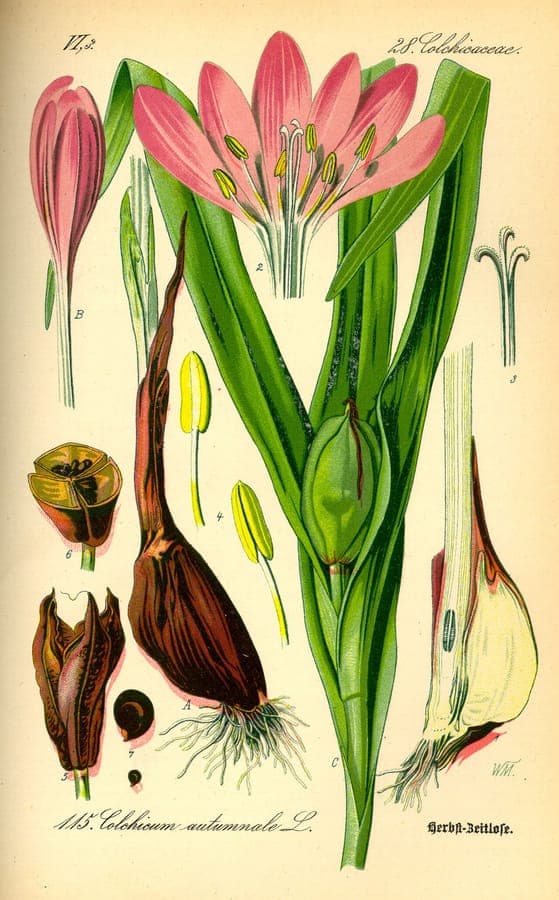
Colchicum autumnale, commonly known as autumn crocus or meadow saffron, is a fascinating plant that defies seasonal expectations. Native to grasslands and woodland edges across western and central Europe - from France to Hungary and as far north as Great Britain - it thrives in temperate climates and brings a rare splash of colour in late summer and early autumn. Despite its common name, it's not a true crocus; it belongs to the Colchicaceae family and blooms without any foliage in sight.
What makes Colchicum truly special is its growth pattern. The leaves appear in spring - broad, strap-like, and up to 30 cm long - and die back by early summer. The bulbs then lie dormant through July and August, only to send up unexpected pinkish-purple flowers in September or October. It's like magic: one day there's nothing, the next you've got delicate blooms nodding above the lawn.
On gardenworld.app, you can design a seasonal planting plan that highlights Colchicum's surprise autumn display, aligning it with other late-blooming perennials for continuous interest.
Appearance & bloom cycle
The flowers of Colchicum autumnale are soft to deep purple, funnel-shaped, and held on stems 10–20 cm tall. Each bulb typically produces one to three blooms, appearing solitary or in small clusters. The blooms last two to three weeks, depending on weather, and often emerge before any leaves are visible.
True leaves don't appear until spring (March to June), growing alongside emerging perennials and fading by early summer. The foliage resembles that of a small lily and must be left intact until fully yellowed - it feeds the bulb for next year's bloom.
Ideal location
Colchicum prefers a light to semi-shaded spot with a light rating of 7 out of 10 - meaning 4–6 hours of sun daily, ideally morning sun with afternoon shade. It performs well in lawns, under deciduous trees, or in mixed borders where spring foliage blends into surrounding plants.
Avoid deep shade or areas under dense evergreens. Full sun is acceptable in cooler regions, but in warmer parts of the UK and southern Europe, partial shade prevents scorching and extends bloom life.
Use gardenworld.app to map sun patterns in your garden and find the best spot for Colchicum's seasonal rhythm.
Soil requirements
Well-drained yet moisture-retentive soil is essential. Colchicum thrives in loamy or clay-loam soils with a pH between 6.5 and 7.0. It tolerates calcareous (chalky) soils well and often naturalises best in alkaline to neutral conditions.
If your soil is heavy clay, improve drainage with grit or compost. For sandy soils, add organic matter to help retain moisture. Avoid waterlogged sites - bulbs will rot if left in standing water.
Free design
Want to see Colchicum: complete guide in your garden? Make a free design now.
Watering
During summer dormancy (July–August), the bulbs require no watering. In autumn, if rainfall is below average, a light soak helps initiate flowering. In spring, during leaf growth, maintain consistent moisture, especially during dry spells.
Never overwater - this is the leading cause of bulb rot.
Pruning
No pruning is needed. Allow flowers to fade naturally and leaves to yellow completely before removal. Cutting foliage early starves the bulb and reduces next year's bloom.
Maintenance calendar
- Jan: Dormant. Check for rodent damage.
- Feb: Dormant.
- Mar: Leaves emerge. Light mulch with compost.
- Apr: Active growth. Keep soil moist.
- May: Foliage at peak.
- Jun: Foliage dies back. Stop watering.
- Jul: Dormant. No care needed.
- Aug: First flowers may appear. Monitor for drought.
- Sep: Peak bloom. Enjoy the display.
- Oct: Flowers fade. No action required.
- Nov: Plant disappears. Prepare for next cycle.
- Dec: Dormant.
Winter hardiness
Colchicum autumnale is fully hardy in USDA zones 5–8, surviving temperatures down to -20°C. It requires no lifting or protection - the bulbs remain in the ground year-round and multiply slowly over time.
Companion plants
Pair with late-flowering perennials like Aster novae-angliae, Sedum 'Autumn Joy', or Helenium for autumn colour. In lawns, naturalise with snowdrops or crocus for a spring-to-autumn sequence. Under shrubs, combine with Helleborus or Anemone nemorosa.
Avoid invasive ground covers that might smother bulbs. Grasses like Deschampsia or Carex add texture without competition.
Closing
Colchicum autumnale is a low-maintenance, high-impact plant that adds mystery and colour to the autumn garden. Its unexpected bloom cycle delights gardeners and visitors alike. Plant bulbs in late summer (August–September) at a depth of 10–15 cm and space 15 cm apart. Available at garden centres across the UK, including local independents and larger chains. Remember: all parts of the plant are toxic - handle with care and keep away from pets and children. With the right conditions, Colchicum will return year after year, slowly spreading to form natural clumps. For design inspiration and planting layouts, visit gardenworld.app and create a garden that celebrates the quiet drama of autumn bloom.
Want to see Colchicum: complete guide in your garden? Make a free design now.
Upload a photo, pick a style, and get a photorealistic design with plant list in under a minute.
No credit card required


Similar plants
Mountain autumn crocus: complete guide
Colchicum montanum
Grow Colchicum montanum successfully: planting depth, drainage, companion plants, and autumn blooming tips for this mountain bulb.
Corsican autumn crocus: complete guide
Colchicum corsicum
Everything about Colchicum corsicum: bloom time, ideal site, bulb care, toxicity and winter hardiness for gardeners.
Autumn Crocus Colchicum cupanii: complete guide
Colchicum cupanii
Complete growing guide for Colchicum cupanii: site requirements, soil preparation, watering, hardiness and companion planting ideas.