
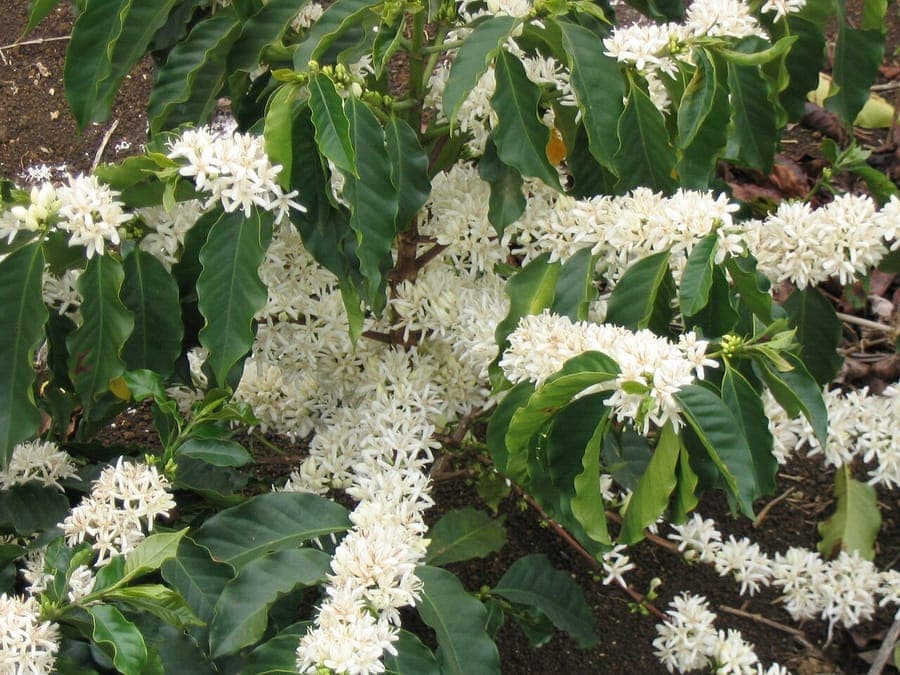
Marcelo Corrêa / CC BY-SA 3.0, via Wikimedia Commons
Coffea arabica: complete guide
Coffea arabica
Want to see Coffea arabica: complete guide in your garden?
1 minute, no credit card
Coffea arabica, known as Arabian coffee or Arabica coffee, is an elegant tropical shrub belonging to the Rubiaceae family (Madder family). This plant naturally occurs in mountainous regions of Ethiopia, South Sudan, and northern Kenya. Coffea arabica provides approximately 60 to 70 percent of globally consumed coffee and is renowned for its superior flavor profile. For home gardeners, this plant offers not only economic value but also aesthetic appeal through glossy foliage and delicate white flowers.
The plant typically reaches heights between 1.5 and 4 meters in garden conditions, though wild specimens exceed 6 meters. Coffea arabica develops as a compact, vertically-oriented shrub with spreading lateral branches. Leaves are opposite, elliptical, 8 to 12 centimeters long, displaying deep glossy green coloration with prominent light-colored midveins. This evergreen foliage provides year-round ornamental appeal.
Blooming typically occurs March through May, extending to October in optimal climates. Flowers develop in clusters along stems, measuring approximately 2 to 3 centimeters in diameter. Each blossom is perfectly white, five-petaled, emitting fragrance strongly resembling jasmine. These enchanting flowers attract numerous pollinators. Following pollination, berries develop requiring six to eight months ripening period, transforming from green through scarlet to deep crimson. Each berry contains two seeds (coffee beans).
Coffea arabica performs best in warm, humid climates without extreme heat. Select locations providing dappled shade where the plant receives 4 to 6 hours indirect daily sunlight. Excessive sun causes foliage scorch, while insufficient light reduces flowering. The plant tolerates temperatures between 15 and 24 degrees Celsius well but weakens above 30 degrees Celsius. Frost sensitivity is pronounced: temperatures below 13 degrees Celsius inhibit growth, below 5 degrees Celsius causing plant death.
The plant requires well-draining, acidic soil with pH between 5.5 and 6.5. Heavy clay soils need amendment with organic matter. An ideal growing mixture combines equal parts potting soil, aged compost, and perlite. For in-ground planting, incorporate 10 centimeters compost into planting hole. Coffea arabica cannot tolerate waterlogging, making drainage critical. A 5 to 10 centimeter mulch layer surrounding the plant aids moisture retention and temperature stabilization.
Watering must be regular but restrained. Keep soil consistently moist without waterlogging. During growing season (March through October), irrigate approximately twice weekly depending on temperature and humidity levels. During drier periods, daily watering may prove necessary. Winter dormancy requires reducing irrigation to approximately half growing-season frequency. Rainwater proves ideal; if using tap water, allow 24 hours standing to diminish chlorine content.
Regular nutrient supply supports flowering and fruit production. Apply slow-release coffee fertilizer or balanced formula (NPK 10-10-10 to 5-10-5) every two weeks during growing season. Micronutrients, especially iron and magnesium, prove important. Annual potassium sulfate application in October enhances bean development quality. Restrict nitrogen because excess promotes foliage growth at flowering expense.
Regular pruning maintains compact form. Cut back upper stems to first two nodes following each flowering period. This stimulates lateral branching and denser growth. Remove dead, diseased, or damaged branches when noticed. Heavy late-winter (February) pruning stimulates flower formation for subsequent season. A well-pruned specimen will produce more flowering side branches than unpruned plants.
The plant requires careful pest and disease monitoring. Common insect pests include aphids, spider mites, and scale insects. Monthly inspection aids early problem detection. Upon infestation, spray cautiously with insecticidal soap. However, fungal diseases pose greatest concern, particularly leaf diseases in humid conditions. Excellent ventilation and prevention of wet foliage help immensely. Avoid foliage spraying.
The plant demonstrates frost sensitivity and cannot tolerate temperatures below 13 degrees Celsius for extended periods. In regions experiencing winter frost, containerize the plant for winter indoor protection. In mild winter climates remaining above 15 degrees Celsius, outdoor permanent cultivation succeeds. Protective cloth helps against unexpected cold snaps. Under prolonged cold conditions, the plant undergoes defoliation and ceases growing.
Coffea arabica pairs well with other tropical plants. Group with Citrus, Mango, or Avocado for tropical backyard atmosphere. Position alongside fragrant flowering shrubs like Jasmine or Gardenias. For Mediterranean or warm-climate gardens, combine with Brugmansia or cold-tolerant tropical specimens. In containers, multiple specimens create attractive displays.
Coffea arabica represents unique choice for warm-climate gardeners wishing to cultivate personal coffee supply. With dappled shade, well-draining acidic soil, regular irrigation and feeding, and careful pest management, you will enjoy years of white flowers and red coffee berries. Cold-climate gardeners require containerization with winter indoor protection. The prospect of personally-grown coffee makes this tropical shrub decidedly worthwhile.
Want to see Coffea arabica: complete guide in your garden? Make a free design now.
Upload a photo, pick a style, and get a photorealistic design with plant list in under a minute.
No credit card required


Similar plants
Oregon bedstraw: complete guide
Galium oreganum
Everything about Oregon bedstraw (Galium oreganum): shade planting, soil requirements, care and use as a low groundcover in woodland and shade gardens.
Awned woodruff: complete guide
Asperula aristata
Full guide to growing Asperula aristata, the awned woodruff: sunny location, alkaline soil, minimal watering, and companion plants for dry or rock gardens.
Purple woodruff: complete guide
Asperula purpurea
Full guide to Asperula purpurea, purple woodruff: sunny sites, chalky soil, watering, pruning, winter hardiness and companion plants for rock and dry gardens.