
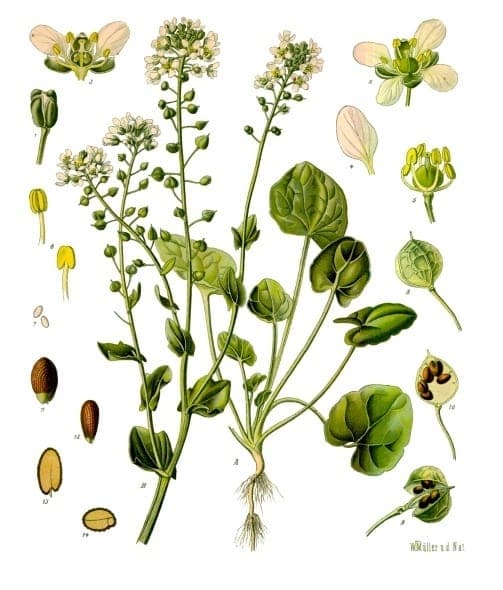
Franz Eugen Köhler, Köhler's Medizinal-Pflanzen / Public domain, via Wikimedia Commons
Scurvy-grass: complete guide
Cochlearia officinalis
Want to see Scurvy-grass: complete guide in your garden?
1 minute, no credit card
Overview
Scurvy-grass, or Cochlearia officinalis, is a humble but resilient herbaceous perennial that's made a quiet comeback in modern gardens. Native to coastal regions across northern and western Europe, including the UK, Ireland, and the Baltic states, it's a member of the Brassicaceae family - related to cabbages, mustards, and rocket. Historically, it was prized by sailors for its high vitamin C content, used to prevent scurvy during long sea voyages. Today, it's appreciated more for its adaptability and early-season charm.
This plant fits perfectly into informal, wildlife-friendly, or coastal gardens. On gardenworld.app, you can design a planting scheme that highlights its natural habitat preferences - moist, open areas with good light. It's especially effective in bog gardens, along stream edges, or tucked between rocks where moisture collects.
Appearance & bloom cycle
Scurvy-grass forms low, spreading clumps reaching 10–25 cm in height. The leaves are spoon-shaped, fleshy, and form a basal rosette. They're deep green, slightly glossy, and have a peppery taste - great for adding zing to salads if harvested young.
From March through July, it produces clusters of small, four-petalled white flowers. Blooming starts in early spring and can continue for months in favourable conditions. The flowers are rich in nectar and attract early pollinators like bees, hoverflies, and small butterflies. After flowering, round seed pods develop and readily self-seed in damp spots.
Ideal location
Choose a spot with light level 7 - full sun to light shade. In hotter inland areas, afternoon shade helps prevent the soil from drying out too quickly. Scurvy-grass excels in cool, damp microclimates. It's ideal for waterside planting, bog gardens, or damp rock crevices.
It's also salt-tolerant, making it a solid choice for coastal gardens. If you're growing in containers, use a large pot with good drainage and keep it in a sheltered, moist area. Use gardenworld.app to map out moisture zones in your garden and find the best spot for scurvy-grass before planting.
Soil requirements
The plant prefers moist, humus-rich soil with a pH between 6.5 and 7.0. It tolerates both clay and loam as long as the soil retains moisture without becoming waterlogged. Avoid dry, sandy soils unless you can irrigate regularly.
At planting time, mix in plenty of well-rotted compost or leaf mould to boost moisture retention. A spring mulch of organic matter helps suppress weeds and keeps the roots cool and hydrated.
Free design
Want to see Scurvy-grass: complete guide in your garden? Make a free design now.
Watering
Keep the soil consistently moist, especially during dry spells in spring and summer. While scurvy-grass can handle temporary flooding, it won't survive prolonged drought. Potted plants need daily checking in summer - water when the top 2 cm of soil feels dry.
In winter, rainfall is usually sufficient. No extra watering needed unless the ground freezes during a dry spell.
Pruning
Minimal pruning is required. Remove any damaged or tired foliage in early spring to encourage fresh growth. If you're harvesting leaves for culinary use, pick them before flowering for the best flavour.
After blooming, cut back spent flower stems to reduce self-seeding if desired. Or leave them for natural spread - it's not invasive, just persistent in the right conditions.
Maintenance calendar
- Jan: Check for frost-damaged leaves; apply light mulch if needed
- Feb: Prepare soil for new plantings; clear debris
- Mar: First flowers appear; monitor for slugs
- Apr: Peak bloom; maintain soil moisture
- May: Continue flowering; harvest young leaves for salads
- Jun: Flowering tapers off; deadhead if controlling spread
- Jul: Seed pods form; allow some to drop for self-seeding
- Aug: Dormant phase; reduce watering
- Sep: New seedlings may emerge; enrich soil lightly
- Oct: No major tasks; plant prepares for winter
- Nov: Leave old foliage for insulation
- Dec: Minimal care; protect containers from hard freezes
Winter hardiness
Scurvy-grass is fully hardy in USDA zones 4–8. It withstands temperatures down to -20°C. Foliage often remains evergreen in milder winters. In colder zones, the top growth may die back, but the roots survive and re-sprout in spring.
No special winter protection is needed in the ground. For container-grown plants, wrap pots or move them to a sheltered spot to prevent root damage from repeated freeze-thaw cycles.
Companion plants
Pair scurvy-grass with other moisture-loving plants like water forget-me-not (Myosotis scorpioides), marsh marigold (Caltha palustris), or brooklime (Veronica beccabunga). It also works well with early bulbs such as snowdrops (Galanthus) or winter aconite (Eranthis).
In rock gardens, combine with sedges (Carex), mosses, or creeping thyme. Avoid pairing with drought-tolerant species like lavender or sedum, which prefer dry, gritty soil.
Closing
Scurvy-grass is a tough, low-maintenance plant that brings quiet beauty and ecological value to damp corners of the garden. It's not flashy, but it's reliable - a perfect fit for naturalistic planting schemes.
You can find Cochlearia officinalis at most garden centres in the UK, especially in spring. Look for healthy plugs or small pots at local nurseries or online retailers. Once established, it asks for little and gives back with blooms, foliage, and habitat support.
Want to see Scurvy-grass: complete guide in your garden? Make a free design now.
Upload a photo, pick a style, and get a photorealistic design with plant list in under a minute.
No credit card required


Similar plants
Brassica cretica: complete guide
Brassica cretica
Brassica cretica, the Cretan cabbage, grows wild on Aegean cliffs. Discover how to grow this drought-tolerant, yellow-flowered Mediterranean perennial.
Corsican cabbage: complete guide
Brassica insularis
Corsican cabbage is a rare Mediterranean rock cabbage with white flowers and blue-green leaves. Location, soil and winter protection.
Prostrate cabbage: complete guide
Brassica procumbens
Prostrate cabbage is a creeping North African cliff plant with yellow flowers. Discover location, soil type and winter protection.