
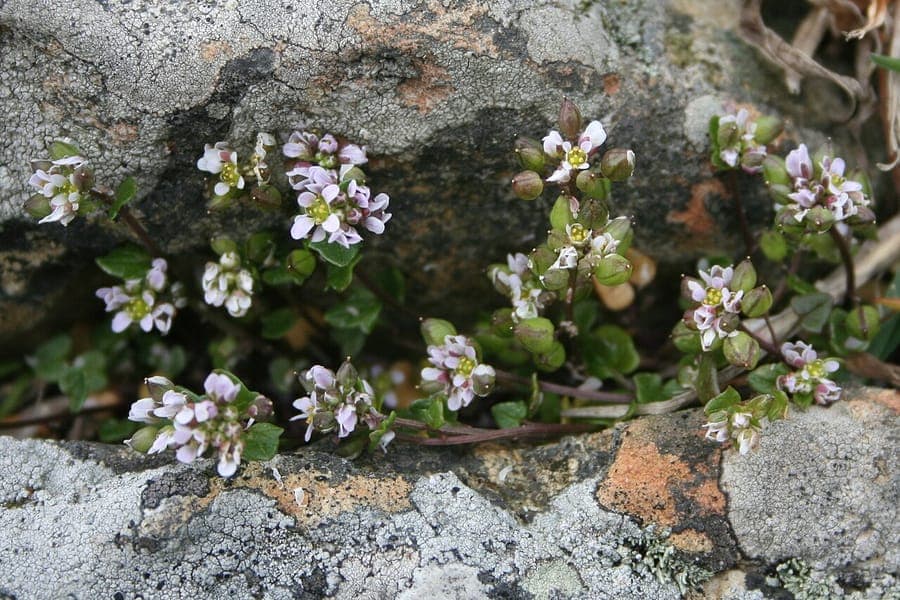
User:Strobilomyces / CC BY-SA 3.0, via Wikimedia Commons
Danish scurvy grass: complete guide
Cochlearia danica
Want to see Danish scurvy grass: complete guide in your garden?
1 minute, no credit card
Overview
Danish scurvy grass (Cochlearia danica) isn't the kind of plant that shouts for attention - it whispers. A low-growing perennial in the Brassicaceae family, it thrives in harsh, salty, and well-drained environments where flashier plants would struggle. Native to coastal regions of Northwest Europe, including Denmark, the UK, and the Netherlands, it's commonly found wedged between rocks, along sea walls, or in disturbed, gravelly areas near roadsides.
This plant earns its name from historical use: like other scurvy grasses, it's rich in vitamin C and was once consumed by sailors to prevent scurvy. In the garden, it's valued not just for its hardiness but for its early blooms, appearing as early as February in mild climates. If you're planning a low-maintenance coastal or rock garden, Danish scurvy grass is a solid contender. You can visualise how it fits into your design using gardenworld.app's garden planning tools.
Appearance & bloom cycle
Danish scurvy grass forms tight, cushion-like rosettes of dark green, spoon-shaped leaves - hence the genus name Cochlearia, from the Latin for 'spoon'. The foliage stays low, rarely exceeding 15 cm in height, but can spread up to 30 cm wide over time. The leaves are slightly toothed and fleshy, an adaptation to dry, salty conditions.
Flowering starts as early as February and can last through May, depending on local climate. The small, white flowers appear in clusters atop short stems, each with four symmetrical petals. While not showy, they're a crucial early nectar source for pollinators like early bumblebees and hoverflies. After flowering, slender seed pods form and burst open when mature, scattering seeds into cracks and crevices.
Ideal location
This plant loves full sun - aim for a light level of 8 or higher on a 1–10 scale. It performs best in open, sunny spots with good air circulation. Partial shade leads to leggy growth and fewer flowers.
The perfect spot in your garden is a dry, stony area: think rock crevices, gravel paths, or the top of a dry stone wall. Its natural tolerance to sea spray makes it ideal for coastal gardens. If you're unsure where to place it, use gardenworld.app to map sunlight patterns in your garden and find the sunniest, driest microclimate.
Soil requirements
Danish scurvy grass prefers alkaline, well-drained soils with a pH between 7.0 and 7.5. It thrives on limestone-rich substrates and naturally occurs on chalky cliffs and road verges where de-icing salt is used.
Avoid heavy clay or waterlogged soils. If your garden has poor drainage, amend the soil with grit, sand, or crushed limestone to improve porosity. A little garden lime sprinkled around the base can help maintain the right pH. The key is drainage - this plant won't tolerate wet feet.
Free design
Want to see Danish scurvy grass: complete guide in your garden? Make a free design now.
Watering
Once established, Danish scurvy grass needs no supplemental watering. It's drought-tolerant and adapted to dry, rocky conditions. Overwatering is a bigger threat than underwatering.
Young plants may benefit from occasional watering during prolonged dry spells in their first season. Use rainwater if possible, especially in areas with hard tap water. In wet springs, ensure the planting site doesn't become waterlogged - a common issue in clay-heavy gardens.
Pruning
Pruning isn't necessary for this plant. Its natural growth habit is compact and self-sustaining. However, you can deadhead spent flower stalks in late spring to prevent excessive self-seeding if you prefer a tidier look.
If you want to limit spread, remove seed pods before they split. On the other hand, if you're aiming for a naturalistic planting, let it seed freely - it often finds perfect niches in stone joints or between paving.
Maintenance calendar
- January: Check for pests or fungal issues. No action needed.
- February: Blooms begin. Keep area free of debris.
- March: Peak flowering. Monitor for aphids or mildew.
- April: Flowers fade. Deadhead if desired.
- May: Seed pods form. Remove if self-seeding is unwanted.
- June–September: Dormant period. No care required.
- October: Observe where seedlings establish.
- November–December: Plant may die back. No intervention needed.
Winter hardiness
Danish scurvy grass is fully winter hardy, surviving down to USDA zone 5 (-20°C). It remains green through mild winters and recovers quickly after frost. No mulching or protection is needed.
In areas with heavy winter rains, the main risk is root rot from saturated soil. Ensure good drainage, especially in containers or low-lying beds. In coastal zones, it handles salt spray and wind with ease.
Companion plants
Pair Danish scurvy grass with other sun-loving, drought-tolerant plants. Try it with Thymus serpyllum, Sedum acre, or Aubrieta. These share similar growing conditions and create a textured, low-maintenance ground cover.
In coastal settings, combine with Eryngium maritimum or Glaucium flavum for contrast in form and colour. Avoid moisture-loving plants that might compete for space or increase humidity.
Closing
Danish scurvy grass won't win any beauty contests, but it's a resilient, ecologically valuable plant for tough spots. It's perfect for rock gardens, coastal walls, or gravel drives - anywhere you need something that survives with little care. While it's not commonly stocked, you might find it at specialist nurseries or online. In the UK, check garden centres with native plant sections. For a tailored design that includes this unassuming gem, try gardenworld.app's custom garden planner.
Want to see Danish scurvy grass: complete guide in your garden? Make a free design now.
Upload a photo, pick a style, and get a photorealistic design with plant list in under a minute.
No credit card required


Similar plants
Brassica cretica: complete guide
Brassica cretica
Brassica cretica, the Cretan cabbage, grows wild on Aegean cliffs. Discover how to grow this drought-tolerant, yellow-flowered Mediterranean perennial.
Corsican cabbage: complete guide
Brassica insularis
Corsican cabbage is a rare Mediterranean rock cabbage with white flowers and blue-green leaves. Location, soil and winter protection.
Prostrate cabbage: complete guide
Brassica procumbens
Prostrate cabbage is a creeping North African cliff plant with yellow flowers. Discover location, soil type and winter protection.