
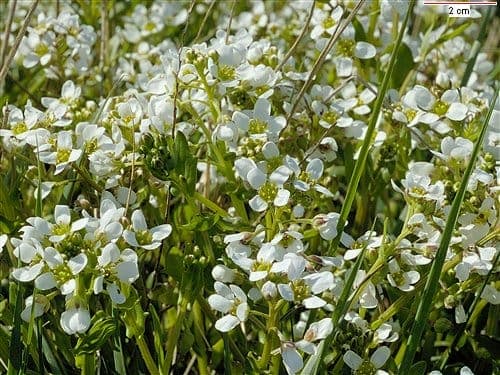
Photographer: John Crellin / CC BY-SA 3.0, via Wikimedia Commons
English scurvygrass: complete guide
Cochlearia anglica
Want to see English scurvygrass: complete guide in your garden?
1 minute, no credit card
Overview
English scurvygrass (Cochlearia anglica) is a specialized maritime plant native to rocky coasts of Western and Northern Europe. This member of the Brassicaceae family has adapted to harsh coastal conditions, making it a perfect choice for seaside gardens seeking authentic native plantings.
Appearance and bloom
The plant forms low rosettes of thick, glossy, spatula-shaped leaves that hug the ground. These distinctive leaves are broad at the apex and taper toward the base, a feature that earned it its common name. From April to June, small white flowers appear in clusters above the foliage, attracting bees and other pollinators before ripening into distinctive seed pods.
Ideal location
English scurvygrass thrives in full sun to partial shade, especially in exposed coastal positions where salt spray and wind are regular features. The plant benefits from excellent air circulation and tolerates maritime conditions that many other plants find inhospitable.
Soil
This plant prefers neutral to alkaline soils (pH 7.5-8.0) with excellent drainage. Sandy, gravelly, and shale-rich substrates are ideal, and the plant even tolerates soils with some salt content, reflecting its natural rocky shore habitat.
Free design
Want to see English scurvygrass: complete guide in your garden? Make a free design now.
Watering
While English scurvygrass can endure dry periods, it performs best with moderate, consistent moisture during the growing season. The soil should remain moist but never waterlogged.
Pruning
Minimal pruning is needed. Deadhead spent flowers to prevent excessive self-seeding, unless you want the plant to naturalize.
Maintenance calendar
- Spring: Growth resumes, begin moderate watering
- Summer: Regular watering, deadhead spent blooms
- Autumn: Growth slows, reduce water
- Winter: Dormancy, minimal attention required
Winter hardiness
Fully hardy throughout Northern Europe and resistant to temperatures well below freezing.
Companion plants
Small tulips, Alchemilla mollis, Dianthus species, other coastal specialists.
Closing thoughts
English scurvygrass offers an authentic way to recreate European maritime vegetation in your garden. Its minimal care requirements and distinctive appearance make it perfect for rock gardens and seaside landscapes.
Find English scurvygrass at Intratuin and Gamma in the Netherlands. In Germany, try OBI or Hornbach.
Explore more plants at gardenworld.app/en and gardenworld.app/nl.
Want to see English scurvygrass: complete guide in your garden? Make a free design now.
Upload a photo, pick a style, and get a photorealistic design with plant list in under a minute.
No credit card required


Similar plants
Brassica cretica: complete guide
Brassica cretica
Brassica cretica, the Cretan cabbage, grows wild on Aegean cliffs. Discover how to grow this drought-tolerant, yellow-flowered Mediterranean perennial.
Corsican cabbage: complete guide
Brassica insularis
Corsican cabbage is a rare Mediterranean rock cabbage with white flowers and blue-green leaves. Location, soil and winter protection.
Prostrate cabbage: complete guide
Brassica procumbens
Prostrate cabbage is a creeping North African cliff plant with yellow flowers. Discover location, soil type and winter protection.