
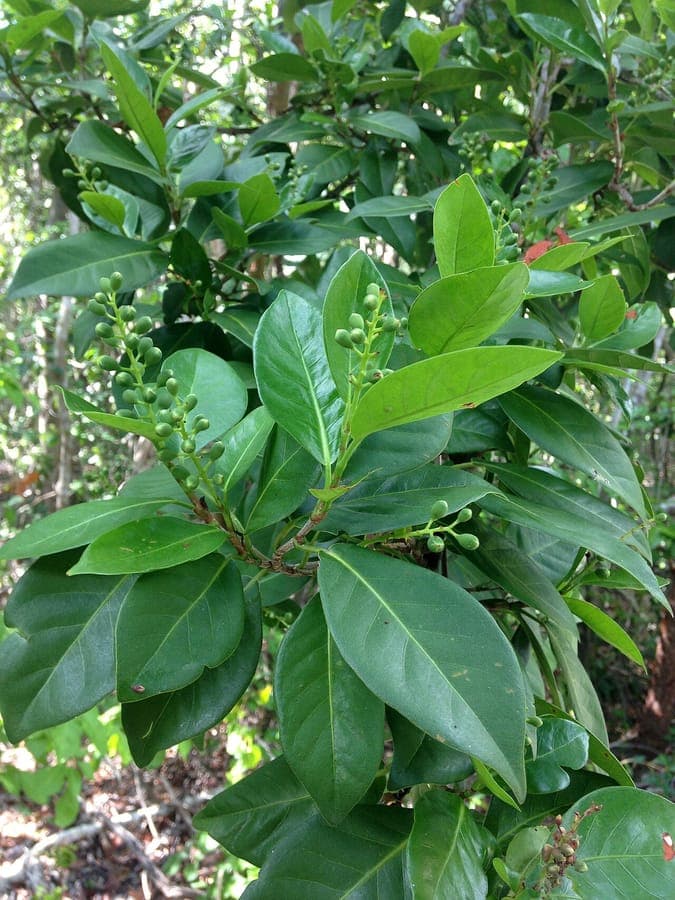
Mason Brock (Masebrock) / Public domain, via Wikimedia Commons
Pigeon plum: complete guide
Coccoloba diversifolia
Want to see Pigeon plum: complete guide in your garden?
1 minute, no credit card
Overview
The pigeon plum (Coccoloba diversifolia) is an evergreen tree or large shrub in the buckwheat family (Polygonaceae). Its native range stretches from Florida through Mexico and Central America across the Caribbean archipelago to northern Venezuela, encompassing Cuba, Jamaica, Puerto Rico, Hispaniola, the Bahamas, Aruba and the Windward Islands. It grows in coastal hammock forests, scrublands and dry-to-moist tropical woodland edges, often in calcareous sandy soils close to the sea. The common name refers to the small, plum-like fruits that pigeons, doves and other fruit-eating birds relish. On gardenworld.app you can discover how trees like this can anchor an exotic or tropical-themed garden design.
In cultivation Coccoloba diversifolia is valued as a shade tree, specimen plant and street tree in warm coastal communities. It has been widely planted across southern Florida, where it is favoured for its salt tolerance, moderate growth rate and ornamental glossy foliage. The species was first formally described by the Austrian botanist Jacquin in 1760. Major taxonomic authorities - including the World Flora Online and Plants of the World Online - accept it as a distinct species with numerous historical synonyms including Coccoloba laurifolia and Coccoloba floridana.
Appearance and bloom cycle
Coccoloba diversifolia typically grows as a single or multi-stemmed tree reaching 5 to 15 metres in height, though cultivated specimens are often smaller. The bark is smooth and mottled grey-brown, attractive in its own right. The leaves are leathery, glossy and dark green, ovate to elliptic in shape, and measure 5 to 15 cm long by 3 to 8 cm wide. Young foliage often emerges with reddish or bronze tones before maturing to a rich green. The species name 'diversifolia' reflects the considerable natural variation in leaf size and shape found across its range.
Flowers are small, white and individually inconspicuous, but they are produced in drooping racemes 10 to 20 cm long that can be attractive en masse. Flowering typically occurs from late spring through early summer in Florida and the Caribbean. The fruit are round to ovoid, grape-like berries, 1 to 1.5 cm in diameter, ripening from green through red to deep purple. Although not palatable to humans, they are eagerly consumed by birds, particularly pigeons and doves, which disperse the seeds widely. The persistent fruit clusters give the tree decorative value beyond its flowering period.
Ideal location
This tree is suited to USDA zones 10 to 12, where minimum winter temperatures remain above -1 degrees Celsius. In the United States it grows outdoors year-round only in southern Florida, Hawaii and parts of coastal California. In Europe, outdoor cultivation is feasible only in the warmest frost-free zones: the Algarve in Portugal, Andalusia and the Canary Islands in Spain. Elsewhere in northern Europe it must be treated as a container plant moved indoors for winter.
In terms of light, pigeon plum performs well in full sun to partial shade. It is notably wind-tolerant - including salt-laden sea winds - making it a reliable choice for coastal gardens in warm climates. In container growing, a sheltered spot on a sunny terrace works well. The plant appreciates warmth radiating from a south-facing wall. In colder climates, maximise sun exposure during the outdoor growing season to encourage compact, woody growth before bringing the plant inside.
Soil requirements
Coccoloba diversifolia is not demanding about soil type. In nature it colonises sandy, calcareous coastal soils that drain freely and are low in organic matter. It tolerates mildly alkaline conditions and moderate salinity. Waterlogged or poorly draining soil is the primary stress to avoid, as standing water around the roots encourages root rot.
For container cultivation, use a free-draining mix of two parts good quality potting compost, one part perlite and one part coarse sand or horticultural grit. This provides adequate moisture retention while ensuring rapid drainage after watering. Repot every two to three years in spring, moving up one pot size each time. UK and Irish garden centres stock perlite and coarse horticultural sand suitable for this purpose.
Free design
Want to see Pigeon plum: complete guide in your garden? Make a free design now.
Watering
Established pigeon plum trees are surprisingly drought-tolerant, reflecting their origins in coastal environments that experience distinct dry seasons. The key principle is to water deeply but infrequently, allowing the upper soil layer to dry out between waterings. During the active growing season from spring through summer, a thorough soaking once a week is usually sufficient for outdoor-grown specimens.
Container plants in active growth need more frequent attention - check the top 3 to 5 cm of the compost and water when this layer feels dry. During winter storage indoors, reduce watering to the bare minimum: once every two to three weeks is usually enough to prevent complete desiccation. Overwatering in cool, low-light conditions is one of the most common causes of decline in container-grown tropical trees.
Pruning
The pigeon plum naturally develops an attractive, rounded or oval crown and needs little corrective pruning. Remove any dead, damaged or crossing branches in late winter or early spring before new growth begins. Avoid heavy pruning, which tends to stimulate excessive vegetative regrowth at the expense of flowering and fruiting. Light tip pruning after the fruiting season can help maintain a compact form on container specimens.
When bringing container plants outdoors in late spring, prune lightly to remove any weak or etiolated growth that developed during the indoor period. Disinfect pruning tools between cuts using a dilute bleach solution or isopropyl alcohol to minimise the risk of disease transmission.
Maintenance calendar
January to March: indoors in temperate climates; minimal watering, no feeding, brightest position available. April: repot if root-bound; once overnight frosts have passed, begin hardening off for outdoor placement. May to August: active growing season; weekly watering, monthly liquid feed with a balanced fertiliser, check for pests. September: begin reducing watering frequency; prepare for return indoors. October to December: bring under cover before first frost; store in a frost-free, well-lit space at minimum 10 degrees Celsius.
Winter hardiness
Coccoloba diversifolia is frost-sensitive. Even brief exposure to temperatures of -2 degrees Celsius causes significant leaf damage and can kill young shoots. USDA zone 10a is the practical minimum for outdoor cultivation. In Belgium and the Netherlands, this species can only be grown as a container plant that spends winters indoors. A minimum winter temperature of 10 degrees Celsius with as much natural light as possible will keep the plant in good condition until it returns outdoors in spring.
In Spain, Portugal and other Mediterranean coastal areas with a genuinely frost-free climate, outdoor specimens can grow into fine trees over many years. Young plants are more vulnerable to occasional cold snaps than mature trees with well-developed root systems. Garden centres specialising in exotic and Mediterranean plants in southern England occasionally stock young pigeon plum specimens.
Companion plants
In warm, frost-free gardens Coccoloba diversifolia associates naturally with other Caribbean and subtropical species. Good companions include Roystonea regia (royal palm), Plumeria rubra (frangipani), Strelitzia reginae (bird of paradise) and Bougainvillea spectabilis. All share a preference for well-drained, sandy or rocky soils in full sun with good salt tolerance.
As a container plant on a summer terrace in temperate climates, it pairs attractively with Lantana camara, Hibiscus rosa-sinensis and Thunbergia alata. These species can all be moved indoors together for winter. Visit gardenworld.app to plan and visualise how a tropical container garden arrangement might look in your outdoor space.
Closing thoughts
The pigeon plum is a handsome, evergreen tree that brings Caribbean character to any garden warm enough to grow it. Its glossy foliage, bird-attracting fruit and salt tolerance make it a practical as well as decorative choice for coastal gardens in USDA zones 10 and above. In temperate gardens it demands more attention as a container plant but offers a rewarding taste of the tropics on any sun-drenched summer terrace.
Want to see Pigeon plum: complete guide in your garden? Make a free design now.
Upload a photo, pick a style, and get a photorealistic design with plant list in under a minute.
10,000+ gardens designed already
No credit card required


Similar plants
Crosby's wild buckwheat: complete guide
Eriogonum crosbyae
Full guide to growing Eriogonum crosbyae: ideal site, soil, watering, winter hardiness and companion plants for this rare western wild buckwheat.
Spreading buckwheat: complete guide
Eriogonum effusum
Full guide to growing Eriogonum effusum: ideal site, soil, watering, winter hardiness and companion plants for this prairie subshrub from the American West.
Tall woolly buckwheat: complete guide
Eriogonum elatum
Full guide to Eriogonum elatum: siting, soil, watering, pruning and companion plants for this elegant white-flowered buckwheat from the western United States.