
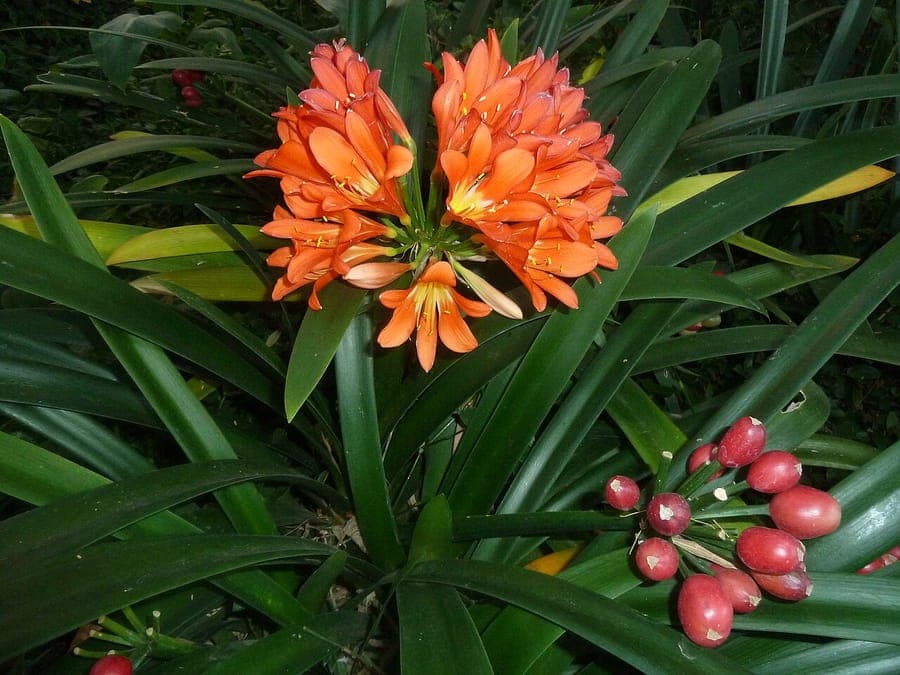
JMK / CC BY-SA 3.0, via Wikimedia Commons
Bush lily: complete guide
Clivia miniata
Want to see Bush lily: complete guide in your garden?
1 minute, no credit card
The bush lily is an elegant African plant from the amaryllis family, renowned for its striking orange flowers and lustrous green foliage that makes any space more beautiful. This houseplant ranks among the most popular ornamental plants because it proves robust, low-maintenance, and visually spectacular. With enduring blooms lasting weeks, the bush lily imparts festive ambiance to any interior space continuously. The plant originates from South African forests where it grows protected beneath tree canopies. In many countries people know this plant under alternative names such as Natal lily and Clivia.
The plant grows slowly in cultivation but establishes elegant, mounded form that increases in size with years. The leaves are leathery, glossy dark green, reaching approximately sixty to ninety centimetres in length on mature specimens. The foliage grows in dense bunches from a central base creating compact plant form. Flowers typically emerge February through March in the northern hemisphere and comprise ten to twenty small orange florets clustered into umbel-like inflorescences. These flowers persist for weeks, rendering this plant exceptionally valuable for interior cultivation. The flowers attract many pollinators and bring vitality into your home environment.
The bush lily proves flexible regarding light requirements and thrives in bright, indirect light locations with abundant glass. While thriving in brighter illumination, mature plants tolerate moderate light reasonably well. Ensure the plant avoids direct midday sun in scorching climates, as this causes leaf scorch issues. Plants in dimmer light grow slowly but remain healthy and survive many years productively.
Humidity levels of forty to sixty percent prove ideal but not strictly essential for growth. Normal household humidity of thirty to forty percent remains acceptable for most specimens. The plant refuses in extremely arid environments where wilting occurs. Misting or placement on a humidity pebble tray helps significantly in dry winters.
Water moderately ensuring plant soil never gets waterlogged: allow potting soil to nearly dry between waterings. During growth periods spring and summer water when top two to three centimetres soil feels dry. In winter reduce dramatically because this plant tolerates dryness better than waterlogging. Never permit water to accumulate in the plant's centre because this directly causes root rot and plant death.
Pruning proves minimal for this species: remove spent flowers immediately following wilting to prevent seed set, which drains plant resources significantly. Dead or damaged foliage may be removed year-round whenever observed. Seed pods require removal unless you desire seed collection for propagation purposes.
Maintenance calendar: February through March flowering period peaks. April through June rest phase less active. July through October slow growth periods. November beginning dormancy gradually. December minimal watering as blooming concludes completely.
The bush lily lacks frost hardiness and thrives between ten and twenty-five degrees Celsius consistently. Below ten degrees Celsius growth halts completely and damage may occur irreversibly. Outside these temperature parameters, protection becomes essential. In winter climates, definitely keep indoors throughout cold months.
Combine with foliage-oriented plants such as Monstera, pothos or anthuriums effectively. The intensely orange flowers of bush lily form spectacular contrast with dark companion foliage nearby. For bold styling, pair with yellow or pink flowering plants for striking visual combinations.
The bush lily ranks as the ultimate houseplant for elegance, flowering and effortless cultivation. With enduring orange blooms and robust nature, this proves the perfect plant for those seeking plant satisfaction without intensive labour. Available at garden centres. Discover more plant inspiration at gardenworld.app!
Want to see Bush lily: complete guide in your garden? Make a free design now.
Upload a photo, pick a style, and get a photorealistic design with plant list in under a minute.
No credit card required


Similar plants
Douglas' Onion: complete guide
Allium douglasii
Douglas' onion is a compact ornamental allium with purple flowers, perfect for rock gardens and sunny borders. Learn care, siting and hardiness.
Oblique onion: complete guide
Allium obliquum
The oblique onion is a hardy ornamental allium with chartreuse flower heads and blue-green foliage. Location, soil and care explained.
False hooded garlic: complete guide
Allium pseudocalyptratum
Discover false hooded garlic (Allium pseudocalyptratum): a rare ornamental onion from Lebanon for rock gardens and alpine troughs.