
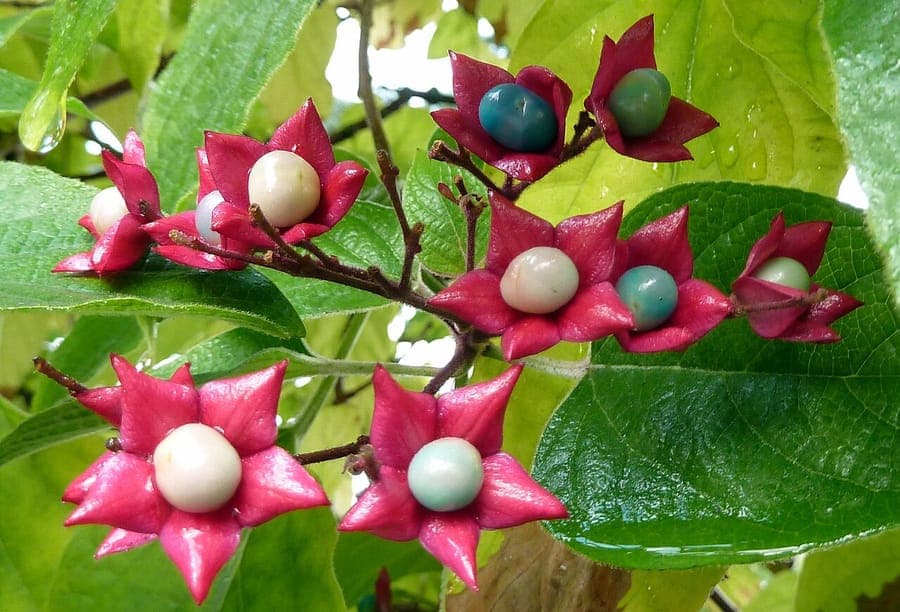
Wendy Cutler from Vancouver, Canada / CC BY 2.0, via Wikimedia Commons
Clerodendrum trichotomum: complete guide
Clerodendrum trichotomum
Want to see Clerodendrum trichotomum: complete guide in your garden?
1 minute, no credit card
Overview
The Glory tree (Clerodendrum trichotomum), also known as Harlequin glorybower or Japanese losbaum, is a beautiful, semi-hardy shrub native to China, Japan, and Korea. This striking plant produces very beautiful smoky-white flowers surrounded by red calyxes, followed by unusually beautiful azure-blue berries that remain for months. With its subtropical appearance and long period of ornamental value, it ranks among the most impressive plants for southern Dutch gardens and sheltered locations.
Appearance & Bloom
Clerodendrum trichotomum is a deciduous to semi-evergreen shrub that typically reaches 2-3 meters in height in the Netherlands, but can reach 4-5 meters in very favorable conditions. The leaves are large, opposite, and somewhat rough in texture, with a distinctly fragrant odor when crushed (not always pleasant). The spectacular flowers appear from August to October in terminal clusters - pure white or light pink flowers surrounded by striking red-carmine calyxes. After flowering, azure-blue to ultramarine-blue berries form in beautifully shaped clusters, remaining very decorative throughout fall and early winter.
Ideal Location
The Glory tree prefers a very sunny, warm location with at least 6-8 hours of direct sunlight daily. Although the plant is semi-hardy in southern Netherlands (to about USDA zone 8), it grows best in very sheltered, south-facing locations against a wall or fence. In northern and central Netherlands, it must be overwintered in a greenhouse in container culture. The plant cannot tolerate strong winds or cold drafts.
Soil
Clerodendrum trichotomum grows in practically any nutrient-rich, well-draining soil. A slightly acidic to neutral pH (6.0-7.5) is ideal. In container culture, make a mixture of 60% potting soil, 30% compost, and 10% perlite. Regular feeding during the growing season promotes growth and flowering.
Free design
Want to see Clerodendrum trichotomum: complete guide in your garden? Make a free design now.
Watering
The plant should be watered regularly during the growing season, especially in dry periods. Once established, it still tolerates considerable drought. Ensure the soil drains well and doesn't become waterlogged. In winter, reduce watering significantly. Occasionally spray the foliage for health.
Pruning
The Glory tree responds well to pruning in early spring (February-March) before the growing season begins. Remove all dead wood and old growth. The plant can be cut back annually to about 1-1.5 meters in height to encourage a denser, fuller form. Flowers appear on new wood, so pruning encourages flowering.
Maintenance Calendar
January-February: Pruning possible; repot in larger containers if needed. March-April: Plant outdoors in sheltered location; water regularly; start feeding. May-July: Full growth; flower preparation. August-October: Flowering; careful watering; berry formation. November-December: Berries remain long hanging; reduce water; winter preparation.
Winter Hardiness
Clerodendrum trichotomum is semi-hardy in southern Netherlands (zone 8, to about -12 degrees Celsius). In more severe winters or in northern Netherlands, protect the plant with thick mulch and possibly a burlap covering, or grow it in containers overwintered in an unheated greenhouse or cool indoor window. Young plants are more sensitive than old ones.
Companion Plants
The Glory tree combines beautifully with other summer bloomers and evergreens. Plant it together with Caryopteris clandonensis (bluebeard), Vitex agnus-castus (chaste tree), and ornamental grasses. The late bloom makes it a perfect partner for Fall asters and Liatris.
Closing
Clerodendrum trichotomum is undoubtedly one of the most spectacular flowering and fruiting plants available for Dutch gardens. With its white flowers with red calyxes, followed by azure-blue berries, it creates months of intriguing ornamental value. For gardeners in southern regions with plenty of sun and shelter, this beautiful specimen absolutely deserves a place in their front garden.
Want to see Clerodendrum trichotomum: complete guide in your garden? Make a free design now.
Upload a photo, pick a style, and get a photorealistic design with plant list in under a minute.
No credit card required


Similar plants
Apple mint (Mentha x villosa): complete guide
Mentha x villosa
Meet apple mint (Mentha x villosa): a fruity-scented kitchen herb with woolly leaves, perfect for tea and mojitos.
Salvia peyronii: complete guide
Salvia peyronii
Discover Salvia peyronii, a rare Lebanese mountain sage. Growing tips, hardiness, and companion planting for a Mediterranean gravel garden.
Bigleaf mint (Mentha x rotundifolia): complete guide
Mentha x rotundifolia
Discover bigleaf mint: cultivation, care tips, and garden uses. Learn how to grow this aromatic herb with soft, hairy leaves.