
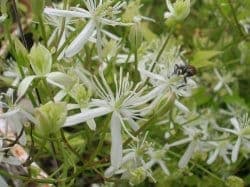
Tabish q at English Wikipedia / CC BY-SA 3.0, via Wikimedia Commons
Ground virginsbower: complete guide
Clematis recta
Want to see Ground virginsbower: complete guide in your garden?
1 minute, no credit card
Overview
Clematis recta, commonly known as ground virginsbower, stands out from most clematis species with its upright, non-clinging growth habit. Unlike its vine-like relatives that scramble with tendrils, this perennial forms stiff, woody stems and grows straight up to 120–180 cm tall, spreading about 80 cm wide. Native to central and southeastern Europe-from Albania and Bulgaria to Germany and Belarus-it thrives in open woodlands, grassy slopes, and sunny clearings. In the garden, it brings a soft, airy texture ideal for the middle or back of mixed borders.
If you're planning a new border, gardenworld.app offers design tools that help you visualise how Clematis recta fits with other perennials based on height, spread and bloom time.
Appearance & bloom cycle
This clematis produces a profusion of small, white flowers from May through July. Each bloom is about 2–3 cm across, with numerous narrow petals giving a fluffy, pom-pom-like effect. The flowers have a subtle, sweet fragrance most noticeable in warm afternoons. After blooming, silvery seed heads form, adding ornamental interest well into autumn.
The foliage is finely divided, bright green, and fern-like, creating a delicate backdrop that contrasts beautifully with bolder-leaved neighbours. Stems are rigid and self-supporting in most conditions, though taller specimens may benefit from light staking in exposed gardens.
Ideal location
Ground virginsbower performs best in full sun to light shade-rated 6 out of 10 on the light scale (10 being full sun). In cooler regions like northern England or Scotland, it thrives in full sun. But in hotter areas such as southern England, it appreciates afternoon shade to prevent root stress. The key is sun on the foliage and cool, shaded roots-plant it at the base of a low shrub or near a north-facing wall to achieve this balance.
Avoid dense shade, which leads to leggy growth and fewer flowers. Use gardenworld.app to map your garden's light patterns and pick the perfect spot for optimal performance.
Soil requirements
Clematis recta prefers well-drained, moderately fertile soil with a pH of 7.5 to 8.0-slightly alkaline to chalky. It tolerates clay as long as it doesn't stay waterlogged. In heavy soils, mix in sharp sand or compost to improve drainage. In sandy soils, add organic matter like leaf mould or well-rotted manure to boost moisture retention.
Avoid acidic conditions-this plant will struggle below pH 7. A light dressing of garden lime at planting time can help if your soil is borderline.
Free design
Want to see Ground virginsbower: complete guide in your garden? Make a free design now.
Watering
Water regularly during the first growing season, especially in dry spells. Once established, it's reasonably drought-tolerant, making it a solid choice for low-maintenance or xeriscaped gardens. During prolonged heatwaves in June or July, a deep soak once a week is enough to keep it healthy.
Always water at the base-never wet the foliage-to reduce the risk of fungal issues. Mulching with bark or compost in spring helps retain moisture and keeps roots cool.
Pruning
One of the easiest clematis to maintain, Clematis recta flowers on new wood. Cut it back hard every early spring (February to early March), leaving just 15–20 cm of stem above ground. This encourages bushy growth and prevents the plant from getting woody and sparse at the base.
Use clean, sharp secateurs for precise cuts. Remove all old stems completely-they won't rebloom and can harbour pests.
Maintenance calendar
- Jan: inspect old stems, prepare for pruning
- Feb: cut back to 15–20 cm
- Mar: new shoots emerge; apply light compost layer
- Apr: rapid growth; watch for slugs
- May: flowering begins; ensure consistent moisture
- Jun: peak bloom; consider light support if needed
- Jul: final flowering month; seed heads form
- Aug: seed heads mature; no feeding required
- Sep: plant dies back; leave stems for winter texture
- Oct: clear debris; mulch lightly if desired
- Nov: dormant phase begins
- Dec: full dormancy; no action needed
Winter hardiness
Hardy to USDA zone 4 (-34°C), ground virginsbower reliably survives UK and northern European winters. Top growth may die back completely, but the crown and roots remain alive. In extremely cold or wet winters, a light mulch of straw or leaf mould can offer extra protection-especially for young plants.
Companion plants
It pairs beautifully with purple-flowering perennials like Salvia nemorosa 'Caradonna' or Nepeta racemosa. Combine with upright grasses such as Stipa tenuissima for movement, or with sturdy plants like Echinacea and Persicaria for structure. Avoid overly aggressive spreaders like mint or buttercup, which can overwhelm its root zone.
Plant in groups of 3–5 for impact. Use low metal frames or twiggy sticks for subtle support.
Closing
Clematis recta is a dependable, low-fuss plant that delivers high visual reward. With its upright form, long bloom season, and easy care, it's perfect for gardeners who want structure without hassle. Once settled, it returns year after year with minimal intervention.
Available at garden centres across the UK. Look for healthy 2-litre pots at trusted retailers. For planting ideas and design inspiration, visit gardenworld.app.
Want to see Ground virginsbower: complete guide in your garden? Make a free design now.
Upload a photo, pick a style, and get a photorealistic design with plant list in under a minute.
No credit card required


Similar plants
Drummond's anemone: complete guide
Anemone drummondii
Discover Drummond's anemone (Anemone drummondii): a silvery-grey mountain plant for cool rock gardens and alpine troughs.
Korean clematis: complete guide
Clematis serratifolia
Clematis serratifolia is a hardy climber with fragrant yellow bell flowers in August-September. Pruning group 3, location and care tips.
Aquilegia brevistyla: complete guide
Aquilegia brevistyla
Discover Aquilegia brevistyla, the elegant North American columbine. Growing tips, shade tolerance, and design ideas for woodland and shadowed gardens.