
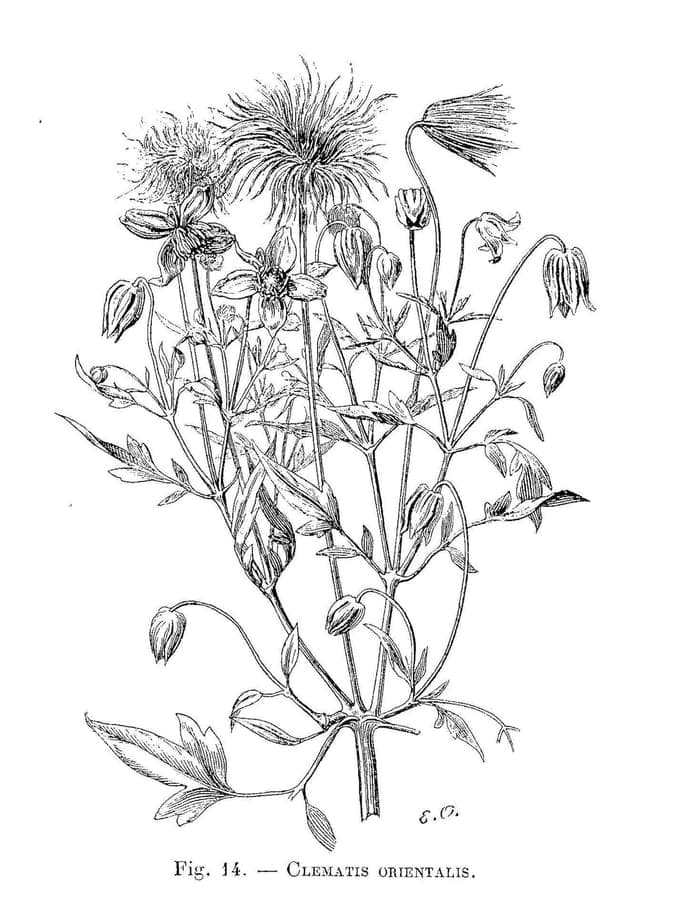
Georges Boucher & S. Mottet / Public domain, via Wikimedia Commons
Oriental virgin's-bower: complete guide
Clematis orientalis
Want to see Oriental virgin's-bower: complete guide in your garden?
1 minute, no credit card
Overview
Clematis orientalis, commonly known as oriental virgin's-bower, is a resilient climbing perennial native to arid regions across Central Asia, from Mongolia to Iran. Unlike many clematis species that demand rich soil and constant moisture, this plant thrives in lean, dry conditions, making it ideal for xeriscaping and low-maintenance gardens. Belonging to the Ranunculaceae family, it's a deciduous vine that typically reaches 2–3 meters in height, using its slender tendrils to climb fences, trellises, and shrubs. Gardeners seeking a tough, ornamental climber that doesn't need coddling will find this species a standout.
On gardenworld.app, you can design a garden layout where oriental virgin's-bower complements gravel gardens or dry stone walls, pairing it with structural plants for year-round interest. It's rarely bothered by deer or rabbits, and though not listed as toxic, it's not typically browsed, which is a bonus in rural gardens.
Appearance & bloom cycle
This clematis produces small, bell-shaped flowers from June to August. The blooms are greenish-yellow, about 2–3 cm across, and appear in clusters along the stems. While not flashy, they have a subtle charm and attract pollinators like hoverflies and small bees. After blooming, the plant develops feathery seed heads that turn silvery-gray and persist into late autumn, adding texture and movement to the garden.
The foliage is pinnate, usually with three to five narrow leaflets per leaf, and has a soft gray-green underside that glimmers in sunlight. The stems are wiry but strong, and the plant climbs by twining leaf stalks rather than tendrils. It gives a light, airy look to structures without overwhelming them, unlike heavier clematis varieties.
Ideal location
Plant Clematis orientalis in full sun to light shade. For best flowering, provide at least 6 hours of direct sun daily. The roots prefer cool, shaded conditions, so keep the base shaded with ground cover or mulch. South- or east-facing walls or fences work well. Provide a support structure between 1.8 and 2.5 meters tall - metal mesh, wire, or wooden lattice all work.
It performs well on pergolas, arbors, or even through upright shrubs like roses or buddleja. On gardenworld.app, you can experiment with layered planting designs, using this vine to soften hardscape edges while maintaining airflow and sun exposure for companions.
Soil requirements
This plant prefers well-drained, sandy, or loamy soil with a pH from 6.0 to 7.5. It tolerates poor soils and low fertility, but struggles in heavy clay unless amended with grit or sand. Avoid rich, water-retentive compost. A light top-dressing of compost at planting is sufficient; additional feeding isn't needed and may reduce flowering.
Free design
Want to see Oriental virgin's-bower: complete guide in your garden? Make a free design now.
Watering
Water regularly during the first growing season - about 10 liters per plant per week, split into two sessions. Once established, it's highly drought tolerant. In extreme heat, occasional deep watering helps, but never let the plant sit in soggy soil. Check soil moisture by inserting a finger 2–3 cm deep; water only when dry at that level.
Pruning
Prune in late winter to early spring (February to early March). Cut all stems back to 30–50 cm above ground. Since it flowers on new wood, hard pruning encourages vigorous growth and abundant blooms. Use sharp, clean secateurs for clean cuts and to reduce disease risk.
Note: The seed plumes are easily dispersed by wind. Remove spent flower heads before they open fully if you want to prevent self-seeding in unwanted areas.
Maintenance calendar
- Jan: Inspect stems, remove any winter damage
- Feb: Begin pruning
- Mar: Finish pruning, loosen soil around base
- Apr: Support new shoots if needed
- May: Foliage fills in, no major care
- Jun: Blooms start, monitor for aphids
- Jul: Peak bloom, minimal watering
- Aug: Flowers fade, seed heads form
- Sep: Seed heads decorative, leave intact
- Oct: Maintain structure, avoid pruning
- Nov: Let plant die back naturally
- Dec: Apply mulch to crown in harsh zones
Winter hardiness
Clematis orientalis is hardy to USDA zone 4 (-34°C). In the UK and most of the US, it survives winter with little protection. In colder zones, a light mulch over the crown helps prevent freeze-thaw cycles from heaving roots. Top growth dies back, but the plant reliably regrows from the base in spring.
Companion plants
Pair with drought-tolerant perennials like lavender, Russian sage, sedum, or yarrow. These share similar needs for sun and drainage. Avoid moisture-loving plants such as ferns or astilbe. Echinacea, rudbeckia, and ornamental grasses make excellent backdrops, enhancing the vine's delicate presence.
Closing
Clematis orientalis is a tough, low-fuss climber that brings seasonal interest without demanding attention. Its tolerance for dry soil and sun makes it perfect for modern, sustainable gardens. You'll find it at garden centres in late spring, especially those focusing on native or resilient plants. Plant it right, prune it hard, and you'll enjoy its airy blooms and feathery plumes for years. With tools on gardenworld.app, you can plan a garden where this vine plays a key role in a balanced, resilient planting scheme.
Want to see Oriental virgin's-bower: complete guide in your garden? Make a free design now.
Upload a photo, pick a style, and get a photorealistic design with plant list in under a minute.
No credit card required


Similar plants
Drummond's anemone: complete guide
Anemone drummondii
Discover Drummond's anemone (Anemone drummondii): a silvery-grey mountain plant for cool rock gardens and alpine troughs.
Korean clematis: complete guide
Clematis serratifolia
Clematis serratifolia is a hardy climber with fragrant yellow bell flowers in August-September. Pruning group 3, location and care tips.
Aquilegia brevistyla: complete guide
Aquilegia brevistyla
Discover Aquilegia brevistyla, the elegant North American columbine. Growing tips, shade tolerance, and design ideas for woodland and shadowed gardens.