
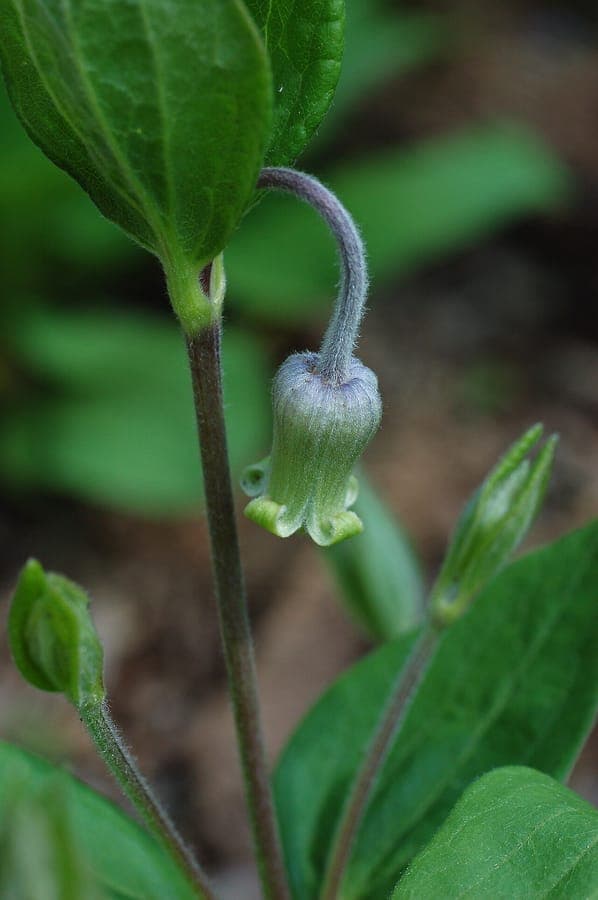
Photo by and (c)2007 Derek Ramsey (Ram-Man) / CC BY-SA 2.5, via Wikimedia Commons
Clematis ochroleuca: complete guide
Clematis ochroleuca
Want to see Clematis ochroleuca: complete guide in your garden?
1 minute, no credit card
Overview
Clematis ochroleuca, commonly called curlyheads or pale yellow clematis, is a semi-woody climbing plant native to the eastern United States. This plant is indigenous to mountainous areas of the Appalachians, from Maryland to North Carolina. It is a relatively obscure species in Europe but certainly deserves more attention from plant enthusiasts.
This is not a typical clematis - it is not a large-flowered variety like the popular 'Nelly Moser', but rather a more modest, semi-shrubby plant with fascinating pale yellow flowers. The plant is known for its feathery seedheads, which are called "curlyheads".
At GardenWorld, we recommend this plant to gardeners seeking something unique and unusual.
Appearance and bloom
Clematis ochroleuca is a semi-woody climber reaching approximately 1-1.5 meters tall. Unlike many other clematis, this is not a vigorous climber - it grows more like a loose shrub or weak climber.
The leaves are small, compound, and somewhat grey-green. They are less prominent than in many other clematis species. The plant loses considerable foliage in hard winters.
The flowers are small to medium, 2-3 cm across, and an intriguing cream to pale yellow colour. They appear from April to May. The flowers have four tepals (petal-like parts) that open and lie flat.
After flowering, the characteristic seedheads form - long, silky hairs that create a tangled mass. This gives the plant a silvery, elegant appearance in late summer and autumn.
Ideal location
Clematis ochroleuca blooms best in full sun to semi-shade. At least 4-5 hours of direct sunlight daily ensures good flowering. The plant can, however, also survive in partial shade.
This is not a vigorous climber - it needs support. Use a low trellis, a low fence, or allow it to grow through other plants.
The plant grows well against south-facing walls. Protection from cold winds is useful in severe frost regions.
Prefers well-drained, not too moist locations.
Soil
Clematis ochroleuca grows in preference in well-drained, moderately fertile soils. In nature it grows in mountain forests on humus-rich, sandy soils.
For cultivation: provide humus-rich earth, with the addition of composted bark or coco-peat. Add sand or perlite for drainage.
The plant accepts pH levels from neutral to slightly acidic (6.0-7.5). Heavy feeding is not necessary - in fact, excessive fertilizer can cause unwanted foliage growth.
Using a mulch as base material would help ensure cool roots - clematis love "cool feet".
Free design
Want to see Clematis ochroleuca: complete guide in your garden? Make a free design now.
Watering
Once established, this clematis is moderately drought-tolerant. Young plants need regular watering, especially during the first growing season.
Water so that the soil remains moist but not waterlogged. Water when the top 2-3 cm feels dry.
Beware of waterlogging - clematis are prone to disease when roots are permanently wet.
In container cultivation, well-drained potting mix must be used and watering should be regular.
Pruning
Clematis ochroleuca flowers on young wood. This means you can prune quite aggressively without damaging flowering.
At the end of winter (February-March), prune back to about 30 cm above ground level. This stimulates new, flowering-bearing growth.
You can also deadhead after flowering to maintain shape and encourage compact growth.
Note: because this plant is semi-woody, you will see some older wood remaining as a base.
Maintenance calendar
Spring: Prune out winter-killed wood. Begin regular watering. Late spring: Check for pests. Add support as needed. Summer: Water regularly. Monitor plant for disease. Autumn: Reduce watering. Admire the feathery seedheads. Winter: Protect from extreme frost. No maintenance needed.
Winter hardiness
Clematis ochroleuca is hardy to USDA zone 5 (-20C to -30C). In the UK and northern Europe no protection is needed. In northern Germany, root protection may be useful.
The plant loses considerable foliage in hard winters. This is normal - it regrows from roots.
Root protection (mulching around the base) helps in extreme cold.
Companion plants
Clematis ochroleuca combines well with:
- Other North American wild plants: Aquilegia canadensis, Oenothera
- Low shrubs: Weigela, Forsythia (as support plants)
- Ornamental grasses: Miscanthus, Panicum for contrast
- Early-blooming bulbs: Allium, Erythronium
Closing
Clematis ochroleuca is a scarce, intriguing specimen that deserves recognition. This is not for everyone - it does not flower as showily as many popular clematis varieties. But for plant enthusiasts seeking something unique and appreciating subtle beauty, this is an excellent choice.
This plant is difficult to obtain in UK or German garden centers. Specialized clematis nurseries are your best source. Growing from seed can also be successful, though this requires patience.
Feel free to introduce this rare American species to your garden!
Want to see Clematis ochroleuca: complete guide in your garden? Make a free design now.
Upload a photo, pick a style, and get a photorealistic design with plant list in under a minute.
No credit card required


Similar plants
Drummond's anemone: complete guide
Anemone drummondii
Discover Drummond's anemone (Anemone drummondii): a silvery-grey mountain plant for cool rock gardens and alpine troughs.
Korean clematis: complete guide
Clematis serratifolia
Clematis serratifolia is a hardy climber with fragrant yellow bell flowers in August-September. Pruning group 3, location and care tips.
Aquilegia brevistyla: complete guide
Aquilegia brevistyla
Discover Aquilegia brevistyla, the elegant North American columbine. Growing tips, shade tolerance, and design ideas for woodland and shadowed gardens.