
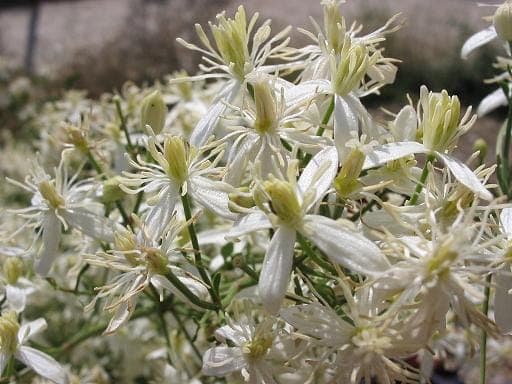
Alberto Salguero Quiles (P40p) / CC BY-SA 3.0, via Wikimedia Commons
Fragrant clematis: complete guide
Clematis flammula
Want to see Fragrant clematis: complete guide in your garden?
1 minute, no credit card
Overview
Clematis flammula, commonly known as fragrant clematis, is a vigorous vine that thrives in temperate climates across Europe. Native to regions like southern France, Greece, and parts of the Balkans, this plant brings both beauty and function to the garden. It grows quickly, reaching 4 to 5 meters in a single season, making it ideal for covering fences, arbors, or stone walls. Unlike many other clematis varieties, it's relatively disease-resistant and doesn't suffer as badly from clematis wilt, a common issue among gardeners.
If you're looking for a plant that combines fast coverage with sensory appeal, this is a top contender. On gardenworld.app, you can create a custom garden layout that integrates Clematis flammula into your structure plans-perfect for pergolas or old walls in need of softening. Its resilience and fragrance make it a standout in any planting scheme.
Appearance & bloom cycle
Flowering begins in June and continues through August, producing abundant clusters of small, pure white flowers-each about 2 to 3 cm wide. The standout feature, however, is the strong, sweet fragrance released mainly in the evening. This scent attracts moths and other night-flying pollinators, adding ecological value to your garden.
The foliage consists of compound leaves with three to five lance-shaped leaflets, dark green and slightly glossy on top. In autumn, the leaves may yellow slightly before dropping late. The plant develops fluffy seed heads by late summer, which persist into winter and add visual interest when frost settles on them.
Ideal location
Fragrant clematis thrives in full sun to light shade, scoring a 7 on the light scale. Like all clematis, it follows the rule: "roots in the shade, head in the sun." Plant it near south- or west-facing walls, but ensure the base is shaded-either by ground cover, mulch, or companion planting. This prevents the roots from overheating and drying out.
In gardens across the UK and northern Europe, it performs well on wooden trellises, stone walls, or over arches. For precise spacing and growth projection, use gardenworld.app to simulate how much coverage you'll achieve in two growing seasons.
Soil requirements
The soil should be well-draining yet moisture-retentive, with a pH between 6.5 and 7. Avoid acidic or heavy clay soils unless amended. At planting, mix in generous amounts of compost or well-rotted manure. A blend of garden soil, compost, and sand (2:1:1) works well.
In areas with heavy clay-common in parts of England or Belgium-dig a planting hole at least 50x50x50 cm and backfill with improved soil. Add a layer of gravel at the bottom for better drainage.
Free design
Want to see Fragrant clematis: complete guide in your garden? Make a free design now.
Watering
Keep the soil consistently moist, especially from April to September. Water once or twice a week depending on rainfall and temperature. Young plants are more vulnerable to drought stress, so don't let the root zone dry out completely. Rainwater is preferred, as tap water with high lime content can affect long-term soil health.
During dry spells, increase watering frequency and apply a 5–8 cm layer of organic mulch to retain moisture and suppress weeds.
Pruning
Clematis flammula belongs to pruning group 3, meaning it flowers on new growth. Cut it back hard in late winter or early spring to 30–40 cm above ground level. This encourages bushy growth and prevents the plant from becoming leggy.
Use clean, sharp secateurs to avoid spreading disease. Remove any dead or damaged stems during spring cleanup. Regular pruning also helps reduce fungal issues by improving airflow.
Maintenance calendar
- Jan: Inspect stems, prepare tools
- Feb: Begin hard back to 30–40 cm
- Mar: Plant new specimens, add compost
- Apr: Start regular watering, watch for aphids
- May: Tie new shoots, mulch root zone
- Jun: Flowers open, fragrance peaks in evenings
- Jul: Full bloom, monitor for pests
- Aug: Bloom tapers, light feed if needed
- Sep: Reduce watering, remove seed heads if desired
- Oct: Let foliage drop, refresh mulch layer
- Nov: Protect young plants with straw or leaves
- Dec: Dormant period, minimal care required
Winter hardiness
Hardy to USDA zone 6 (-23°C to -18°C), Clematis flammula survives most European winters without protection. In colder regions like eastern Germany or northern France, young plants benefit from a winter mulch of straw or bracken. Mature plants usually survive unscathed.
Even if top growth dies back in severe winters, the roots remain alive and send up new shoots in spring. Avoid waterlogged soil in winter, as this increases the risk of root rot.
Companion plants
Pair with low-growing perennials like Nepeta, Geranium 'Rozanne', or Allium 'Purple Sensation' to shade the root zone. These also provide contrast in texture and bloom time. Behind the clematis, plant upright species such as Echinacea, Phlox, or Salvia for depth.
Avoid invasive groundcovers or aggressive self-seeders. Also, don't plant near large shrubs that might outcompete it for water and nutrients.
Closing
Clematis flammula is a reliable, fast-growing climber that brings fragrance and vitality to any garden. With proper siting and care, it will thrive for years. Purchase healthy stock from reputable garden centres across the UK or online. For planning, use tools like gardenworld.app to visualize how it integrates with your existing layout. Whether covering an old wall or softening a wooden fence, this clematis earns its place in the garden-not just for looks, but for the evening perfume that drifts through the air.
Want to see Fragrant clematis: complete guide in your garden? Make a free design now.
Upload a photo, pick a style, and get a photorealistic design with plant list in under a minute.
No credit card required


Similar plants
Drummond's anemone: complete guide
Anemone drummondii
Discover Drummond's anemone (Anemone drummondii): a silvery-grey mountain plant for cool rock gardens and alpine troughs.
Korean clematis: complete guide
Clematis serratifolia
Clematis serratifolia is a hardy climber with fragrant yellow bell flowers in August-September. Pruning group 3, location and care tips.
Aquilegia brevistyla: complete guide
Aquilegia brevistyla
Discover Aquilegia brevistyla, the elegant North American columbine. Growing tips, shade tolerance, and design ideas for woodland and shadowed gardens.