
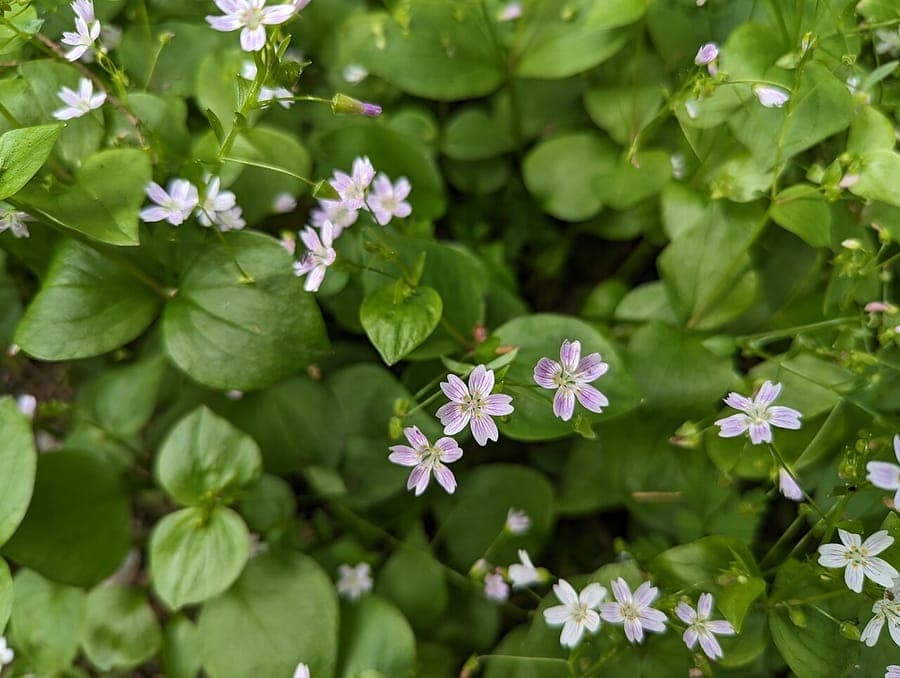
Guerric Haché / CC0, via Wikimedia Commons
Candy-flower: complete guide
Claytonia sibirica
Want to see Candy-flower: complete guide in your garden?
1 minute, no credit card
Overview
Candy-flower (Claytonia sibirica) is a delicate, low-growing perennial that brings subtle beauty to the early spring garden. Despite its name suggesting Siberian origins, it's actually native to western North America-from Alaska down through British Columbia to California-and thrives in cool, moist forests and stream banks. In gardens across the UK and northern Europe, it's become a welcome addition for those who appreciate understated, naturalistic planting.
This plant behaves as a short-lived perennial or self-seeding annual, forming loose mats that spread gently over time. It's not aggressive, but it does appreciate consistent moisture and shade, making it ideal for woodland edges, shaded rock gardens, or beneath deciduous trees. It's also edible-the succulent leaves have a mild, spinach-like flavour and can be added to salads in spring.
On gardenworld.app, you can design a shaded garden layout that highlights candy-flower's fleeting bloom period and integrates it seamlessly with other spring ephemerals.
Appearance & bloom cycle
Candy-flower grows to about 10–15 cm in height, with fleshy, lance-shaped leaves arranged in loose spirals along slender, branching stems. The foliage is bright green and slightly glossy, giving the plant a fresh, dewy appearance even on overcast days.
The flowers are small-around 1 cm wide-with five pale pink to white petals that often have a deeper pink flush at the base. They bloom from February to May, depending on local climate, with peak flowering in March and April. One fascinating trait: the blossoms only open fully in sunlight and close at night or on cloudy days, protecting pollen and conserving energy.
Seed pods develop quickly after pollination, splitting open to disperse tiny black seeds. These germinate in autumn or early winter when soil temperatures drop, producing new rosettes that overwinter and bloom the following spring.
Ideal location
Plant candy-flower in partial to full shade, especially under deciduous trees like maples, birches, or hazels that provide dappled light in spring before leafing out fully. It performs poorly in hot, dry sun, particularly in south-facing borders.
Ideal microclimates include north-facing slopes, shaded woodland paths, or under shrubs that offer protection from drying winds. It also does well in rock gardens with sheltered crevices where moisture lingers.
For UK gardeners, USDA zones 4–8 are suitable, with best performance in zones 6–7 where winter chill is sufficient for germination but extreme cold is rare.
Use gardenworld.app to map light patterns in your garden and find the perfect shaded pocket for this delicate species.
Free design
Want to see Candy-flower: complete guide in your garden? Make a free design now.
Soil requirements
The soil should be moist but well-drained, rich in organic matter. Loamy or clay-loam soils work best, as they retain moisture without becoming waterlogged. Avoid sandy or chalky soils unless amended with leaf mould or compost.
pH range: 5.5 to 7.0. If your soil is too alkaline, mix in peat-free ericaceous compost to lower the pH slightly.
Before planting, loosen the top 10 cm of soil and incorporate a generous layer of compost. This improves moisture retention and provides nutrients without the need for fertiliser.
Watering
Keep the soil consistently moist from autumn through late spring. During dry spells in March or April, water weekly if rainfall is below 25 mm. Avoid overhead watering once flowers appear, as this can damage delicate blooms.
Once the plant dies back in early summer (usually by June), stop watering entirely. The seeds lie dormant in the soil until autumn rains and cooling temperatures trigger germination.
Pruning
No pruning is required. The plant naturally dies down after setting seed. You can remove spent foliage if it looks untidy, but leaving it in place helps protect developing seedlings and adds organic matter to the soil.
Do not cut back too early-wait until growth turns brown and brittle.
Maintenance calendar
- September: Seeds germinate. Keep soil moist.
- October–January: Rosettes form and overwinter. Protect from severe frost with leaf litter if needed.
- February: Flower buds appear. Watch for slugs.
- March–April: Peak bloom. Ensure consistent moisture.
- May: Flowering ends. Seed pods form.
- June: Plant dies back. No care needed.
- July–August: Dormant period. Avoid disturbing soil.
Winter hardiness
Candy-flower is fully hardy to USDA zone 4 (down to -30°C). Young rosettes can survive under snow cover and even continue slow growth during mild winter spells. In exposed gardens, a light mulch of leaf mould helps prevent frost heave.
No winter protection is needed in most UK and northern European climates.
Companion plants
Pair candy-flower with other spring ephemerals: snowdrops (Galanthus), crocus, Erythronium, or Trillium. It also blends well with ferns, hostas, and carex, which emerge later and cover the fading foliage.
Avoid planting near aggressive ground covers like ivy or periwinkle, which will smother it. Instead, use it as a living mulch under shrubs or along shaded pathways.
Closing
Candy-flower isn't a showstopper, but it's a quiet hero of the early garden-offering colour when little else is blooming and supporting early pollinators like hoverflies and solitary bees. It asks for little: shade, moisture, and patience.
Buy seeds or plugs from garden centres in late winter, or look for established plants at specialist nurseries. Retailers like B&Q, Wyevale, or local independents often carry spring woodland plants.
And remember: on gardenworld.app, you can simulate seasonal changes to see how candy-flower fits into your garden's yearly rhythm-perfect for planning a low-maintenance, pollinator-friendly space.
Want to see Candy-flower: complete guide in your garden? Make a free design now.
Upload a photo, pick a style, and get a photorealistic design with plant list in under a minute.
No credit card required


Similar plants
Montia linearis: complete guide
Montia linearis
Discover narrow-leaf montia, a delicate alpine herb with fine linear foliage and white blooms. Learn care tips, growing requirements, and how to cultivate this North American mountain plant.
Lewisia rediviva: complete guide
Lewisia rediviva
Lewisia rediviva, known as Bitterroot, is a stunning alpine plant with delicate pink flowers. Learn how to cultivate this rare mountain gem in your garden with expert care tips.
Montia fontana: complete guide
Montia fontana L.
Water-blinks (Montia fontana) is a tiny aquatic plant ideal for pond gardens and water features. Learn care requirements, water parameters, and propagation methods.