
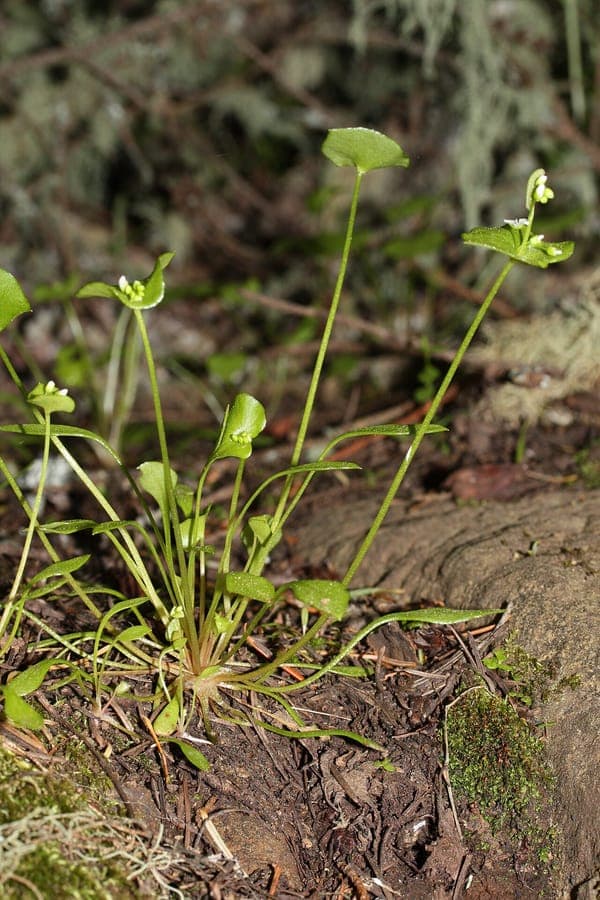
Walter Siegmund (talk) / CC BY-SA 3.0, via Wikimedia Commons
Cuban-spinach: complete guide
Claytonia perfoliata
Want to see Cuban-spinach: complete guide in your garden?
1 minute, no credit card
Overview
Cuban-spinach, or Claytonia perfoliata, is a tender, low-growing herb that brings life to early spring gardens. Native to regions stretching from British Columbia down through Mexico, this hardy annual or short-lived perennial thrives in USDA zones 4 to 8. Standing between 10 and 20 cm tall, it emerges as one of the first green signs of the season, often poking through leaf litter under deciduous trees. Its succulent foliage and delicate white blooms offer both visual appeal and culinary value.
The plant earns its common name from its mild, spinach-like flavor, making it a favorite in salads and light sautés. The leaves form a distinctive perfoliate pattern - where the leaf base wraps around the stem - giving it a clean, geometric look. As a member of the Montiaceae family, it's closely related to other miner's lettuce species but stands out for its resilience and adaptability.
On gardenworld.app, you can design a seasonal planting scheme that integrates Cuban-spinach with other early risers like garlic mustard or creeping phlox, ensuring your garden transitions smoothly from winter dormancy to spring vibrancy.
Appearance & bloom cycle
Claytonia perfoliata features smooth, glossy green leaves that grow opposite each other along slender, upright stems. The foliage is soft and juicy, with a translucent quality that catches morning light beautifully. Between April and June, clusters of small, star-shaped white flowers appear at the stem tips. Each bloom is about 1 cm across, with five petals and a subtle pinkish base that deepens in sunlight.
The flowering period peaks in May and attracts early-season pollinators such as hoverflies and small bees. While not a showy plant, its quiet presence adds texture and freshness to woodland edges, rockeries, and understory plantings. The flowers open fully on sunny days and partially close in overcast conditions, a charming trait that gardeners appreciate.
Once flowering ends, the plant sets seed quickly and often self-sows, returning reliably the following year if conditions are favorable.
Ideal location
Cuban-spinach prefers a light level of 5 - meaning partial shade to light sun. It performs best under open canopies, along north-facing borders, or in areas that receive morning sun but afternoon shade. In hotter zones, full sun can cause leaf scorch, so aim for filtered light.
Ideal spots include beneath shrubs, at the base of hostas, or tucked between emerging perennials. Avoid areas with heavy foot traffic, as the stems are fragile. Urban gardeners might consider planting it in shallow raised beds or containers with a soil-based compost mix.
Using gardenworld.app, you can preview how Cuban-spinach fills in bare spring spots before other plants wake up, helping you plan visual continuity.
Free design
Want to see Cuban-spinach: complete guide in your garden? Make a free design now.
Soil requirements
This plant thrives in well-drained, humus-rich soil with a pH between 6.0 and 7.0. It tolerates clay if amended with organic matter but dislikes waterlogged conditions. A mix of garden soil, compost, and a bit of perlite works well in containers.
Avoid overly sandy or nutrient-poor soils, as they lead to stunted growth. A light application of balanced organic fertilizer in late winter supports lush foliage. Mulching with leaf mold or compost helps retain moisture and suppresses weeds.
Watering
Keep the soil consistently moist but never soggy. Water when the top 2–3 cm of soil feels dry - especially important during dry spells in March and April. Drought stress causes the plant to bolt quickly, reducing leaf quality.
In rainy climates, natural precipitation may be sufficient. In drier areas, a weekly deep watering encourages deeper root development. Avoid overhead watering if possible to prevent fungal issues.
Pruning
Pruning isn't necessary, but you can harvest young leaves from March onward for continuous production. Snip off the top 5–8 cm of growth, leaving the base intact. This encourages bushier regrowth and delays flowering.
If you want to limit spreading, deadhead spent blooms before seed forms. Otherwise, allow natural reseeding for next year's display.
Maintenance calendar
- January: Check for early growth; protect from harsh frosts with horticultural fleece.
- February: Apply a thin layer of compost. Begin monitoring for slugs.
- March: Start harvesting young leaves. Keep soil evenly moist.
- April: Flowers appear. Watch for aphids on new growth.
- May: Peak bloom. Support pollinators by leaving some plants to flower fully.
- June: Plants begin to yellow and die back. Remove dead stems or leave for self-seeding.
- July–December: Dormant. No active care needed.
Winter hardiness
Cuban-spinach is reliably hardy down to -20°C (USDA zone 4). It often survives winter as a rosette, ready to grow quickly in spring. In colder zones, a light mulch of leaves or straw offers extra protection. Seeds can germinate at temperatures as low as 5°C, often appearing in late winter.
In milder climates, it may behave as a true perennial, returning from rootstock. In colder areas, it acts as a winter annual, reseeding freely.
Companion plants
Pair Claytonia perfoliata with hellebores, epimediums, or early crocus. It complements shade-tolerant plants like ferns, heuchera, or tiarella. Avoid aggressive spreaders like mint or ground ivy that could outcompete it.
In edible gardens, plant it near chives, parsley, or lettuce for easy access to fresh greens.
Closing
Cuban-spinach is a quiet achiever in the garden - unassuming but invaluable. It offers food, beauty, and ecological benefit with minimal input. Its ability to thrive in cool, moist conditions makes it perfect for gardeners seeking low-effort, high-reward plants.
You can find seeds or starter plants at garden centres across the UK and North America. For those in the US, check local nurseries in February and March. In Europe, garden centres like Intratuin or Gamma often stock it in early spring. Start small, and you'll soon see how this humble herb earns its place in any well-planned garden.
Want to see Cuban-spinach: complete guide in your garden? Make a free design now.
Upload a photo, pick a style, and get a photorealistic design with plant list in under a minute.
No credit card required


Similar plants
Montia linearis: complete guide
Montia linearis
Discover narrow-leaf montia, a delicate alpine herb with fine linear foliage and white blooms. Learn care tips, growing requirements, and how to cultivate this North American mountain plant.
Lewisia rediviva: complete guide
Lewisia rediviva
Lewisia rediviva, known as Bitterroot, is a stunning alpine plant with delicate pink flowers. Learn how to cultivate this rare mountain gem in your garden with expert care tips.
Montia fontana: complete guide
Montia fontana L.
Water-blinks (Montia fontana) is a tiny aquatic plant ideal for pond gardens and water features. Learn care requirements, water parameters, and propagation methods.