
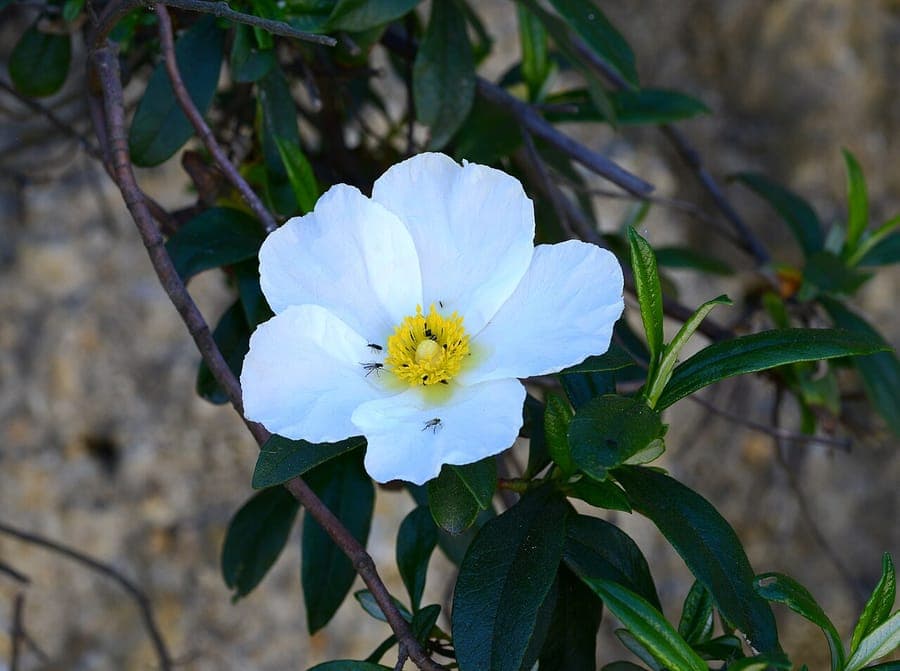
Alvesgaspar / CC BY-SA 3.0, via Wikimedia Commons
Montpelier rock-rose: complete guide
Cistus monspeliensis
Want to see Montpelier rock-rose: complete guide in your garden?
1 minute, no credit card
Overview
Cistus monspeliensis, commonly known as Montpelier rock-rose, is a resilient Mediterranean subshrub that thrives in hot, dry conditions. Native to regions stretching from southern France to Greece and the Balearic and Canary Islands, this hardy plant is built for life on rocky slopes and coastal bluffs. It grows to about 60–80 cm tall with a spread of 70 cm, forming an open, bushy mound. Its narrow, grey-green leaves and short-lived but abundant white flowers make it a standout in xeriscapes and informal gardens. On gardenworld.app, you can design a drought-resistant garden layout that highlights this sun-loving beauty.
Appearance & bloom cycle
The Montpelier rock-rose features lance-shaped leaves up to 4 cm long, covered in fine hairs that give them a silvery sheen. The foliage is evergreen in mild climates, providing year-round structure. From May to June, the plant bursts into bloom with large, five-petaled white flowers, each around 5 cm wide. At the base of each petal is a striking dark purple spot, creating a subtle focal point. Each flower lasts just one day, but new buds open daily, ensuring a continuous display for four to six weeks. After flowering, small woody seed capsules form, typical of the Cistaceae family.
Ideal location
Plant Cistus monspeliensis where it receives full sun - a rating of 8 on the light scale. It performs best in south- or southwest-facing areas with excellent air circulation. Avoid shaded or damp corners. This plant is ideal for coastal gardens due to its tolerance of salt spray. It also grows well in containers on sunny patios or rooftops. If you're unsure about sunlight exposure in your garden, gardenworld.app offers tools to map sun patterns and help position your rock-rose perfectly.
Soil requirements
This rock-rose prefers light, well-drained soils with a pH between 4.5 and 5.0. It handles poor, sandy, or gravelly soils with ease but struggles in heavy clay unless amended with grit or coarse sand. Never plant it in water-retentive soil - root rot is a common killer. Avoid rich compost or manure; excess nutrients lead to leggy growth and fewer flowers. A mix of native soil, grit, and a little leaf mould works well in borders or pots.
Watering
Water young plants regularly during their first growing season to establish strong roots. Once established, Cistus monspeliensis is extremely drought-tolerant and rarely needs supplemental watering, even in prolonged dry spells. When you do water, soak the base deeply but infrequently - once every 10 to 14 days in hot weather. Never wet the foliage, and avoid overhead irrigation. Overwatering is the most common mistake with this plant.
Free design
Want to see Montpelier rock-rose: complete guide in your garden? Make a free design now.
Pruning
Prune right after flowering, between late June and early July. Cut back flowering stems by about one-third to maintain a compact shape and encourage new growth for next year's blooms. Remove any dead wood and thin out crowded interior branches to improve airflow. Use clean, sharp secateurs and cut just above an outward-facing bud. Avoid hard pruning in autumn or winter, as new growth may not harden off before frost.
Maintenance calendar
- Jan: Check for frost damage; avoid watering
- Feb: Inspect plant structure; prepare tools for spring
- Mar: Check root zone; loosen any tight root balls if repotting
- Apr: Monitor bud development; no fertiliser needed
- May: Peak bloom; water sparingly if soil is dry
- Jun: Prune after flowering; deadhead spent blooms
- Jul: Let plant rest; no feeding or major pruning
- Aug: Monitor for drought stress; water only in extreme heat
- Sep: Leave plant debris as natural mulch
- Oct: Remove dead leaves; prevent soil compaction
- Nov: Protect young plants with dry mulch (straw or bracken)
- Dec: Minimal care; watch for wet soil conditions
Winter hardiness
Cistus monspeliensis is hardy in USDA zones 8b to 10. In cooler zones like 8a, it may survive mild winters with some protection. Young plants are more vulnerable - cover them with dry bracken or horticultural fleece if frost is forecast. In harsh winters, top growth may die back, but the plant often regrows from the base in spring. Persistent wet soil in winter is more dangerous than cold itself.
Companion plants
Pair Montpelier rock-rose with other Mediterranean plants like lavender (Lavandula angustifolia), rosemary (Rosmarinus officinalis), or santolina. Low-growing thymes (Thymus vulgaris) and sedums work well at the front of borders. Avoid aggressive spreaders or plants that demand rich, moist soil. On gardenworld.app, you can preview how this rock-rose pairs with drought-tolerant companions in your garden design.
Closing
Cistus monspeliensis is a reliable, low-maintenance shrub for sunny, dry gardens. Its bright white flowers and silvery foliage bring texture and light to challenging spots. Buy from trusted garden centres like local independents or national chains where plants are grown in conditions similar to your garden. With proper placement and light pruning, this rock-rose will thrive for years, adding effortless charm to your outdoor space.
Want to see Montpelier rock-rose: complete guide in your garden? Make a free design now.
Upload a photo, pick a style, and get a photorealistic design with plant list in under a minute.
No credit card required


Similar plants
Curled-leaf rock rose: complete guide
Cistus crispus
Everything you need to grow Cistus crispus, the curled-leaf rock rose from the western Mediterranean. Siting, soil, pruning, and winter care fully explained.
Marjoram-leaved sun rose: complete guide
Helianthemum marifolium
Everything about Helianthemum marifolium, the marjoram-leaved sun rose: location, dry soil, flowering season and care for this Mediterranean rock plant in your garden.
Beach-heath: complete guide
Hudsonia tomentosa
Complete guide to Hudsonia tomentosa: growing this woolly sand-heath on poor sandy soils, its care needs, companions and garden uses.