
Gerhard Nitter / CC BY-SA 3.0, via Wikimedia Commons
Tuberous thistle: complete guide
Cirsium tuberosum
Want to see Tuberous thistle: complete guide in your garden?
1 minute, no credit card
Overview
Cirsium tuberosum, commonly known as tuberous thistle, is a sturdy, clump-forming perennial that stands out in summer borders and wild meadows across central and southern Europe. Unlike its invasive relatives, this species behaves well in garden settings, staying upright and non-spreading under average conditions. Native to France, Germany, Great Britain, Italy, Spain, Switzerland, and former Yugoslavia, it thrives in dry grasslands and on limestone slopes where moisture is scarce.
What sets this thistle apart is its underground tuber - a fleshy, nutrient-storing root that allows the plant to survive prolonged droughts. It's reliably hardy in USDA zones 5 through 8, making it a solid long-term performer in temperate and cooler gardens. Growing 80 to 120 cm tall, it adds vertical interest and bold texture to planting schemes. Its deep purple flowers are a magnet for bees, butterflies, and hoverflies, making it a valuable addition to pollinator gardens.
On gardenworld.app, you can design a planting plan that integrates tuberous thistle with complementary bloom times and soil needs, ensuring a balanced, dynamic garden.
Appearance & bloom cycle
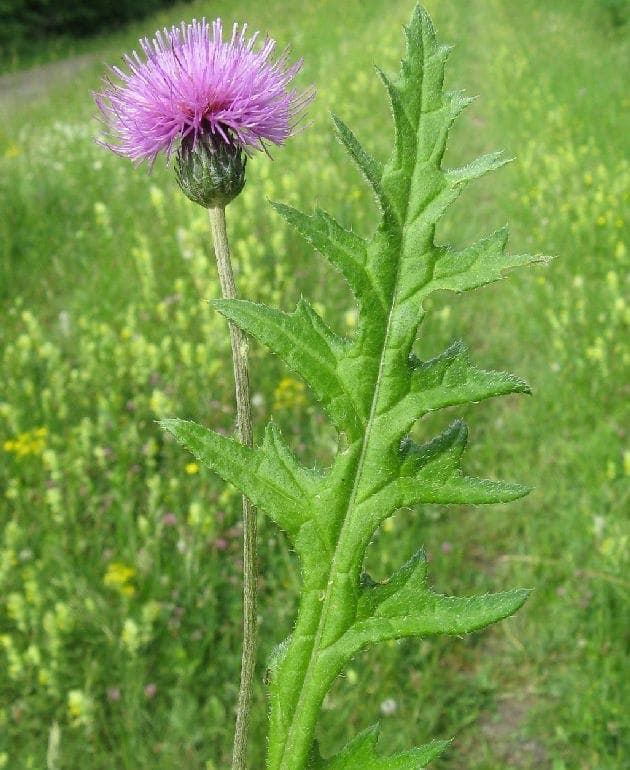
The tuberous thistle develops a basal rosette of dark green, lance-shaped leaves in its first year, with fine spines along the margins - noticeable but not aggressively prickly. In the second or third year, it sends up tall, branching stems topped with dense, globe-like flower heads. These blooms appear from June through August, peaking in midsummer.
Each flower head is 3 to 4 cm wide, rich purple to magenta, and composed of numerous narrow florets. They're held singly or in small clusters at the stem tips, attracting a wide range of pollinators. The plant has a biennial to short-lived perennial habit, often lasting 3 to 5 years before needing replacement. Deadheading encourages tidiness but isn't essential for control, as self-seeding is minimal under garden conditions.
Ideal location
This plant rates a 7 out of 10 for light demand, meaning it performs best in full sun to light shade. Aim for at least 6 hours of direct sunlight daily. South- or southwest-facing slopes are ideal, especially where air circulation is good and water doesn't pool. Avoid dense shade or areas under large trees, as this leads to weak stems and poor flowering.
In UK and US gardens, consider using tuberous thistle in gravel gardens, dry borders, or on raised beds. It's particularly effective when planted in drifts among silver-foliaged or drought-tolerant companions. Use gardenworld.app to map sun exposure in your yard and place this thistle where it'll get maximum light without competition.
Soil requirements
Tuberous thistle demands well-drained, alkaline soil with a pH between 7.5 and 8. It thrives in chalky or limestone-based substrates and tolerates poor, sandy, or gritty soils. Heavy clay or acidic loams are unsuitable unless amended with lime and coarse grit to improve drainage and raise pH.
Never plant it in water-retentive soil - root rot is the main cause of failure. Raised beds or sloped areas help prevent this. Avoid rich composts or high-nutrient mixes; these promote lush foliage at the expense of flowering and can weaken stem strength. In garden centres, look for 'chalk-loving plant' soil blends to give it the right start.
Free design
Want to see Tuberous thistle: complete guide in your garden? Make a free design now.
Watering
Once established, Cirsium tuberosum is extremely drought-tolerant. Water newly planted specimens weekly during the first growing season if rainfall is below 25 mm per week. Apply about 5 litres per plant, deeply and infrequently, to encourage deep root development.
After year one, rely on natural rainfall. Only intervene during extended dry spells in summer. Overwatering leads to floppy growth and fungal issues. Use a soaker hose if needed, but avoid wetting the foliage.
Pruning
Minimal pruning is required. Cut back flowered stems to the basal rosette in late September to maintain a neat appearance. Leave a few seed heads intact through autumn to feed finches and other birds, and to add winter structure.
Remove any yellowing or diseased leaves with clean secateurs. Do not mulch heavily over the crown - this can trap moisture and rot the tuber. No feeding is necessary; in fact, fertiliser can do more harm than good.
Maintenance calendar
- Jan: Check for crown rot in wet winters; keep mulch light.
- Feb: Clear away old foliage carefully to expose new growth.
- Mar: Loosen soil around plant, avoid disturbing tuber.
- Apr: Monitor for emerging shoots; water only if dry.
- May: Plant new tubers; keep soil dry.
- Jun: Bloom begins; watch for slugs on young rosettes.
- Jul: Peak flowering; no watering needed.
- Aug: Allow seed development; observe pollinator activity.
- Sep: Cut back spent stems; collect seeds if desired.
- Oct: Leave some foliage as winter mulch.
- Nov: Check for fungal spots in damp conditions.
- Dec: Minimal care; protect young plants in zone 5 with leaf litter.
Winter hardiness
Hardy in USDA zones 5–8, the tuberous thistle survives temperatures down to -20°C. In zone 5, a light covering of dry leaves or straw helps protect young crowns from freeze-thaw cycles. The main threat in winter isn't cold, but wet soil - ensure excellent drainage to prevent tuber rot. Mature plants generally overwinter well without intervention.
Companion plants
Pair with other drought-tolerant, chalk-loving perennials like Salvia x sylvestris, Eryngium planum, or Sedum 'Matrona'. These share similar water and pH needs. Grasses such as Deschampsia cespitosa or Molinia caerulea add movement and contrast. Avoid moisture-loving plants like ferns or hostas, which create conflicting conditions.
The tuberous thistle also works well in naturalistic plantings with Knautia macedonica or Scabiosa columbaria, creating a long-season pollinator buffet.
Closing
The tuberous thistle isn't a mainstream garden plant, but it deserves a place in any resilient, wildlife-friendly design. It brings bold colour, architectural form, and ecological value with minimal input. Buy it from garden centres in the UK, or order from native plant suppliers. Look for established plants rather than seeds for faster results.
Plant the tuber just below the soil surface - too deep and it may rot. Stake only if grown in rich soil or exposed sites. And use gardenworld.app to visualise how this striking thistle fits into your overall garden layout, season by season.
Want to see Tuberous thistle: complete guide in your garden? Make a free design now.
Upload a photo, pick a style, and get a photorealistic design with plant list in under a minute.
No credit card required


Similar plants
Calendula stellata: complete guide
Calendula stellata
Complete guide to Calendula stellata, the star-flowered marigold from Sicily: location, soil, watering and companion planting tips.
Korean chrysanthemum: complete guide
Chrysanthemum x rubellum
Chrysanthemum x rubellum is a hardy autumn perennial with single pink to copper flowers from August to November. Care and combinations.
Helianthus divaricatus: complete guide
Helianthus divaricatus
Helianthus divaricatus is a North American woodland sunflower with yellow summer blooms, ideal for naturalistic borders and shady edges.