
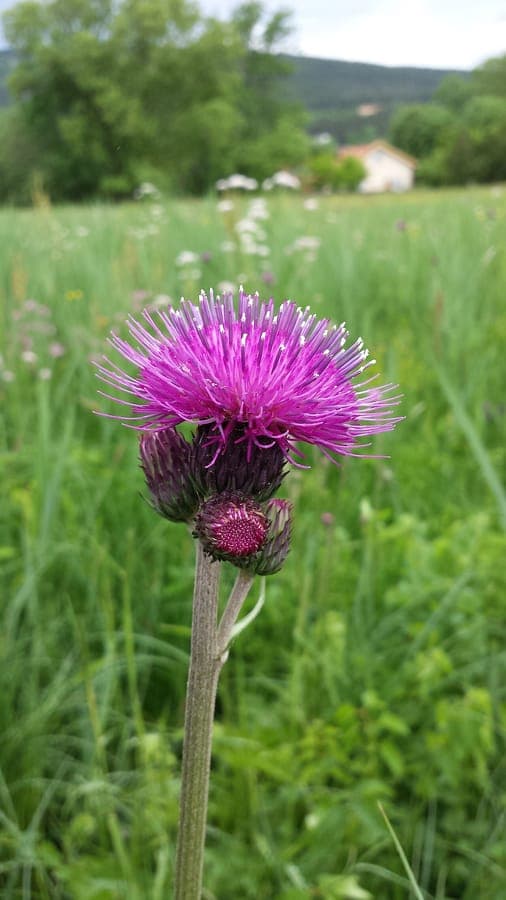
Stefan.lefnaer / CC BY-SA 3.0, via Wikimedia Commons
Brook thistle: complete guide
Cirsium rivulare
Want to see Brook thistle: complete guide in your garden?
1 minute, no credit card
Overview
Cirsium rivulare, commonly known as Brook thistle, is a graceful perennial that brings architectural flair and ecological value to the garden. Native to moist woodlands and grassy slopes across central and western Europe, it thrives in conditions that mimic its natural habitat. Unlike many thistles, it's not invasive or overly spiny-instead, it offers elegant, fern-like foliage and striking purple flower heads that hover above the border like delicate lanterns. It's a plant that works equally well in formal cottage gardens and wilder, naturalistic schemes. On gardenworld.app, you can design a planting plan that highlights the airy texture of Brook thistle and positions it where it'll shine all summer.
Appearance & bloom cycle
Brook thistle grows 90 to 120 cm tall, forming upright, branching stems with finely divided, dark green leaves that have a soft, almost silvery underside. The foliage is deeply lobed but not aggressively spiny, making it safe to handle and easy to integrate into mixed borders. From June through September, the plant produces thistle-like blooms-deep purple, dome-shaped flower heads about 5 cm wide. Each bloom lasts several weeks and attracts a wide range of pollinators, including honeybees, bumblebees, and butterflies like the red admiral and painted lady.
Deadheading encourages longer flowering, and leaving some seed heads in late autumn provides food for goldfinches and other small birds. The plant has a loose, open habit, allowing it to blend seamlessly with neighbouring perennials.
Ideal location
Choose a spot with full sun to light shade-around 6 to 7 hours of direct sunlight daily (level 7 on the light scale). Avoid deep shade or scorching south-facing locations with reflective heat. A partially shaded border near shrubs or tall grasses works well, as long as the plant gets morning or late afternoon sun.
Brook thistle performs best in moist, fertile borders or near the edge of damp areas like pond margins. It's not suited for dry gravel gardens or exposed, windy sites. Use it in wildlife gardens, cottage borders, or informal plantings where movement and texture are valued. On gardenworld.app, you can map out microclimates in your garden to find the perfect zone for this moisture-loving perennial.
Soil requirements
The plant prefers a rich, moisture-retentive soil with good drainage. Loam or clay-loam soils with a pH between 6.5 and 7.0 are ideal. Avoid highly acidic or sandy soils unless amended with compost or well-rotted manure. A top dressing of compost in early spring boosts fertility and helps retain moisture.
If your soil is heavy, improve aeration by mixing in grit or organic matter. For light, sandy soils, add leaf mould or compost to increase water-holding capacity. Mulching in spring with composted bark or leaf litter helps maintain consistent soil moisture and suppresses weeds.
Free design
Want to see Brook thistle: complete guide in your garden? Make a free design now.
Watering
Keep the soil consistently moist, especially during the first growing season and prolonged dry spells. Water deeply once or twice a week in summer rather than frequent shallow watering. Mature plants have some drought tolerance but will wilt and reduce flowering if left too dry.
Water at the base to prevent fungal diseases like powdery mildew, which can develop in humid conditions. Avoid overhead watering, particularly in the evening. Drip irrigation or soaker hoses work well in borders with multiple moisture-loving plants.
Pruning
Pruning isn't essential, but it improves appearance and flowering. Deadhead spent blooms regularly to prolong the flowering season and reduce self-seeding (though Cirsium rivulare is not aggressive). In late autumn or early spring, cut back old stems to about 10 cm above ground level.
If the clump becomes sparse in the center, divide the plant in early spring before new growth begins. Replant divisions in enriched soil and water well until established.
Maintenance calendar
- January: Check old stems; leave for winter interest or cut back.
- February: Prepare for division; tidy up debris.
- March: Divide and replant; add compost.
- April: Apply balanced fertiliser; watch for aphids.
- May: Continue feeding; water during dry spells.
- June: Flowers begin; deadhead first blooms.
- July: Maintain moisture; deadhead regularly.
- August: Monitor for mildew; ensure good airflow.
- September: Allow late flowers to set seed or deadhead.
- October: Remove diseased foliage; prepare for winter.
- November: Apply light mulch; protect root zone.
- December: Shield young plants from frost with straw.
Winter hardiness
Brook thistle is hardy in USDA zones 5 to 8 (-29°C to -12°C). In colder zones, protect the crown with a light mulch of straw or leaves. In areas with wet, frozen winters, ensure good drainage to prevent root rot. Container-grown plants should be moved to a sheltered location or insulated with bubble wrap.
Companion plants
Pair Brook thistle with late-summer bloomers like Echinacea purpurea, Persicaria amplexicaulis, Molinia caerulea, and Salvia nemorosa. It also works well with tall ferns, Carex species, and moisture-loving perennials such as Iris sibirica. Avoid overly aggressive spreaders like mint or goldenrod that might overwhelm it.
For contrast, plant near silver-foliaged perennials like Stachys byzantina or Artemisia ludoviciana. The airy habit of Brook thistle makes it ideal for planting in drifts through mixed borders.
Closing
Cirsium rivulare is a quietly brilliant addition to any garden that values beauty and biodiversity. It asks for little-consistent moisture, fertile soil, and a little grooming-but gives back with months of pollinator activity and elegant structure. You can find Brook thistle at garden centres like Wyevale or Thompson & Morgan, or explore planting combinations on gardenworld.app. Let the platform help you create a balanced, seasonal design where this thistle plays a starring role.
Want to see Brook thistle: complete guide in your garden? Make a free design now.
Upload a photo, pick a style, and get a photorealistic design with plant list in under a minute.
No credit card required


Similar plants
Calendula stellata: complete guide
Calendula stellata
Complete guide to Calendula stellata, the star-flowered marigold from Sicily: location, soil, watering and companion planting tips.
Korean chrysanthemum: complete guide
Chrysanthemum x rubellum
Chrysanthemum x rubellum is a hardy autumn perennial with single pink to copper flowers from August to November. Care and combinations.
Helianthus divaricatus: complete guide
Helianthus divaricatus
Helianthus divaricatus is a North American woodland sunflower with yellow summer blooms, ideal for naturalistic borders and shady edges.