
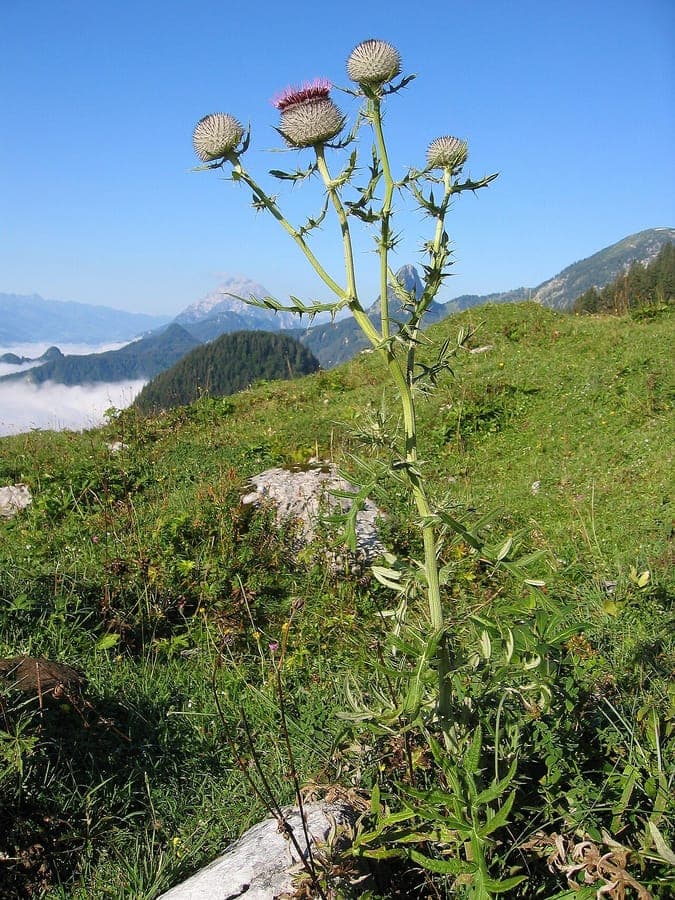
User:Tigerente / CC BY 2.5, via Wikimedia Commons
Woolly thistle: complete guide
Cirsium eriophorum
Want to see Woolly thistle: complete guide in your garden?
1 minute, no credit card
Overview
Cirsium eriophorum, commonly known as woolly thistle, is a striking perennial that brings rugged charm to naturalistic garden designs. Native to parts of Europe including Austria, France, Germany, and Great Britain, this member of the Asteraceae family thrives in dry, sunny grasslands and rocky slopes. It's not commonly found in the wild across all regions, but it's gaining popularity in gardens for its architectural form and low maintenance.
Unlike aggressive thistles, woolly thistle doesn't spread rampantly. It forms upright clumps 60–90 cm tall with a spread of about 40 cm. Its most distinctive feature is the dense covering of white, woolly hairs on the stems and buds - a natural adaptation that reduces water loss and protects against pests.
On gardenworld.app, you can design a planting scheme that highlights the woolly thistle's texture and bloom time, integrating it with other drought-tolerant species for a resilient, low-water garden.
Appearance & bloom cycle
The woolly thistle has lance-shaped, dark green leaves with spiny margins, but the spines are relatively soft compared to other thistles. The stems are densely covered in white, felt-like trichomes, giving them a silvery appearance. This woolly coating extends to the flower buds, which open in midsummer.
Flowering occurs from July to August. The flower heads are rich purple, 3–4 cm in diameter, and surrounded by bracts that retain the woolly texture - earning it nicknames like 'cotton-bearing thistle'. Each head is packed with nectar-rich florets, attracting bees, bumblebees, and butterflies, including the small tortoiseshell and red admiral.
After blooming, the seed heads develop a thistle-down appearance, similar to dandelions, and can persist into autumn, providing visual interest and food for finches and other seed-eating birds.
Ideal location
Woolly thistle needs full sun - aim for a light level of 8 or higher. That means south- or southwest-facing borders, rocky outcrops, or dry slopes. It performs poorly in shade, where it becomes leggy and fails to flower well.
Give each plant at least 50 cm of space to prevent competition, especially in lean soils where resources are limited. It works well in gravel gardens, wildflower meadows, or as a structural plant in mixed perennial beds.
Avoid overcrowding with vigorous growers like goldenrod or mint, which can overwhelm it. Instead, plant it where its form can stand out.
Soil requirements
This thistle prefers well-drained, calcareous (chalky or limestone-rich) soils with a pH between 8 and 9. It tolerates poor, sandy, or gravelly soils but struggles in acidic or heavy clay soils. If your soil is too acidic, amend it with ground limestone to raise the pH.
Test your soil with a simple kit before planting. On gardenworld.app, you can upload soil test results to get tailored planting recommendations, including pH adjustments and companion species that thrive in alkaline conditions.
Free design
Want to see Woolly thistle: complete guide in your garden? Make a free design now.
Watering
Once established, woolly thistle is highly drought-tolerant. During the first growing season (especially May to June), water young plants weekly if there's no rain - about 5 litres per plant. After that, supplemental watering is rarely needed, even in dry summers.
Overwatering is a bigger risk than underwatering. Soggy soil leads to root rot, so ensure excellent drainage. A gravel mulch helps keep the base dry and suppresses weeds.
Pruning
Pruning is minimal. After flowering, cut back spent stems to just above the basal rosette in September. This keeps the garden tidy and limits self-seeding, though Cirsium eriophorum is not invasive.
If you want to support birds, leave some seed heads standing through winter. Goldfinches and siskins will feed on the seeds, and the dried silhouettes add winter structure to the garden.
Maintenance calendar
- February–March: Remove any damaged or old foliage
- April: Prepare soil, adjust pH if needed
- May: Plant out young specimens, water weekly if dry
- June: Monitor growth, apply light feed if soil is very poor
- July–August: Peak bloom, minimal care required
- September: Cut back flowered stems
- October–November: Leave some seed heads for wildlife
- December–January: Dormant period, no maintenance
Winter hardiness
Woolly thistle is hardy in USDA zones 5 to 8. In the UK and much of northern Europe (zone 7), it survives winter without protection. The roots remain viable underground, while the top growth dies back.
In wet winters, ensure the crown stays dry. A gritty mulch around the base improves drainage and prevents rot. Avoid covering the crown with organic mulch, which can trap moisture.
Companion plants
Pair woolly thistle with plants that share its preference for sun and well-drained soil:
- Stachys byzantina – for contrasting silver foliage
- Eryngium planum – similar architectural form and blue tones
- Nepeta racemosa – long bloom season and pollinator appeal
- Sedum 'Matrona' – for late-season colour and height
- Festuca ovina glauca – for fine texture and blue-green contrast
Avoid moisture-loving plants like astilbe or hostas, which create conflicting cultural needs.
Closing
Woolly thistle is not a flashy bedding plant, but a resilient, ecologically valuable perennial that adds drama and function to the garden. It's perfect for sustainable landscapes, wildlife gardens, or anyone tired of high-maintenance borders.
You can find Cirsium eriophorum at garden centres across the UK. Look for nursery-grown stock rather than wild-collected plants to support conservation. When planted right, this thistle becomes a low-effort, high-impact feature year after year.
Want to see Woolly thistle: complete guide in your garden? Make a free design now.
Upload a photo, pick a style, and get a photorealistic design with plant list in under a minute.
No credit card required


Similar plants
Calendula stellata: complete guide
Calendula stellata
Complete guide to Calendula stellata, the star-flowered marigold from Sicily: location, soil, watering and companion planting tips.
Korean chrysanthemum: complete guide
Chrysanthemum x rubellum
Chrysanthemum x rubellum is a hardy autumn perennial with single pink to copper flowers from August to November. Care and combinations.
Helianthus divaricatus: complete guide
Helianthus divaricatus
Helianthus divaricatus is a North American woodland sunflower with yellow summer blooms, ideal for naturalistic borders and shady edges.