
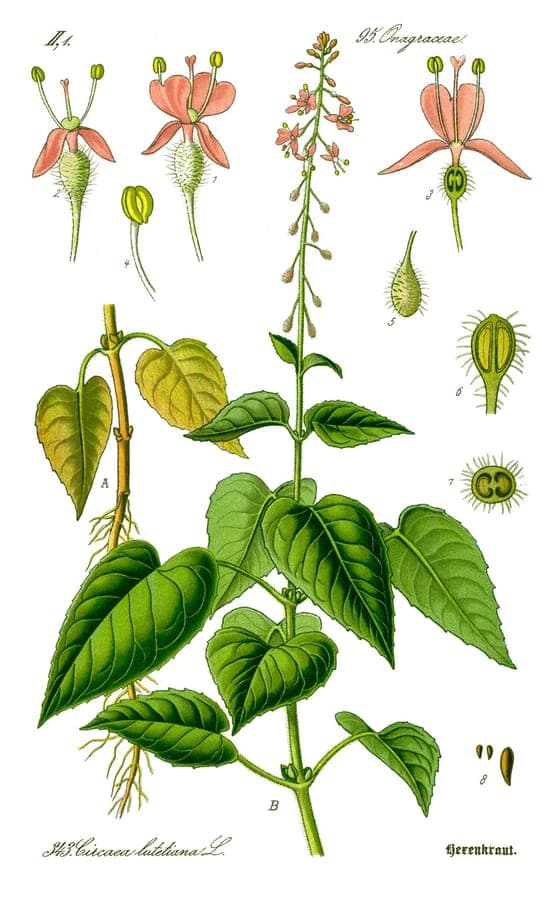
User:Kilom691 / Public domain, via Wikimedia Commons
Enchanter's-nightshade: complete guide
Circaea lutetiana
Want to see Enchanter's-nightshade: complete guide in your garden?
1 minute, no credit card
Overview
Enchanter's-nightshade (Circaea lutetiana) is a modest yet resilient perennial that thrives in cool, shaded corners where many plants struggle. Don't let its unassuming look fool you-this member of the Onagraceae family brings quiet elegance to woodland gardens and shady borders. Native to forests across Central and Western Europe, it grows naturally under deciduous trees, forming small colonies through creeping rhizomes. At 20–50 cm tall, it's perfect for the front or middle of a shaded bed.
Despite its magical-sounding name, it's not toxic nor related to true nightshades. The name likely comes from Circe, the mythological enchantress, possibly due to its sticky seeds that cling to clothing-like subtle spells catching on passersby. It's a plant for gardeners who appreciate understated beauty and low-maintenance greenery. On gardenworld.app, you can design a shade garden layout that highlights plants like Enchanter's-nightshade, blending them seamlessly with ferns and spring ephemerals.
Appearance & bloom cycle
The plant features slender, hairy stems with opposite, lance-shaped leaves 3–8 cm long. The foliage is medium green, slightly rough to the touch, with a finely toothed margin. From June through September, small white flowers appear in loose, spike-like racemes at the stem tips. Each flower has two delicate petals, two green sepals, and prominent stamens, giving them a star-like appearance up close.
After pollination, the flowers develop into bur-like fruits covered in tiny hooks. These cling easily to animal fur or clothing, aiding seed dispersal. While not as aggressive as burdock, it can spread slowly over time. The long flowering season makes it a valuable addition to any shade garden seeking continuous interest.
Ideal location
Enchanter's-nightshade prefers light to medium shade (light level 4 out of 10). It performs best under the dappled canopy of deciduous trees, along woodland edges, or in north-facing borders. Full sun will scorch its leaves and dry the soil too quickly, while deep, dense shade reduces flowering and causes leggy growth.
It's ideal for naturalistic planting schemes and works well in cottage gardens, wild corners, or beneath shrubs like hazel or dogwood. Pair it with hostas or ferns for texture contrast. On gardenworld.app, you can simulate how this plant integrates into your garden's microclimate, helping you place it where moisture and shade align perfectly.
Soil requirements
This plant favors moist, humus-rich, loamy or clay-loam soils with a pH between 6.5 and 7.0. It needs consistent moisture but not waterlogged conditions. Improve sandy soils with compost or leaf mould to boost water retention and nutrient content.
Avoid highly acidic soils (below pH 6.0), which can stunt growth. In alkaline conditions, ensure organic matter is added regularly to prevent nutrient lock-up. A spring mulch of well-rotted leaf compost helps maintain moisture and suppresses weeds without smothering the plant.
Free design
Want to see Enchanter's-nightshade: complete guide in your garden? Make a free design now.
Watering
Keep the soil evenly moist, especially during dry spells in summer. Young plants need more frequent watering until established. Water deeply once or twice a week rather than shallow daily sprinkles, encouraging roots to grow downward.
Once mature, Enchanter's-nightshade is fairly resilient, relying on natural rainfall in woodland settings. However, in urban gardens with faster-draining soils, supplemental watering during July and August is recommended. Use rainwater when possible to avoid lime buildup in sensitive soils.
Pruning
Pruning isn't essential. In late autumn, after the foliage dies back, you can cut the stems down to ground level for a tidy appearance. If you want to limit self-seeding, remove spent flower spikes before the fruits develop.
In early spring, thin out overcrowded patches by dividing the rhizomes. Wear gloves-the sticky seeds can cling to skin and clothing. Replant divisions in other shady spots or share them with fellow gardeners.
Maintenance calendar
- January–February: Dormant. No action required.
- March: Watch for new shoots. Apply a thin layer of compost if needed.
- April–May: Keep soil moist. Watch for slugs, which may target young growth.
- June–September: Peak bloom. Water during dry periods. Deadhead lightly if desired.
- October–November: Cut back dead foliage. Mulch lightly with leaf mould.
- December: Dormant. No maintenance.
Winter hardiness
Enchanter's-nightshade is fully hardy in USDA zones 5–8. It dies back in winter but returns reliably each spring. No winter protection is needed, though a light mulch in colder zones helps retain soil moisture and insulate roots. In milder regions, foliage may persist into early winter.
Companion plants
Pair with native woodland species like wood anemone (Anemone nemorosa), bluebell (Hyacinthoides non-scripta), or common dog violet (Viola riviniana). It also complements ferns such as Polystichum setiferum or Matteuccia struthiopteris.
For structure, combine with Solomon's seal (Polygonatum) or wild geraniums. Avoid overly vigorous groundcovers like ivy or periwinkle, which may outcompete it. Spring bulbs like snowdrops or scilla add early-season contrast.
Closing
Enchanter's-nightshade won't dominate your garden, and that's its strength. It's a quiet performer in shady, damp areas where flashier plants fail. With minimal care, it provides months of delicate blooms and supports local ecology. Its subtle charm grows on you-much like its slow, steady spread through the soil. Find it at garden centres like B&Q, Wyevale, or local nurseries specialising in native plants.
Want to see Enchanter's-nightshade: complete guide in your garden? Make a free design now.
Upload a photo, pick a style, and get a photorealistic design with plant list in under a minute.
No credit card required


Similar plants
Shortfruit evening primrose: complete guide
Oenothera brachycarpa
Everything about Oenothera brachycarpa - the shortfruit evening primrose from the American Southwest. Growing tips, placement and care for your garden.
Sundrops (Oenothera tetragona): complete guide
Oenothera tetragona
Everything about Oenothera tetragona - the cheerful daytime-blooming sundrops perennial. Growing tips, placement, pruning and care for a long summer display.
Seabeach evening primrose: complete guide
Oenothera humifusa
Full guide to Oenothera humifusa, the seabeach evening primrose native to the US Atlantic coast. Yellow blooms, silvery foliage, drought-tolerant.