
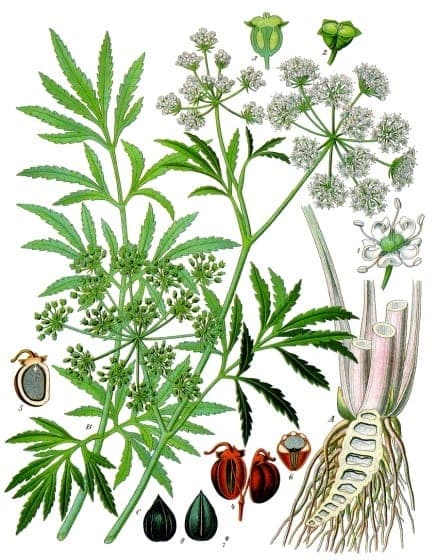
Franz Eugen Köhler, Köhler's Medizinal-Pflanzen / Public domain, via Wikimedia Commons
Cowbane: complete guide
Cicuta virosa
Want to see Cowbane: complete guide in your garden?
1 minute, no credit card
Overview
Cowbane, scientifically known as Cicuta virosa, is a forb herb in the Apiaceae family - the same group that includes carrots, parsley, and hemlock. Don't let that fool you. This plant is one of the most poisonous in North America and Europe. Every part, from root to flower, contains cicutoxin, a potent neurotoxin that can cause seizures, respiratory failure, and death within hours of ingestion.
It's not a plant you grow. It's a plant you learn to spot - especially if you're designing a natural pond edge or restoring a damp meadow. In the wild, it thrives in wet ditches, marshes, and along slow-moving streams from Alaska to the Baltic States.
On gardenworld.app, you can create a custom garden layout that avoids hazardous species like cowbane. The platform flags toxic plants during design, helping you build a safe, beautiful space without hidden dangers.
Appearance & bloom cycle
Cowbane stands 2 to 4 feet tall (60–120 cm), with hollow, ridged stems that are often purple-mottled at the nodes. The leaves are 2–3 pinnately compound, with lance-shaped leaflets that resemble wild carrot or fennel. Crush a leaf, and you'll catch a sharp, unpleasant odor - not the anise scent of edible relatives, but something more acrid.
It blooms from July to August. The flowers are small, white, and arranged in umbrella-like clusters (umbels) 3–6 cm across, typically with 12–20 rays. Each flower has five heart-shaped petals. After blooming, it forms green, oval fruits that turn brown and hard when mature.
The real danger? Mistaking it for water parsnip or wild celery. The difference is subtle - look for the chambered, honeycombed roots of cowbane, which ooze a yellow, bitter fluid when cut. That fluid is pure poison.
Ideal location
Cowbane loves full sun to light shade - think a light score of 7/10. It needs at least 5–6 hours of direct sunlight daily. It grows in saturated soils, often with standing water up to 10 cm deep. You'll find it in USDA zones 4–8, from British Columbia to Bulgaria, wherever the ground stays wet year-round.
In a garden setting, you won't plant it. But if you're building a rain garden or a pond margin, be vigilant. Cowbane seeds can blow in or arrive via birds. If you see it sprouting near water features, remove it carefully - never with bare hands.
Soil requirements
It prefers rich, silty, or clay soils with a pH between 7.0 and 7.5 - neutral to slightly alkaline. The soil must stay consistently moist, ideally with a high water table. It thrives in alluvial zones, where spring floods deposit organic matter. Avoid planting edible root crops nearby - contamination risk is real.
Don't try to mimic its conditions for ornamental use. There are safer wetland plants like joe-pye weed (Eutrochium), cardinal flower (Lobelia), or iris versicolor that give the same drama without the danger.
Free design
Want to see Cowbane: complete guide in your garden? Make a free design now.
Watering
No extra watering needed. Cowbane grows where the water table is high. In dry summers, it may die back, but that's a sign the site isn't suitable - not that you should irrigate. Adding water might encourage it to return next year.
If you're managing a damp border, keep irrigation targeted. Don't flood areas where children or pets play. And never compost suspicious plants - toxins can persist in soil.
Pruning
Do not prune cowbane. There's no horticultural reason to cut it, and every reason to avoid contact. The sap can cause skin irritation, and airborne particles from cutting may trigger respiratory issues. If removal is necessary, wear gloves, long sleeves, and a mask.
Pull entire plants, including roots, and bag them for disposal. Never burn - burning releases toxic fumes. Take it to hazardous waste or follow local guidelines for toxic plant disposal.
Maintenance calendar
- January: Dormant. No action.
- February: Dormant.
- March: Watch for early shoots in wet zones.
- April: Monitor pond edges and ditches.
- May: Inspect moist areas weekly.
- June: Young growth is highly toxic - keep pets away.
- July: Blooming begins. Avoid contact.
- August: Peak bloom. Do not deadhead.
- September: Fruits ripen. Prevent seed spread.
- October: Above-ground parts die back. Remove safely if desired.
- November: Check soil for regrowth.
- December: Dormant.
Winter hardiness
Cowbane is winter-hardy in USDA zones 4–8. In zone 8 (like the UK and Pacific Northwest), it survives mild winters with little snow cover. The roots persist below ground, sending up new shoots in spring. In colder zones, a deep frost may kill the rootstock, but in wet, insulated soils, it often returns.
Companion plants
In the wild, cowbane grows near water hemlock (not the same species), water parsnip, and various sedges (Carex). But these aren't companions you'd want in a garden. For a safe, similar look, plant blue flag iris, marsh marigold, or culver's root.
You can find these at garden centres like those in the UK or through specialist nurseries. Just double-check Latin names - common names can be deadly misleading.
Closing
Cowbane isn't a garden plant. It's a warning. If you're designing a wetland area, knowledge is your best tool. Learn to identify it, respect its power, and keep your space safe.
Use gardenworld.app to simulate your garden design and test for risky species. Upload a photo, and the platform can help identify unknown plants. When it comes to toxic species, ignorance isn't just risky - it's dangerous.
Want to see Cowbane: complete guide in your garden? Make a free design now.
Upload a photo, pick a style, and get a photorealistic design with plant list in under a minute.
No credit card required


Similar plants
Whorled carrot: complete guide
Daucus involucratus
Daucus involucratus is a Mediterranean umbellifer with white flower heads framed by lacy bracts. Growing this gravel garden gem.
Daucus muricatus: complete guide
Daucus muricatus
Daucus muricatus, the spiny wild carrot, grows wild on Mediterranean coasts. Discover sowing, June-July bloom, and wildflower meadow use.
Daucus pumilus: complete guide
Daucus pumilus
Daucus pumilus is a dwarf wild carrot relative with white lacy umbels, thriving on dunes and coastal rock in poor, fast-draining soil.