
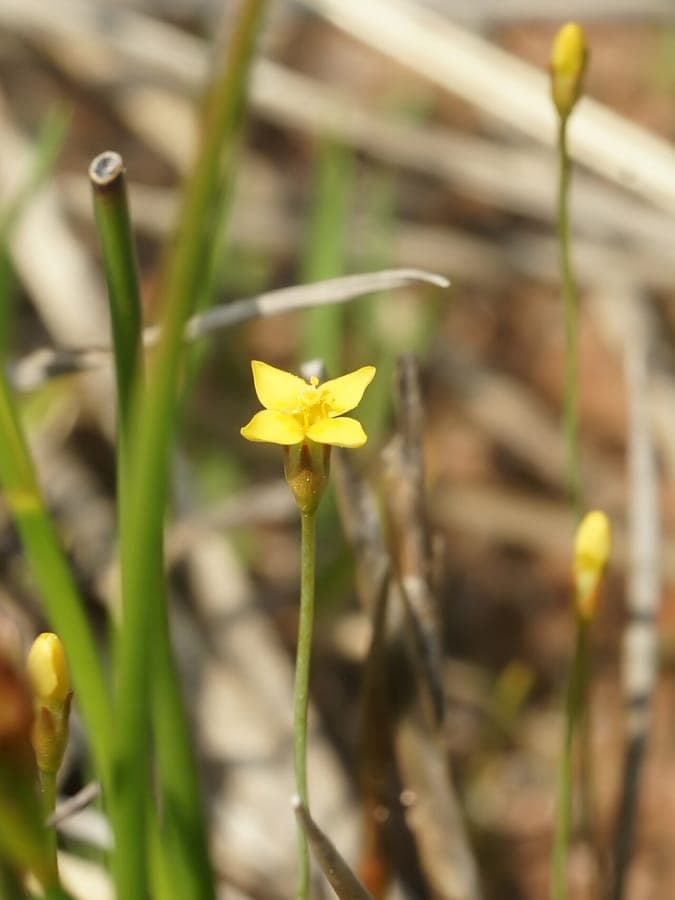
(Hans Hillewaert) / CC BY-SA 3.0, via Wikimedia Commons
Yellow centaury: complete guide
Cicendia filiformis
Want to see Yellow centaury: complete guide in your garden?
1 minute, no credit card
Overview
Yellow centaury, or Cicendia filiformis, is a dainty annual herb that slips under the radar in most gardens – but shouldn't. Standing just 5 to 10 cm tall, it thrives in dry, open habitats where richer plants struggle. Native to heaths and sandy grasslands across western Europe, it's a natural fit for gardens aiming for a wild, low-maintenance aesthetic. While rare in the wild in some regions, it's surprisingly easy to grow if you match its simple needs.
Part of the Gentianaceae family, it shares DNA with bold blue gentians but expresses itself in a delicate, golden-yellow form. It's not a showstopper in the traditional sense, but in a garden that values subtle beauty, it's a gem. On gardenworld.app, you can design a planting scheme where Yellow centaury weaves through fine-textured ground cover, creating seasonal interest without fuss.
Appearance & bloom cycle
This plant spreads via thin, thread-like stems that creep along the soil surface. Leaves are small, linear, and arranged in opposite pairs – bright green and barely noticeable until you get close. The real show comes in summer, when tiny yellow flowers bloom from May through September, peaking in June and July.
Each flower is only 4–6 mm across, with four or five slightly spreading petals that form a miniature star. They open fully in direct sun and close on cloudy days or at dusk. The contrast between open and closed blooms gives the plant a dynamic presence. You'll often find them nestled among moss or pebbles, adding flecks of gold to dry corners of the garden.
Ideal location
Yellow centaury wants full sun to light shade – aim for a light intensity of 8 out of 10. It performs best in hot, dry spots with minimal competition: think rock gardens, sandy banks, or gravel paths. Avoid dense shade, heavy clay, or areas under large shrubs. It's not a plant for lush borders or moist woodlands.
Pair it with other sun-loving, low-nutrient specialists like heather (Calluna), sandwort (Arenaria), or sundew (Drosera). If you're sketching a naturalistic planting plan, gardenworld.app offers templates where Yellow centaury integrates seamlessly into drought-tolerant, open-ground designs.
Soil requirements
The soil must be well-drained, sandy, and acidic. Aim for a pH between 4.5 and 5.0. Chalky or alkaline soils will block nutrient uptake and likely kill the plant. Don't enrich the soil – this species thrives in poor conditions. Compost, manure, or fertilizer? Skip it.
A good mix: 60% horticultural sand, 30% ericaceous compost, 10% peat moss or sphagnum. In containers, use a gritty, low-nutrient potting blend. The goal is fast drainage and zero water retention. You can find suitable mixes at garden centres like B&Q, Wyevale, or local independents.
Free design
Want to see Yellow centaury: complete guide in your garden? Make a free design now.
Watering
Young plants need consistent but light watering until established (about 4 weeks). After that, reduce frequency sharply. Mature Yellow centaury survives on rainfall and dew. Overwatering is a common killer – soggy soil leads to rot.
Use rainwater when possible; tap water can raise pH over time. Water at the base in the morning to avoid wetting foliage. Never let the plant sit in water. In prolonged drought, a light sprinkle may help, but don't make it a habit.
Pruning
Pruning isn't necessary. As an annual, it completes its life cycle in one season. You can deadhead spent flowers to encourage more blooms, but it's not essential. If you want self-seeding, leave the stems intact through autumn and winter.
Avoid mowing or trimming heavily in fall – you'll remove the seed bank. A light trim in late summer is okay if the plant looks straggly, but use sharp scissors and cut carefully to avoid disturbing nearby seedlings.
Maintenance calendar
- March: Prepare soil, start seeds indoors in trays if desired
- April: Sow directly outdoors once soil warms above 8°C
- May: Seedlings emerge; protect from slugs and excessive moisture
- June - August: Peak bloom; ensure full sun and dry conditions
- September: Flowers fade; allow seed pods to form
- October - February: No action; plant dies back, seeds overwinter
Winter hardiness
Yellow centaury is not perennial. The above-ground parts die with the first frosts. However, it reliably self-seeds in suitable conditions. Seeds lie dormant in the soil and germinate in spring when temperatures rise and light levels increase.
It's hardy in USDA zones 6–9. In colder zones (below -15°C), natural regeneration may be spotty. Leave old growth in place – it shelters seeds and stabilises soil. Clear gently in early spring if needed, but avoid deep raking.
Companion plants
Stick with low-growing, non-competitive species: Common heather (Calluna vulgaris), Thrift (Armeria maritima), Bird's-eye pearlwort (Sagina procumbens), and Round-leaved sundew (Drosera rotundifolia). These share similar soil and light needs.
Avoid vigorous ground covers like ivy or vinca – they'll smother Yellow centaury. Also steer clear of heavy mulches or compost layers that retain moisture and block light.
Closing
Yellow centaury won't dominate your garden, and that's the point. It's for gardeners who appreciate quiet beauty, seasonal shifts, and plants that ask for little. No feeding, no pruning, no fuss – just sun, sand, and a bit of patience.
Try it in a rock crevice, a gravel path edge, or a heath-style bed. Once established, it may return year after year through self-seeding. Buy seeds or young plants from garden centres or specialist nurseries. And if you're planning a low-input, high-character garden, use gardenworld.app to map out where Yellow centaury can shine in your design.
Want to see Yellow centaury: complete guide in your garden? Make a free design now.
Upload a photo, pick a style, and get a photorealistic design with plant list in under a minute.
No credit card required


Similar plants
Branched gentianella: complete guide
Gentianella ramosa
Full growing guide for Gentianella ramosa, the branched Alpine gentianella of the SW Alps - location, soil, watering, winter care and companion plants.
Spiked centaury: complete guide
Schenkia spicata
Full growing guide for Schenkia spicata (spiked centaury): sunny position, dry soil, bloom season and garden companions.
Narrow-leaf gentian: complete guide
Gentiana angustifolia
Narrow-leaf gentian growing guide: intense blue trumpet flowers in May-July on well-drained limestone. Full cultivation tips.