
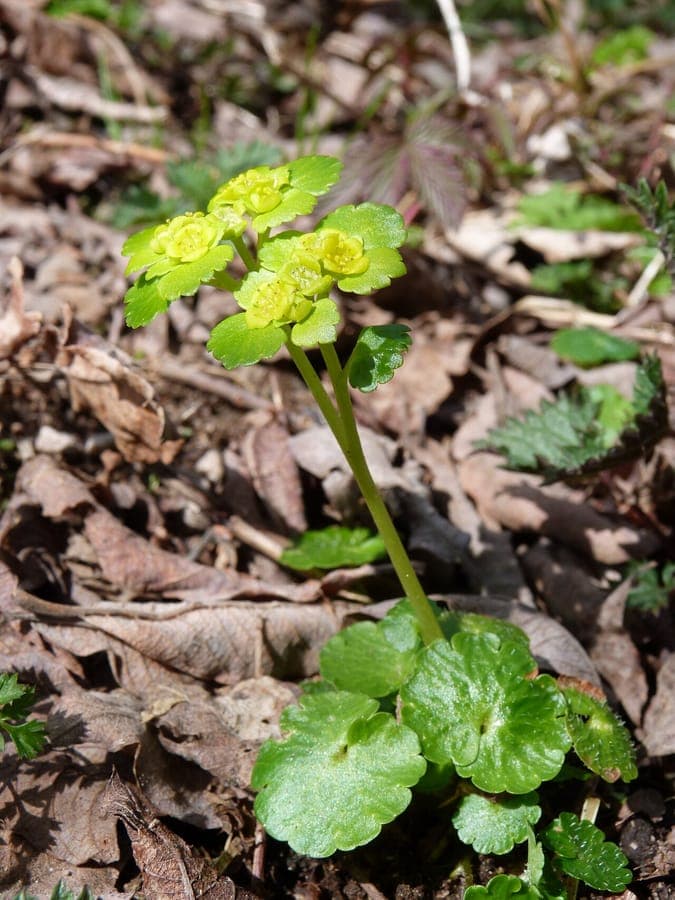
Florian Grossir / CC BY-SA 3.0, via Wikimedia Commons
Alternate-leaf golden saxifrage: complete guide
Chrysosplenium alternifolium
Want to see Alternate-leaf golden saxifrage: complete guide in your garden?
1 minute, no credit card
Overview
Alternate-leaf golden saxifrage (Chrysosplenium alternifolium) is a subtle yet resilient ground cover that thrives in moist, shady corners where few other plants dare to grow. Native to damp woodlands, stream banks, and rocky crevices across Central and Eastern Europe, this low-growing perennial brings quiet charm to wild-style gardens. It forms a creeping mat of glossy, kidney-shaped leaves, followed by clusters of tiny, yellow-green flowers in spring. It doesn't shout for attention, but if you're drawn to understated beauty and naturalistic planting, this one's worth a spot in your garden.
On gardenworld.app, you can design a planting scheme where Alternate-leaf golden saxifrage fills those tricky damp hollows or shaded spots under deciduous trees.
Appearance & bloom cycle
This plant stays low-typically 5 to 10 cm tall-but spreads slowly to about 30 cm across over time. The leaves are rounded to heart-shaped, glossy green, and slightly toothed. As the name suggests, they grow alternately along the stem, not in pairs, giving the plant a more irregular, natural look. The foliage remains semi-evergreen in mild winters, slowly dying back only in prolonged cold or drought.
Flowering occurs from April to June, depending on local climate. The flowers are tiny, cup-shaped, and yellow to yellow-green, clustered in dense, button-like inflorescences. They lack true petals, which makes them easy to miss, but they're a valuable early nectar source for hoverflies, small bees, and other pollinators. After blooming, the plant remains vegetative through summer, although growth slows in dry spells.
Ideal location
Think cool, damp, and sheltered. Full sun is a no-go unless the soil stays constantly saturated. Ideal spots include under canopy trees (like alder or birch), along the edge of a pond, in a bog garden, or tucked beside a north-facing wall that retains moisture. It also performs well in rock crevices where water collects.
Avoid windy areas-its delicate stems can get battered. In urban gardens, create microclimates using taller plants or structures to shield it from drying winds.
Soil requirements
The soil must be consistently moist to wet, humus-rich, and well-aerated. A pH between 5.5 and 7.0 is ideal-slightly acidic to neutral. Avoid heavy clay that compacts and suffocates roots. Instead, mix in leaf mould, composted bark, or peat-free compost to improve moisture retention without waterlogging.
Do not fertilise. This plant evolved in nutrient-poor conditions, and excess nutrients can lead to weak growth or fungal issues. If your soil drains too fast, a thin mulch of leaf litter helps retain moisture-just don't smother the crowns.
Free design
Want to see Alternate-leaf golden saxifrage: complete guide in your garden? Make a free design now.
Watering
Keep the soil evenly moist from March through July. During dry springs, you may need to water every few days, preferably with rainwater. Tap water, especially if hard, can leave mineral deposits that harm the roots over time. In prolonged summer droughts, the plant may die back to the ground, but it usually re-emerges the following spring if the roots stay cool and damp.
Never let the soil dry out completely in the growing season. A drip irrigation system or soaker hose works well for consistent moisture in larger plantings.
Pruning
No pruning is needed. The plant naturally stays compact and doesn't require shaping. If old foliage looks ragged after winter, you can gently rake it out in early spring before new growth starts. Use clean hands or scissors to avoid spreading disease.
If it spreads into areas where it's not wanted-rare, but possible-lift the outer runners with a trowel and replant elsewhere or discard.
Maintenance calendar
- Jan: Check for frost heave. No action needed if mulched.
- Feb: Monitor for early growth in mild spells.
- Mar: Remove old leaves. Begin moisture checks.
- Apr: Flowers appear. Maintain even soil moisture.
- May: Peak bloom. Watch for pollinators.
- Jun: Flowers fade. Reduce watering slightly.
- Jul: Dormant in dry heat. Keep soil damp.
- Aug: Dormant. No feeding.
- Sep: Consider dividing or transplanting if needed.
- Oct: Leave fallen leaves as natural mulch.
- Nov: Protect crowns with leaf litter if harsh winter expected.
- Dec: Wait it out.
Winter hardiness
Hardy to USDA zone 5 (-20°C). The plant dies back in cold winters but the roots survive in moist, well-drained soil. In areas with freeze-thaw cycles, a light mulch of leaves helps prevent root disturbance. Avoid planting in soils that freeze solid-this can damage shallow roots.
In milder zones (7–9), foliage may stay green all winter, adding subtle texture to dormant gardens.
Companion plants
Pair with other moisture-loving shade plants: ferns (Dryopteris, Athyrium), Carex, Tellima, or Omphalodes. It also works well with early spring ephemerals like Erythronium or Hepatica, which bloom before the saxifrage spreads.
Avoid aggressive ground covers like Lamium or mint relatives. Plant at the front or edge of borders where its delicate form can be appreciated up close.
On gardenworld.app, you can preview how Alternate-leaf golden saxifrage integrates with your existing shade plants and plan seasonal texture shifts.
Closing
Alternate-leaf golden saxifrage won't win prizes for showiness, but it's a quiet hero for difficult, wet, shady spots. It asks for little-just consistent moisture and shelter-and repays with reliable spring interest and ecological value.
You can find it at garden centres, especially those specialising in native or woodland plants. Look in spring displays or order online. Be careful not to confuse it with the similar Chrysosplenium oppositifolium, which has opposite leaves. Plant it with intention, and it'll find its place.
Want to see Alternate-leaf golden saxifrage: complete guide in your garden? Make a free design now.
Upload a photo, pick a style, and get a photorealistic design with plant list in under a minute.
10,000+ gardens designed already
No credit card required


Similar plants
Korean astilbe: complete guide
Astilbe grandis
Discover Korean astilbe (Astilbe grandis): a tall shade plant with elegant flower plumes for pond edges and borders.
Heuchera pilosissima: complete guide to seaside alumroot
Heuchera pilosissima
Seaside alumroot (Heuchera pilosissima), an elegant North American dwarf perennial with hairy red-tinged foliage and red flower spikes.
Starry saxifrage: complete guide
Micranthes stellaris
Full guide to Micranthes stellaris, the starry saxifrage: location, soil, blooming and garden use. A tough alpine plant for moist, shady rock faces and pond margins.