
Franz Xaver / CC BY-SA 3.0, via Wikimedia Commons
Nakedweed: complete guide
Chondrilla juncea
Want to see Nakedweed: complete guide in your garden?
1 minute, no credit card
Overview
Chondrilla juncea, commonly called Nakedweed, is a wiry, herbaceous forb that thrives in dry, open landscapes. Native to southern and eastern Europe, parts of North Africa, and western Asia, it's become naturalised in many temperate zones, including parts of the UK and northern Europe. A member of the Asteraceae family, it shares kinship with dandelions and hawkweeds but grows more upright and slender. It's not a garden staple, but it's a reliable performer in tough spots-thin soils, roadside edges, and rocky patches. If you're designing a drought-friendly garden, Nakedweed earns its place. On gardenworld.app, you can map out a xeriscape design where this plant fits naturally among gravel and stone.
Appearance & bloom cycle
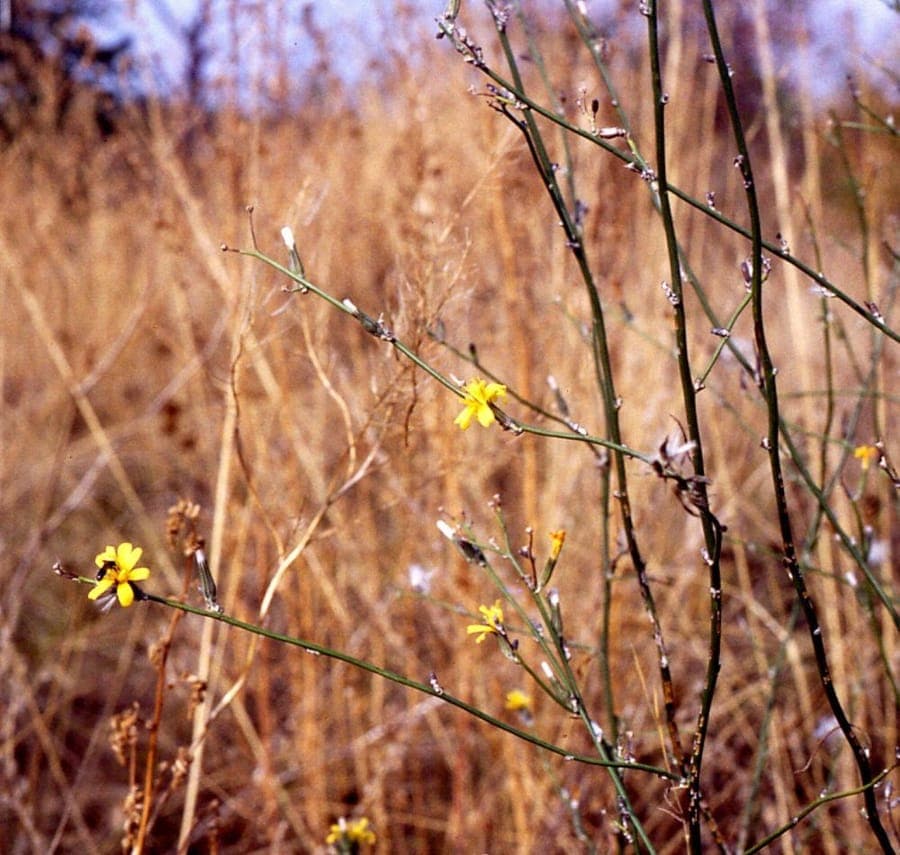
Nakedweed typically reaches 40 to 80 cm in height with multiple erect, branching stems. The foliage is narrow, linear, and slightly hairy, resembling rush or reed leaves-hence the alternative name 'rush skeletonweed'. Leaves are arranged alternately along the stem and become smaller toward the top. From July through September, it produces small, daisy-like yellow flowers, each about 1.5–2 cm wide. Unlike dandelions, the blooms don't close at night but do shut during overcast or rainy weather. Each flower head contains only ligulate (strap-shaped) florets-no disc florets-which is a key identifier. The flowering period is long and consistent in full sun, providing late-season colour when many other plants have faded.
Ideal location
This plant demands full sun-rate it an 8 out of 10 for light exposure. It performs best in open, unshaded areas with southern or southwestern exposure. Think dry slopes, gravel beds, or the edges of patios where heat reflects. It's perfect for xeriscaping or naturalistic planting schemes. Avoid planting under trees or near tall shrubs that cast shade. If your garden has a hot, dry corner that other plants avoid, that's Nakedweed's sweet spot. Garden centres often stock it as a niche plant, but you can also start from seed collected in the wild (where permitted).
Soil requirements
Well-drained soil is non-negotiable. Sandy, gritty, or loamy-sand soils work best. Chalky substrates with a pH between 7.0 and 7.5 are ideal. Avoid heavy clay or water-retentive soils-these cause root rot and poor establishment. Nakedweed prefers low fertility; rich compost or manure can actually hinder growth by encouraging competing weeds. If your soil is too acidic (below pH 6.5), a light application of garden lime in early spring can help. Minimal soil prep is needed-just rake the surface to create a fine tilth before sowing.
Free design
Want to see Nakedweed: complete guide in your garden? Make a free design now.
Watering
Once established, Nakedweed is extremely drought-tolerant. During the first few weeks after germination or transplanting, keep the soil lightly moist to help roots develop. After that, watering is rarely needed-even during prolonged dry spells (3+ weeks without rain). Overwatering is more dangerous than underwatering; excess moisture leads to fungal issues and weak stems. If you must irrigate, use drip lines rather than overhead sprinklers to keep foliage dry.
Pruning
Pruning isn't essential, but you can deadhead spent flowers in late summer to prevent excessive self-seeding. The plant spreads easily via wind-dispersed seeds with a parachute-like pappus, similar to dandelion fluff. If you want to control its spread, cut back flowering stems before seeds mature. Use sharp, clean shears to avoid disease transfer. The cuttings can be composted unless signs of mildew or rot are present.
Maintenance calendar
- Jan: Dormant. No action needed.
- Feb: Check soil compaction; lightly fork if hard.
- Mar: Sow seeds in pots under glass; keep in bright light.
- Apr: Harden off seedlings; transplant outdoors after last frost.
- May: Monitor for slugs; water seedlings during dry spells.
- Jun: Prepare for bloom; reduce watering.
- Jul: Flowers open; ensure full sun exposure.
- Aug: Deadhead if desired; inspect for pests.
- Sep: Allow some seed heads to ripen for collection.
- Oct: Cut back dead stems; gather seeds for next season.
- Nov: Clear debris; compost healthy material.
- Dec: Dormant; leave bare.
Winter hardiness
Nakedweed is hardy to USDA zone 6 (-23°C to -18°C). In zones 7 and above, it reliably self-seeds and returns each year. The parent plant dies back in autumn, but seeds overwinter in the soil and germinate in spring. In colder, wetter climates, seed viability may drop due to rot, so ensure excellent drainage. Mulch is unnecessary and can trap moisture-avoid it.
Companion plants
Pair Chondrilla juncea with other full-sun, drought-tolerant species: Lavender (Lavandula spp.), Russian sage (Perovskia atriplicifolia), yarrow (Achillea millefolium), or feather grass (Stipa tenuissima). It blends well in gravel gardens, rockeries, or wildflower meadows. Avoid aggressive spreaders like bindweed or mint, which can overwhelm it. For a modern, low-water look, combine with architectural succulents like Sedum 'Matrona' or Euphorbia myrsinites.
Closing
Nakedweed isn't flashy, but it's tough, persistent, and quietly beautiful in the right setting. It asks for little and gives back with months of yellow blooms and structural interest. It's a smart pick for tough soils and hot exposures where other plants struggle. You won't find it at every garden centre, but suppliers like Truffaut, Jardiland, and OBI often carry related drought-tolerant species you can pair with it. Start seeds indoors or buy young plants in spring. Use gardenworld.app to visualise a low-maintenance, sun-drenched border where Nakedweed plays a supporting yet essential role.
Want to see Nakedweed: complete guide in your garden? Make a free design now.
Upload a photo, pick a style, and get a photorealistic design with plant list in under a minute.
No credit card required


Similar plants
Calendula stellata: complete guide
Calendula stellata
Complete guide to Calendula stellata, the star-flowered marigold from Sicily: location, soil, watering and companion planting tips.
Korean chrysanthemum: complete guide
Chrysanthemum x rubellum
Chrysanthemum x rubellum is a hardy autumn perennial with single pink to copper flowers from August to November. Care and combinations.
Helianthus divaricatus: complete guide
Helianthus divaricatus
Helianthus divaricatus is a North American woodland sunflower with yellow summer blooms, ideal for naturalistic borders and shady edges.