
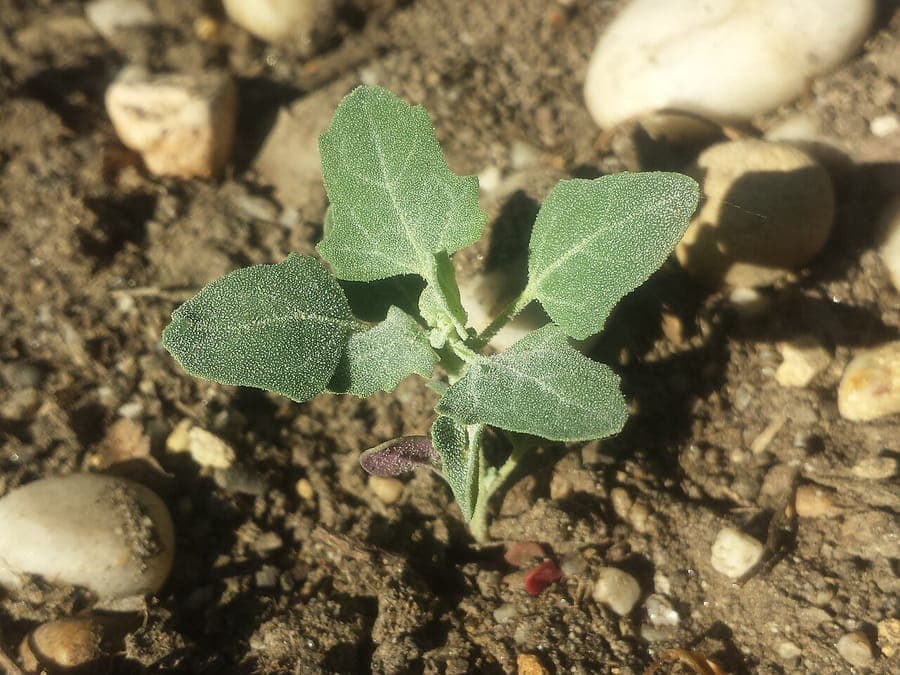
Stefan.lefnaer / CC BY-SA 4.0, via Wikimedia Commons
Grey goosefoot: complete guide
Chenopodium opulifolium
Want to see Grey goosefoot: complete guide in your garden?
1 minute, no credit card
Overview
Grey goosefoot (Chenopodium opulifolium) is an annual herb in the family Amaranthaceae, closely related to the common fat hen (Chenopodium album). The species name 'opulifolium' means 'with leaves like Viburnum opulus' (guelder rose), describing the characteristic three-lobed foliage. Native across an enormous range spanning Europe, the Mediterranean, the Middle East, Central Asia, Nepal, and much of sub-Saharan Africa, grey goosefoot is one of the most geographically widespread members of its genus.
In northern Europe - including Great Britain, Belgium, and Scandinavia, where it is introduced rather than native - grey goosefoot appears on dry, sunny, moderately nutrient-rich soils: harbour grounds, railway embankments, roadsides, waste ground, and disturbed earth with a neutral to slightly alkaline pH. Like most members of the goosefoot family, it is primarily a plant of open, disturbed habitats rather than stable, competitive plant communities.
Grey goosefoot blooms from June through October with small, inconspicuous greenish-white flowers clustered in dense panicles. It is wind-pollinated and self-fertile, setting abundant small black seeds that persist in the soil seed bank for years. Ecologically, the plant provides food for seed-eating birds (finches, buntings) and small insects throughout the season. While not a conventional ornamental, it has an understated botanical character: the mealy, grey-green foliage with distinctive leaf shape is genuinely attractive on close inspection.
For anyone designing a naturalistic wildflower meadow or an ecologically managed garden, grey goosefoot can play a supporting role in the plant community. Browse planting inspiration for naturalistic designs at gardenworld.app.
Appearance & bloom cycle
Grey goosefoot is an erect, lightly branched annual reaching 30-80 cm, occasionally 100 cm on fertile soils. Stems are reddish-green to greenish, lightly ridged, and coated with a fine mealy powder - a whitish-grey waxy bloom of microscopic bladder cells that is characteristic of the goosefoot family. This powdery surface is especially dense on young growth and the undersides of leaves.
The leaves are the plant's most distinctive feature. They are three-lobed, somewhat rhomboid in outline, with a prominent central lobe and two smaller lateral lobes - the resemblance to guelder rose leaves is unmistakable once pointed out. Leaves measure 2-5 cm across, grey-green to blue-grey with the mealy coating, and have a broadly wedge-shaped to slightly heart-shaped base. The texture is soft and slightly waxy to the touch.
Flowers are small, greenish-white, and aggregated in dense branched panicles arising from leaf axils and terminal branches. Bloom begins in June and continues through October. Each flower has five small, keeled sepals that enclose the fruit at maturity. The plant is wind-pollinated and does not require showy flowers to set seed effectively. After pollination, small, round, black seeds ripen within the persistent calyx.
Compared to common fat hen (Chenopodium album), grey goosefoot is distinguished by its more deeply and consistently three-lobed leaves, its more uniformly grey-blue mealy coating, and its somewhat more compact flower clusters. The two species frequently grow side by side on disturbed ground and can be confused by the untrained eye.
Ideal location
Grey goosefoot thrives in full sun to light partial shade. It requires an open, sunny position with good warmth. In nature it grows on dry, warm sites with strong solar exposure: south-facing slopes, harbour and industrial land, railway lines, embankments, and open fallow ground.
In garden settings: allow it to establish on a warm, well-drained corner, or include it intentionally in a ruderal plant mix, an ecological wildflower meadow, or a pioneer planting on dry ground. It is unsuitable for moist soils, heavily shaded positions, or intensively managed ornamental beds. As a spontaneous volunteer in the garden, it might be treated as a weed - but it is worth reconsidering if you value its ecological contributions and distinctive appearance.
Soil requirements
Grey goosefoot prefers dry to moderately moist soil with a neutral to slightly alkaline pH. The optimal pH range is 7.0 to 7.5. It does not tolerate acidic soils (pH below 6.5) and performs best on moderately fertile to nutrient-rich soils with good structure and adequate lime content. It thrives particularly well on sandy loam, calcareous sand, urban fill soils, and loess.
The soil need not be carefully prepared. Bare, lightly disturbed ground suffices for good germination. On excessively fertile soils with nitrogen surplus, the plant grows luxuriantly but can become tall and ungainly. On lean, well-drained soils it remains compact and more attractive.
Avoid wet, poorly drained soils and persistently moist clay. Waterlogging slows germination and causes early root disease. A drainage rate of at least 1-2 cm per hour is desirable.
Free design
Want to see Grey goosefoot: complete guide in your garden? Make a free design now.
Watering
Grey goosefoot is a drought-tolerant plant that performs well without supplemental irrigation. It adapts to dry conditions and survives periods of two to three weeks without rain once established on a suitable dry site.
During the germination phase - the first two to three weeks after sowing - some moisture is helpful for reliable germination. Once seedlings have reached 5-10 cm and developed an adequate root system, additional watering is unnecessary except during extreme summer drought.
For garden use, deliberately withholding irrigation encourages compact growth of 40-60 cm, keeping the plant neat and manageable. On moist, fertile ground the plant shoots to 80-100 cm and appears less tidy. Lean, dry conditions consistently produce the most attractive specimens.
Pruning
As an annual herb, grey goosefoot requires no traditional pruning. The plant completes its entire lifecycle - germination, growth, flowering, seed set, death - within a single growing season. If you want to prevent unlimited self-seeding, remove the flower heads before the seeds fully ripen, typically in August or September. Cut flower stalks when the panicles begin turning from green to brownish.
In an ecologically managed wildflower meadow or naturalistic garden, pruning is counterproductive: the plant fulfils its ecological role most effectively when allowed to complete its lifecycle undisturbed. To control spread, uproot the entire plant including roots in early summer, before seed ripening, to prevent re-establishment.
Dry stems can be shredded for mulch or composted after winter.
Maintenance calendar
March-April: Seeds germinate spontaneously at soil temperatures above 10 °C on suitable sites. Alternatively, sow deliberately on bare, sunny ground.
April-May: Seedlings emerge and grow rapidly. Recognisable by their grey-green, mealy leaves. Thin if overcrowded.
May-June: Rapid vegetative growth phase. No special maintenance required. Observe the distinctive leaf shape and mealy coating.
June-October: Flowering period. Small greenish-white flowers in dense panicles. Wind-pollinated. Good minor nectar source for small insects and hoverflies.
August-September: Seed ripening. Remove flower heads before full seed maturity if you want to limit self-seeding.
October-November: Plant dies after the first hard frost. Stems can remain standing as winter structure for insects.
December-February: Leave dry stems or remove. Lightly cultivate the ground as preparation for the new season.
Winter hardiness
Grey goosefoot is a strictly annual plant (USDA zones 5-10) that does not survive winter as a mature individual. It dies completely at the first hard frost, typically in October or November. The seeds, however, are highly cold-tolerant: they overwinter in the soil at temperatures of -15 °C and below and germinate spontaneously the following spring when soil temperature rises above 10 °C.
In northern Europe (USDA zones 5-8), grey goosefoot behaves as a reliable self-seeder on suitable open, dry ground. On disturbed soil, fallow land, and roadsides it can persist for years through annual germination from the seed bank. On intensively managed garden soil with regular cultivation, it rarely establishes a persistent seed bank.
The species is not considered ecologically invasive in northern Europe: it appears primarily on specific ruderal habitats and causes no problems in diverse native plant communities. In well-managed ornamental gardens with regular soil cultivation, it spreads minimally.
Explore more wildflower and native plant profiles at gardenworld.app, where you'll find planting guides adapted for northern European garden conditions.
Companion plants
As a ruderal pioneer, grey goosefoot fits best in plant communities of open, dry, lean ground. Ecologically meaningful companions include:
- Chenopodium album (fat hen): closely related, shared habitat requirements, together providing a rich seed source for finches, siskins, and linnets.
- Atriplex patula (common orache): fellow goosefoot family member for ruderal sites, complementary structure.
- Sinapis arvensis (wild mustard): co-blooming on ruderal ground, attractive to butterflies and various bees.
- Polygonum aviculare (knotgrass): low ground-covering companion for the same dry, open soils.
- Artemisia vulgaris (mugwort): taller structural backdrop for a ruderal wildflower planting.
- Pastinaca sativa (wild parsnip): similar sun and chalk preferences, strong presence in the same habitat type.
In formal ornamental gardens grey goosefoot has almost no conventional role. It belongs in naturalistic, ecologically oriented plantings where plant diversity and wildlife value are prioritised.
Closing
Grey goosefoot is not a plant for formal show gardens, but a botanically interesting pioneer species with understated charm and genuine ecological value. Its mealy grey-green foliage with distinctive three-lobed leaves, its vast geographical range from Europe to Africa and Asia, and its function as a seed producer for birds and small insects make it a modest but fully valid member of the plant world. For the gardener who values wild plants and has an open, dry corner available, grey goosefoot is worth allowing to germinate and observing through its lifecycle.
Want to see Grey goosefoot: complete guide in your garden? Make a free design now.
Upload a photo, pick a style, and get a photorealistic design with plant list in under a minute.
10,000+ gardens designed already
No credit card required


Similar plants
Bassia laniflora (woolly summer-cypress): complete guide
Bassia laniflora
Full guide to Bassia laniflora: origin, appearance, ideal location, soil, watering and care for this drought-tolerant annual.
Suaeda spicata: complete guide
Suaeda spicata
Everything about Suaeda spicata (spiked seablite): a rare salt-tolerant coastal succulent from the western Mediterranean and Macaronesia.
California amaranth: complete guide
Amaranthus californicus
Full guide to California amaranth (Amaranthus californicus): growing tips, ideal location, soil needs, watering, and garden design ideas.