
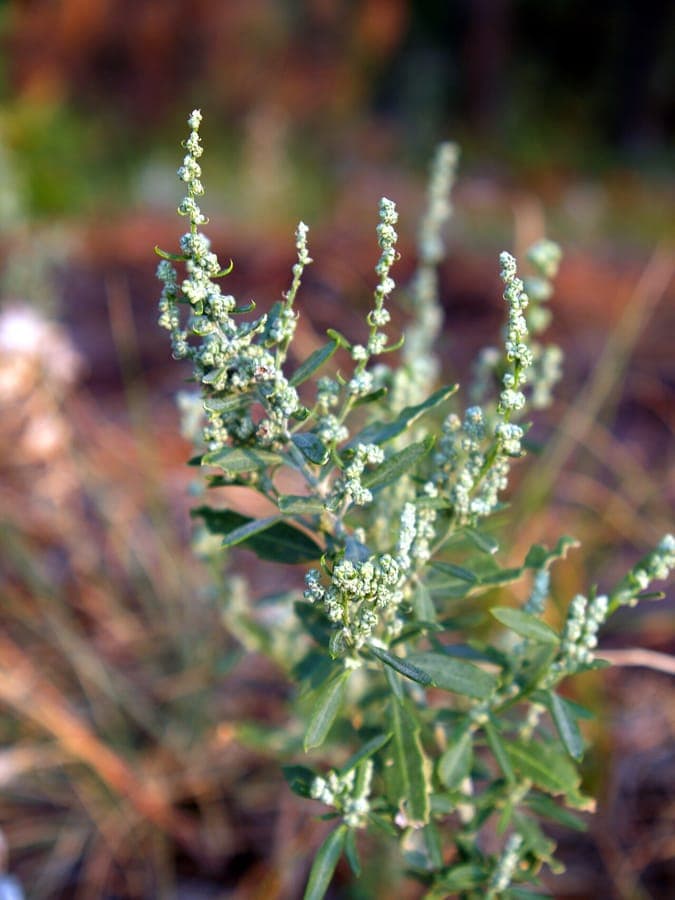
Jim Pisarowicz / Public domain, via Wikimedia Commons
Pigweed: complete guide
Chenopodium berlandieri
Want to see Pigweed: complete guide in your garden?
1 minute, no credit card
Overview
Pigweed (Chenopodium berlandieri) is a hardy, fast-growing annual forb native to a broad stretch of North America, from Alabama to British Columbia. While often dismissed as a weed, this plant has surprising value in the garden - both as a pioneer species and as a contributor to soil health and biodiversity. In recent years, pigweed has gained attention among ecological gardeners for its resilience, low maintenance, and usefulness as a dynamic accumulator. It's related to quinoa and lamb's quarters, and its young leaves are edible when cooked. For gardeners embracing naturalistic planting schemes, pigweed offers texture, structure, and seasonal interest without demanding much in return.
On gardenworld.app, you can design a low-input garden layout that integrates pigweed as a temporary ground cover or support plant in polycultures.
Appearance & bloom cycle
Pigweed typically reaches 30 to 120 cm in height, with erect, branched stems that give it an open, airy form. The stems are green to purplish, often slightly hairy, and support triangular to diamond-shaped leaves 3–8 cm wide. The foliage is coarsely toothed and may have a mealy, whitish underside - a classic trait of many Chenopodium species. From July through October, tiny greenish flowers appear in dense clusters along the upper leaf axils. These aren't showy, but they attract small pollinators and provide late-season seeds for birds like finches and sparrows.
The plant completes its life cycle in a single growing season, setting abundant seed before dying back with the first hard frost. Its seed bank can persist in soil for several years, leading to natural reseeding in disturbed areas.
Ideal location
Pigweed thrives in full sun - at least 6 hours of direct sunlight daily. It tolerates light shade but grows leggy and less robust in lower light. Choose open, unshaded spots in vegetable patches, wildflower meadows, or on the edges of garden beds where soil has been recently turned. Avoid heavily shaded or waterlogged areas, as these reduce vigor and increase fungal risk.
This plant excels in casual, low-maintenance gardens. Pair it with other sun-loving annuals and perennials such as Echinacea, Rudbeckia, or Amaranthus. Use it as a nurse plant for slower-establishing perennials. On gardenworld.app, you can map out a seasonal succession plan that includes pigweed as a summer placeholder before fall-planted crops.
Soil requirements
Pigweed is highly adaptable to soil types, growing well in sandy, loamy, or clay soils. It prefers a pH range of 6.0 to 8.0 and does best in well-drained ground. While it tolerates poor, compacted, or disturbed soils, it performs poorly in constantly wet conditions. Avoid overly rich soils or heavy fertilization - this leads to excessive leafy growth and weak stems prone to flopping.
No soil amendments are needed. In fact, pigweed often grows better in leaner soils, where it doesn't face intense competition from more demanding plants. A light mulch of straw can help retain moisture early on but isn't required.
Free design
Want to see Pigweed: complete guide in your garden? Make a free design now.
Watering
Once established, pigweed is drought-tolerant and rarely needs supplemental watering. Young seedlings, however, benefit from consistent moisture for the first three weeks. Provide about 2.5 cm of water per week if rainfall is insufficient. After that, natural rainfall is usually enough, even during dry spells.
Overwatering encourages shallow roots and increases susceptibility to pests like aphids. Use rainwater when possible, especially during heatwaves, as tap water with high chlorine levels can stress young plants.
Pruning
Pruning isn't essential, but pinching back the tips in early summer (around June) can encourage bushier growth and stronger stems. This helps prevent the plant from becoming top-heavy and collapsing in heavy rain. Remove any damaged or diseased stems with clean secateurs. If you want to limit self-seeding, cut off seed heads before they mature and dispose of them in the trash, not the compost.
Maintenance calendar
- March–April: Sow seeds directly in the garden when soil reaches 10°C, or start indoors 4 weeks earlier.
- May: Transplant seedlings 25 cm apart. Protect from late frosts.
- June: Pinch tips to promote branching. Watch for slugs and aphids.
- July–August: No feeding. Water only during prolonged drought.
- September–October: Collect seeds for next year or allow natural dispersal.
- November: Remove dead plants. Lightly rake soil to prepare for spring.
Winter hardiness
As an annual, pigweed dies after the first hard frost, typically in late October or November. It's not winter-hardy, but it can reappear the following year from dropped seeds. These seeds remain viable in the soil for several years, germinating when soil is disturbed and temperatures rise above 15°C in spring. In milder climates (USDA zones 7–8), volunteer seedlings may emerge as early as March.
Avoid deep mulching over winter if you want natural reseeding - it can block light and prevent germination.
Companion plants
Pigweed grows well alongside other sun-loving species like zinnias, cosmos, and black-eyed Susans. It also pairs with vegetables such as carrots and onions, where its loose form doesn't shade out neighbors. Avoid planting near low-growing groundcovers or aggressive spreaders that may outcompete it. In wildlife gardens, it complements native grasses and late-blooming forbs.
Closing
Pigweed may not be a showstopper, but it's a practical, resilient plant that supports garden ecology. It's perfect for gardeners who value function over form and want to reduce inputs without sacrificing biodiversity. Sow it in bare patches, let it grow, and enjoy its subtle presence. Seeds are available at most garden centres, including specialty organic suppliers. And remember - on gardenworld.app, you can create a custom garden plan that uses pigweed as part of a dynamic, evolving planting strategy.
Want to see Pigweed: complete guide in your garden? Make a free design now.
Upload a photo, pick a style, and get a photorealistic design with plant list in under a minute.
No credit card required


Similar plants
Bassia laniflora (woolly summer-cypress): complete guide
Bassia laniflora
Full guide to Bassia laniflora: origin, appearance, ideal location, soil, watering and care for this drought-tolerant annual.
Suaeda spicata: complete guide
Suaeda spicata
Everything about Suaeda spicata (spiked seablite): a rare salt-tolerant coastal succulent from the western Mediterranean and Macaronesia.
California amaranth: complete guide
Amaranthus californicus
Full guide to California amaranth (Amaranthus californicus): growing tips, ideal location, soil needs, watering, and garden design ideas.